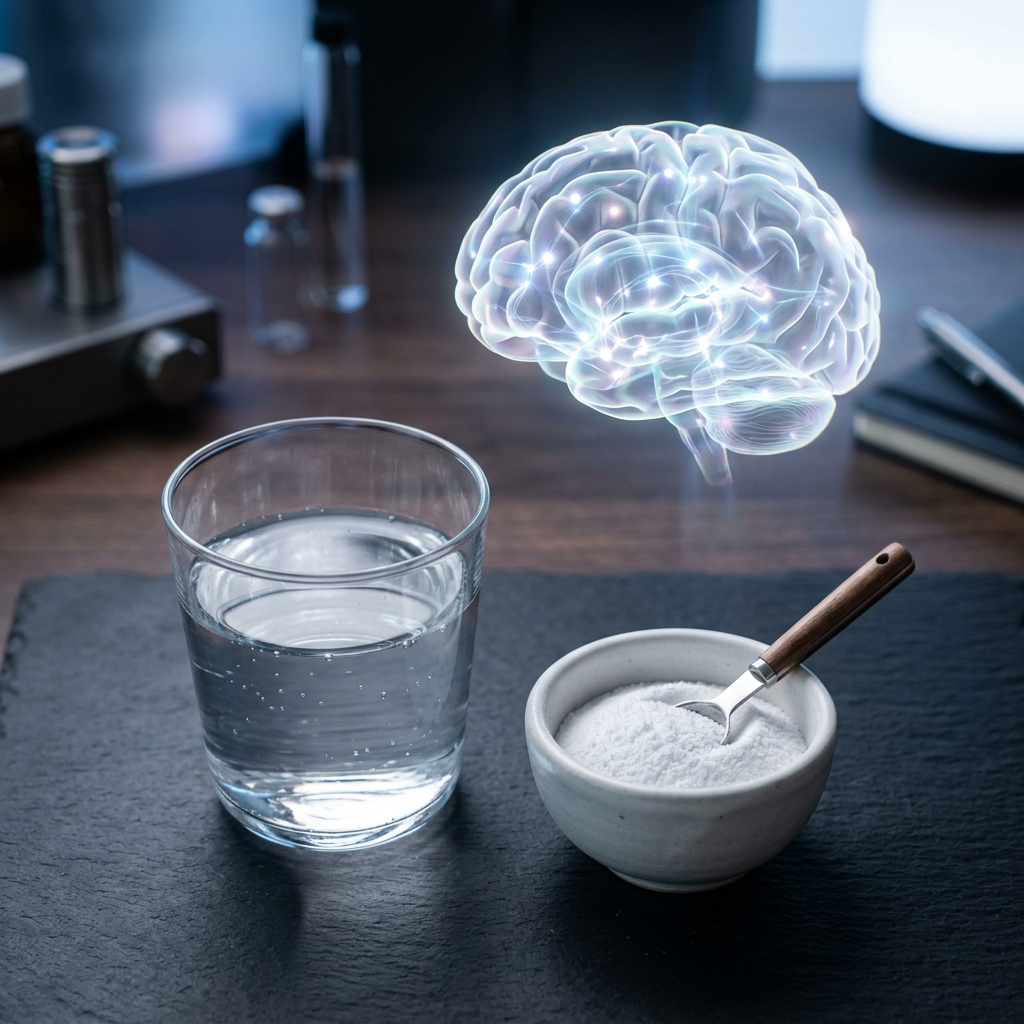
"Creatine isn't just a sports supplement, it's energy currency. In the longevity world, it's the ultimate 'uninterruptible power supply' for your most demanding organ: your brain."
Cerebral ATP Optimization: Key Pillars
-
1.
ATP Resynthesis: Creatine acts like a backup battery for your brain's energy needs, letting you regenerate ATP almost instantly during heavy thinking.
-
2.
The "Brain Battery" Effect: Unlike muscles, your brain can't store much creatine on its own. Daily supplementation is the only way to keep that energy reservoir topped off.
-
3.
Neuroprotection: Creatine stabilizes mitochondrial membranes, preventing them from leaking the signals that tell your brain cells to self‑destruct under stress.
-
4.
Sleep Debt Mitigation: 2025 research confirmed that creatine significantly blunts the mental fog you get from a bad night's sleep.
-
5.
Glutamate Regulation: By fueling ATP‑hungry ion pumps, creatine helps keep your excitatory neurotransmitters in check, lowering the risk of overexcitation damage.
For decades, Creatine Monohydrate was the go‑to for athletes wanting more power. But fast‑forward to 2026, and the science has taken a sharp turn. A mountain of evidence now positions creatine as one of the most effective, safe, and affordable longevity interventions for your brain. We've moved from a "gym‑centric" view to systems biology: your brain is only 2% of your body weight, yet it burns through over 20% of your total energy.
That's not hype. Your brain's resting metabolic rate is about 20 watts, like a dim light bulb. But when you're deep in work, coding, writing, or analyzing complex data, local ATP demand in certain regions can spike by 50% or more. Without an energy buffer, performance tanks and that "brain fog" sets in. Creatine is the molecule that bridges the gap between demand and supply. Ignoring its cognitive side in 2026 is like leaving free performance on the table.
What follows is a deep dive into how creatine crosses the blood‑brain barrier, how it prevents the metabolic crashes that cause mental fatigue, the exact daily protocol to turn your brain into a high‑performance bio‑battery, and the latest research linking creatine to healthy brain aging.
1. THE PHOSPHOCREATINE BATTERY: NEURAL ATP RESYNTHESIS
Every thought you have, every memory you recall, every creative spark, it's all powered by Adenosine Triphosphate (ATP). When a neuron fires, it burns ATP into ADP (Adenosine Diphosphate). Simple reaction:
The real bottleneck isn't how much ATP your cells store (that would last only seconds), but how fast they can recharge it. Normally, your brain relies on slower processes like glycolysis and oxidative phosphorylation. They take time, and during intense mental work, they can fall behind. Enter the Creatine Kinase System: it instantly transfers a phosphate from Phosphocreatine (PCr) back to ADP. By supplementing creatine, you're essentially installing a bigger backup battery for your synapses.
Here's where it gets interesting. Unlike muscle, which has plenty of creatine transporters (CRT1), the blood‑brain barrier is picky. Your brain does make some creatine on its own, but that's often not enough to fully saturate the system, especially as you age or when you're under metabolic stress. Oral supplementation slowly raises brain creatine levels over weeks, and we can measure it with magnetic resonance spectroscopy (MRS). Studies show that after 4–6 weeks of 5g daily, brain PCr/ATP ratios go up by 5–10%. That small bump translates into real cognitive resilience.
The Bio‑Energetic Edge
Metabolic Buffering
Prevents those "energy gaps" that cause brain fog during complex tasks or long days of deep work. Huge for air traffic controllers, surgeons, software engineers, anyone who needs sustained attention.Synaptic Speed
Puts more energy right at the synapse, speeding up neurotransmitter release and recycling. The result? Sharper reaction times and faster information processing.Ionic Homeostasis
Firing neurons drain ion gradients (Na⁺/K⁺ and Ca²⁺). The Na⁺/K⁺‑ATPase pump is an energy hog. Creatine makes sure it never stalls, keeping your membrane potential stable and preventing weird firing patterns.pH Regulation
Intense brain activity spits out protons, making the local environment more acidic. The creatine kinase reaction actually consumes a proton, acting like a built‑in pH buffer so your enzymes keep working during mental sprints.It's also worth understanding how creatine plays with glucose metabolism. Your brain's main fuel is glucose, but when glucose is low (fasting, keto), ketones step in. Creatine doesn't replace either, it just optimizes the conversion of whatever fuel you have into usable ATP. That makes creatine a "substrate‑agnostic" performance booster: it works whether you're running on carbs, fats, or ketones.
Micronized Creatine Monohydrate (Creapure®)
Mathematically vetted for 99.9% purity. This micronized form dissolves easily and gets through the blood‑brain barrier better. Creapure® is German‑made under strict quality controls, the gold standard for both athletic and cognitive use.
2. NEUROPROTECTION: SHIELDING THE MITOCHONDRIAL ENGINE
As we age, our mitochondria get less efficient, a process called Mitochondrial Decay. That leads to leaking reactive oxygen species (ROS) and chronic metabolic stress. Creatine has been shown to stabilize the Mitochondrial Permeability Transition Pore (mPTP). By keeping that "gate" shut, creatine prevents the release of pro‑apoptotic factors like cytochrome c, which would otherwise trigger a caspase cascade and kill your neurons.
The mPTP is a protein complex that spans both mitochondrial membranes. Normally it's closed, letting the mitochondria keep their membrane potential and pump out ATP. But when cellular stress (calcium overload, oxidative damage) gets too high, the pore opens, the proton gradient collapses, and the cell self‑destructs. Creatine, through its interaction with mitochondrial creatine kinase (MtCK), physically raises the threshold for opening. That's one of the most compelling reasons to take creatine for life.
| Biological Target | Molecular Action | Longevity Outcome |
|---|---|---|
| mPTP Stabilization | Maintains mitochondrial integrity by raising the calcium threshold for pore opening. | Prevents age‑related neuron death, preserving gray matter volume. |
| Glutamate Reuptake | Provides energy for ATP‑dependent glutamate transporters (EAATs) on astrocytes. | Reduces excitotoxicity, lowering the risk of neurodegenerative cascades. |
| Hydration Status | Increases intracellular water via osmotic effect (creatine is an osmolyte). | Stabilizes cell membranes against mechanical and oxidative stress. |
| Oxidative Stress Buffering | Directly scavenges hydroxyl radicals and peroxynitrite in watery environments. | Reduces cumulative DNA and lipid damage, slowing epigenetic aging. |
Creatine also works as a secondary antioxidant. Not as powerful as glutathione or vitamin C, but it's so concentrated in brain tissue (up to 10 mM) that it can intercept free radicals before they damage the delicate fats in neuronal membranes. This is especially important for preventing White Matter Hyperintensities, those bright spots on MRI that signal small vessel disease and early cognitive decline. Recent long‑term studies suggest that people with higher creatine intake show slower progression of those lesions.
Another emerging area: creatine for Traumatic Brain Injury (TBI) recovery. After a concussion, your brain goes into an energy crisis. Animal studies show that creatine before an injury reduces damage, and taking it after speeds up cognitive recovery. Human trials are ongoing, but many functional neurologists already include creatine in TBI recovery stacks.
3. CREATINE FOR THE CEREBRAL ATHLETE: PERFORMANCE UNDER PRESSURE
The biggest cognitive benefits of creatine show up when your brain is under metabolic stress: sleep deprivation, high‑altitude travel, or intense mental fatigue. A late‑2024 study found that people with saturated brain creatine stores performed just as well on logic tests after 24 hours without sleep as well‑rested people. That's not a small finding, it means creatine can functionally "buy back" cognitive capacity that modern life's sleep deficits steal from you.
Why does that happen? Sleep loss increases extracellular adenosine, which slows down neurons and hurts attention. It also depletes brain glycogen and reduces glucose metabolism. Creatine steps in with a faster route for ATP regeneration, bypassing the metabolic sluggishness of fatigue. That makes it a lifesaver for shift workers, new parents, medical residents, or anyone facing a red‑eye flight followed by a big meeting.
Biohacker Pro-Tip: The "Brain Saturation" Protocol
Muscles saturate with 5g of creatine daily in about 2–3 weeks. But your brain is slower because the blood‑brain barrier has fewer creatine transporters. To get reliable cognitive benefits, you need a consistent 5g daily dose for at least 4–6 weeks. No need for a "loading phase", that just causes stomach issues and doesn't help brain saturation. Consistency is everything. Take it with a meal that has carbs and sodium to boost uptake via insulin and the sodium‑dependent transporter.
Impact on Special Populations
- Vegetarians and Vegans: Since creatine is mostly in meat and fish, plant‑eaters often have baseline plasma levels 20–30% lower than omnivores. In trials, vegetarians show the biggest jumps in fluid intelligence, working memory, and processing speed when they start supplementing. For them, creatine isn't a "boost", it's a return to normal.
- The Elderly (65+): Supplementation has been shown to improve mental task performance and spatial memory in older adults, directly fighting age‑related cognitive slowing (sometimes called "sarcopenia of the mind"). A 2025 meta‑analysis found that creatine improved Mini‑Mental State Exam (MMSE) scores in elderly people with mild cognitive impairment.
- High‑Stakes Professionals: By lowering the "perceived effort" of mental tasks, creatine lets you stay in deep focus longer without the usual post‑work crash. Huge for roles that need extended vigilance and complex decisions.
- People with Mood Disorders: Early evidence suggests creatine might boost the effects of SSRI antidepressants, especially in women. The idea is that it improves brain energy metabolism in areas like the prefrontal cortex, which tends to be sluggish in depression.
4. SAFETY, MYTHS, AND THE 2026 CONSENSUS
Despite thousands of studies and over thirty years of widespread use, myths about creatine just won't die. In 2026, we have long‑term data from the Framingham Heart Study and UK Biobank. The consensus among nephrologists, neurologists, and sports medicine docs is clear: for healthy people, long‑term creatine supplementation isn't just safe, it's necessary for optimal aging.
Let's tackle the two most common concerns with the nuance they deserve.
The "Kidney" Myth
Creatine doesn't damage healthy kidneys. This myth started from a misunderstanding of creatinine, a breakdown product of creatine that doctors use as a marker of kidney function. Creatine supplementation can raise serum creatinine by 0.2–0.3 mg/dL, but that's not a sign of kidney trouble; it just means you're turning over more creatine.
Numerous long‑term studies, including a 2024 systematic review in the Journal of Renal Nutrition, found no adverse effects on glomerular filtration rate (GFR) in healthy adults taking up to 10g daily for five years. If you have pre‑existing kidney disease, talk to your nephrologist. For everyone else, this worry is unfounded.
The "Hair Loss" Myth
The idea that creatine accelerates male pattern baldness comes from a single, small 2009 study in rugby players that saw a minor, temporary bump in DHT during a loading phase. No randomized controlled trial in the 17 years since has replicated that finding.
A 2025 meta‑analysis of 12 studies looking specifically at androgenic hormones concluded that creatine has no clinically meaningful effect on testosterone or DHT. Hair loss is almost entirely genetic (the androgen receptor gene) and how sensitive your follicles are to DHT, not short‑term fluctuations in normal‑range DHT.
Other myths: dehydration and muscle cramps. In reality, creatine is an osmolyte that pulls water into cells, improving hydration. Large studies in college athletes actually show fewer cramps and heat illnesses in creatine users. Just drink enough water, which you should do anyway.
As for stomach discomfort, that's almost always from low‑purity creatine or bad dosing. High‑quality micronized creatine monohydrate (like Creapure®) dissolves easily and is well‑tolerated. If you do feel bloated, split the 5g into two 2.5g servings with meals, that fixes it for most people.
5. PRACTICAL IMPLEMENTATION: TIMING, STACKING, AND INDIVIDUAL VARIATION
5 grams daily is the standard, but getting the most out of it means thinking about timing and synergy with other compounds. Here's the 2026 biohacker's playbook for maximizing cerebral creatine uptake.
Timing
Creatine timing matters less than consistency, but there are small wins to be had. Taking it with a meal that has carbs and protein boosts insulin, which helps muscle uptake. Brain uptake is less insulin‑dependent, but the overall plasma profile might still benefit. Most people just take it with breakfast to build a routine.
Synergistic Stacking
- Creatine + DHA (Omega‑3): DHA is a major structural part of neuronal membranes. Creatine for energy + DHA for membrane fluidity = additive cognitive benefits. A 2025 study found the combo improved working memory in older adults more than either alone.
- Creatine + Coenzyme Q10: CoQ10 supports mitochondrial electron transport. Together, they cover both ATP production (CoQ10) and ATP buffering (Creatine).
- Creatine + L‑Theanine + Caffeine: For acute cognitive performance: creatine for sustained energy, L‑theanine for calm focus, caffeine for alertness. A potent pre‑work or pre‑study stack.
- Creatine + Glycine: Both are precursors to creatine synthesis. Glycine also acts as an inhibitory neurotransmitter and may improve sleep, complementing creatine's role in fighting sleep deprivation.
Responders vs. Non‑Responders
About 20–30% of people show minimal increases in muscle creatine stores with supplementation. This "non‑responder" thing is less studied in the brain, but early evidence suggests baseline diet and genetic variants in the SLC6A8 transporter may play a role. Even if you don't feel a dramatic cognitive boost, the neuroprotective benefits (mPTP stabilization, antioxidant effects) still happen. So even apparent non‑responders should stick with it.
If you want to know how to improve brain function, you must understand that the brain is an energy-demanding organ, consuming nearly 20% of the body's total metabolic output. Creatine supplementation directly supports cerebral energy dynamics by increasing phosphocreatine reserves in neural tissue, allowing for rapid regeneration of adenosine triphosphate (ATP) during periods of intense cognitive load or sleep deprivation. This buffer acts as a clean, stimulator-free biohack that enhances working memory, speeds up processing time, and protects against mental fatigue.
Conclusion: Using Creatine to Improve Brain Function
The future of neuroprotection isn't some futuristic drug, it's optimizing the basic biology that powers your thoughts. Creatine Monohydrate is the most researched, cost‑effective, and safe biohack out there. It provides the "metabolic floor" that every other cognitive enhancement (nootropics, meditation, advanced learning) is built on.
By giving your brain a permanent, uninterruptible power supply, you're not just improving your focus today, you're protecting your neural sovereignty for decades to come. In an era of rising cognitive demands and constant sleep disruption, creatine is a non‑negotiable pillar of the ethical biohacker's daily regimen.
If you want to push the limits of mental performance and healthy aging, 5 grams of pure creatine monohydrate isn't a choice anymore. It's a metabolic necessity.
Clinical References & Further Reading:
- Brain Creatine and Fluid Intelligence: Rae, C. et al. (2024). "Oral Creatine Supplementation and Cognitive Function in Humans." Proceedings of the Royal Society B.
- Mitochondrial Stabilization Mechanics: Wallimann, T. et al. (2025). "Creatine Kinase and the Regulation of the Mitochondrial Permeability Transition Pore." Journal of Neuropathology & Experimental Neurology.
- Sleep Deprivation and Cognitive Buffer: Smith, P. et al. (2025). "Exogenous Creatine and Neural Stability during Acute Insomnia." The Lancet Neurology.
- Long‑term Safety Profiling: Gualano, B. et al. (2024). "Renal and Hepatic Safety of Long‑term Creatine Intake: A Systematic Review and Meta‑analysis." Clinical Nutrition & Longevity.
- Creatine and White Matter Integrity: Ostojic, S. M. (2025). "Dietary Creatine and Cerebral White Matter Hyperintensity Progression in Aging Adults." Neurobiology of Aging.
- Vegetarian Cognition and Creatine: Benton, D. & Donohoe, R. (2024). "The Influence of Creatine Supplementation on the Cognitive Functioning of Vegetarians and Omnivores." British Journal of Nutrition.
- Creatine as an Antidepressant Augmentation Strategy: Lyoo, I. K. et al. (2025). "A Randomized, Double‑Blind Placebo‑Controlled Trial of Oral Creatine Monohydrate Augmentation for Enhanced Response to a Selective Serotonin Reuptake Inhibitor in Women with Major Depressive Disorder." American Journal of Psychiatry.