"We spend over 90% of our lives indoors. Longevity real estate is a structural healthspan movement that transforms your home from a source of environmental toxin exposure into an active filter for cellular preservation, circadian alignment, and mitochondrial protection."
Key Takeaways: Home Biohacking
-
1.
Indoor Toxin Burden: Indoor air often contains up to 5x higher concentrations of Volatile Organic Compounds (VOCs) and particulates than outdoor air due to furniture off-gassing and sealed spaces.
-
2.
Active Air & Water Filtering: Integrating localized Energy Recovery Ventilators (ERVs) to keep CO2 under 600 ppm and whole-house sub-micron water filtration removes systemic inflammatory triggers.
-
3.
Circadian & EMF Cleansing: Dynamic circadian lighting aligned with the solar cycle and bedroom demand switches that isolate electrical circuits lower sympathetic nervous system tone.
Introduction: The Indoor Habitat and Cellular Aging
Human beings evolved as outdoor organisms, constantly interacting with natural solar cycles, clean moving air, and wild water networks. Today, however, modern humans spend over 90% of their lives indoors. Our homes and offices have become our primary biological filters. While modern construction techniques have made buildings highly energy-efficient, they have also sealed us inside a physical bubble, trapping toxins and creating artificial environments that conflict with our evolutionary biology.
This desynchronization has a severe impact on healthspan. Chronic exposure to indoor air pollution, heavy metals in tap water, artificial light at night, and electromagnetic noise keeps the sympathetic nervous system in a state of low-grade arousal. The result is a persistent cellular stress response, driving systemic inflammation and accelerating aging at the DNA level. The longevity real estate movement seeks to reverse this trend by redesigning the home envelope to act as an active promoter of cellular preservation, circadian stability, and cellular detoxification.
The Environmental Toxin Load: VOCs, Formaldehyde, and Microplastics
Indoor air is a complex chemical soup. Building materials, carpets, paints, and engineered wood furniture continuously emit Volatile Organic Compounds (VOCs), such as formaldehyde, benzene, and toluene, through a process known as off-gassing. This off-gassing can continue for up to 5 years after construction. Inhaling these compounds daily places a heavy metabolic burden on our phase I and phase II liver detoxification pathways, depletion glutathione reserves and raising levels of oxidative stress across the body.
In addition to VOCs, modern homes are packed with synthetic microfibers, microplastics, and chemical flame retardants (polybrominated diphenyl ethers, or PBDEs). These microscopic particles accumulate in household dust and are inhaled or absorbed through the skin, acting as potent endocrine disruptors that interfere with thyroid hormone synthesis and metabolic regulation. To lower this toxic burden, longevity real estate enforces strict Zero-VOC construction standards, utilizing natural plaster, solid wood, organic textiles, and active charcoal air filters to capture chemical vapors before they can interact with our cells.
The Mechanical Engineering of Active Air Filtration: ERVs and HEPA H13
To maintain indoor air quality at a clinical standard, passive ventilation is insufficient. In a sealed bedroom overnight, carbon dioxide (CO2) levels rise rapidly due to respiration, often exceeding 1,500 to 2,000 ppm by morning. Breathing high levels of CO2 causes mild respiratory acidosis, elevating heart rate, restricting oxygen delivery to tissues, and triggering frequent micro-arousals that fragment slow-wave sleep. To prevent this, a longevity home requires active mechanical ventilation.
An Energy Recovery Ventilator (ERV) is a balanced mechanical ventilation system that continuously brings in fresh, filtered outdoor air while exhausting stale indoor air. The incoming and outgoing air streams pass through a thermal core, transferring heat and moisture to maintain energy efficiency. By combining an ERV with medical-grade HEPA H13 or H14 filters—which capture 99.97% of particles down to 0.3 microns, including mold spores, pollen, and PM2.5 particulates—you maintain bedroom CO2 levels below 600 ppm and particulate counts near zero, protecting your respiratory tract and maximizing overnight cellular recovery.
Biohacker Pro-Tip: Zero-VOC Furniture and the GREENGUARD Gold Standard
If you are renovating or purchasing furniture, strictly select items certified as "GREENGUARD Gold" or "Zero-VOC." Paints, varnishes, and engineered wood emit formaldehyde and polyurethane particles for up to 5 years after installation. Using active carbon filters can mitigate some exposure, but eliminating the source is the single most effective way to lower your home's environmental toxic load and prevent long-term cellular stress.
Whole-House Water Purification: Carbon Blocks and Reverse Osmosis
Water is the primary solvent of the human body, making up 60% of our physical mass. However, standard municipal tap water contains a wide range of contaminants, including heavy metals (lead, copper), industrial chemicals, chlorine, fluoride, microplastics, and trace pharmaceutical residues. While these levels may satisfy basic government safety standards, chronic low-dose exposure over decades contributes to renal stress, liver load, and endocrine disruption.
Longevity real estate integrates a multi-stage water filtration system directly at the main point of entry (POE) of the home. This whole-house system typically combines a sediment filter (to capture physical rust and sand), a catalytic carbon block filter (to remove chlorine, chloramines, and VOCs), and a sub-micron filter (to capture microplastics). For drinking and cooking water, a point-of-use (POU) Reverse Osmosis (RO) system combined with a remineralization stage removes 99% of dissolved solids, ensuring you hydrate with pure, mineral-rich water that supports cellular hydration without toxic burden.
Circadian Smart Lighting: Equivalent Melanopic Lux (EML)
Light is the primary synchronizer of our master circadian clock, the suprachiasmatic nucleus (SCN). The SCN calculates biological time based on **Equivalent Melanopic Lux (EML)**, a metric that measures light intensity weighted by its biological impact on the melanopsin system in our eyes, rather than standard visual brightness. A standard warm LED bulb, while visually dim, can still present high EML values, suppressing melatonin synthesis.
To automate your circadian lighting, incorporate smart bulbs (like Philips Hue or LIFX) programmed on a dynamic daily schedule. In the morning, the bulbs should emit cool, blue-enriched light (> 5,000K, high EML) to stimulate cortisol. After sunset, the system should transition to low-intensity, warm amber light, and finally to pure, monochromatic red-spectrum light (wavelengths > 620 nm, zero EML) 2 hours before bed, allowing your endogenous melatonin to rise naturally.
Longevity Home Design Specifications
| Feature | Biological Stressor Prevented | Technology / Method |
|---|---|---|
| Circadian Smart Lighting | Melatonin suppression, circadian rhythm disruption | Tunable LED systems shifting from high-blue (morning) to red-spectrum (evening) |
| Sub-Micron Air Filtration | Inflammatory response to mold, PM2.5, and dust | Whole-house MERV 16 HEPA filters integrated with ERV fresh air exchange |
| Carbon Water Purification | Heavy metal burden, fluoride, endocrine disruptors | Whole-house carbon block + point-of-use reverse osmosis with remineralization |
| Electromagnetic Field Mitigation | Voltage-Gated Calcium Channel leaking, cellular oxidative stress | Demand switch kill-circuits for bedrooms, shielded cabling, sleeping zone Faraday cages |
The Biophysics of Electromagnetic Fields & Cellular Stress
Electromagnetic Fields (EMFs)—which encompass radiofrequency (RF) radiation from wireless signals and extremely low frequency (ELF) fields from household electrical wiring—interfere with human cells during the night. Research suggests that chronic exposure to electromagnetic radiation acts as a cellular stressor, disrupting the function of Voltage-Gated Calcium Channels (VGCCs) in cell membranes. When these channels are exposed to EMFs, they leak calcium ions into the cytoplasm, triggering a cascade of nitric oxide and generating peroxynitrite, a highly reactive free radical.
This intracellular oxidative stress prevents the cell from entering a true state of recovery during the night. Furthermore, several trials have indicated that chronic magnetic field exposure can suppress the pineal gland's ability to synthesize melatonin, shifting the endocrine cycle. To create a zero-EMF recovery zone, you must address both wireless signals and the active electrical fields running through your bedroom walls.
To mitigate EMFs, unplug all electrical devices within 2 meters of your bed. Turn off your Wi-Fi router overnight using a mechanical timer. For an advanced solution, install a remote demand switch in your electrical panel, allowing you to turn off the power to your bedroom circuits with the push of a button before bed, creating a zero-voltage zone. Shielded cabling (MC cable) can also be run through the walls to block electric fields, ensuring a peaceful sleep environment.
Volatile Organic Compounds (VOCs) and Hepatic Phase II Glucuronidation
Breathing indoor Volatile Organic Compounds (VOCs) like formaldehyde and benzene does not just damage lung tissue; it places a heavy metabolic strain on Phase II hepatic detoxification. Once VOCs enter the bloodstream via the alveoli, they are transported to the liver, where Phase I cytochrome P450 enzymes oxidize them into highly reactive intermediates. These intermediates are often more toxic than the parent molecules, generating free radicals that deplete the liver's glutathione pool.
To neutralize these intermediates, the liver must conjugate them via Phase II pathways, primarily UDP-glucuronosyltransferases (UGTs) and glutathione S-transferases (GSTs). If your home environment continuously exposes you to VOCs, your Phase II pathways become exhausted, leading to systemic accumulation of toxic intermediates. This exhaustion impairs the liver's ability to clear other endogenous wastes (like excess estrogen or metabolic byproducts), driving chronic low-grade inflammation. By building with zero-VOC materials, you immediately reduce this toxic liver load, preserving glutathione reserves for systemic cellular defense.
Voltage-Gated Calcium Channels (VGCCs) and Electromagnetic Biophysics
The biophysical mechanism by which electromagnetic fields (EMFs) trigger cellular stress centers on the Voltage-Gated Calcium Channels (VGCCs) located in cell membranes. VGCCs are highly sensitive to electrical changes; their voltage sensor consists of four alpha-helical structures containing positively charged amino acids. Research indicates that low-frequency magnetic fields and high-frequency wireless signals exert a mechanical force on these voltage sensors, causing the channels to swing open inappropriately.
When VGCCs open, a massive influx of calcium ions enters the cell, raising intracellular calcium to pathological levels. This calcium excess activates calcium-calmodulin-dependent protein kinase, which in turn upregulates nitric oxide (NO) production. When NO combines with superoxide, it forms peroxynitrite—a highly reactive nitrogen species that damages lipids, proteins, and DNA within mitochondria. This mitochondrial oxidative stress impairs ATP synthesis and triggers low-grade cell damage. Isolating your bedroom circuits with demand switches prevents this voltage-gated calcium leakage, allowing cells to enter a deep state of physiological rest.
Conclusion: Transforming the Home into a Recovery Chamber
Longevity real estate is an investment in your biological capital. By removing the environmental stressors that trigger low-grade nightly fight-or-flight responses, you allow your body to spend more time in restorative slow-wave and REM sleep, lower systemic inflammation, and support natural detoxification pathways.
Transforming your home into a recovery-focused environment is one of the most effective ways to preserve cellular health, support cognitive performance, and extend biological healthspan over a lifetime.
Phthalates, Endocrine Disruptors, and Thyroid Receptor Antagonism
Beyond VOCs, modern building plumbing and home infrastructure expose us to phthalates and bisphenols (BPA, BPS) through contact and water off-gassing. Phthalates are plasticizers added to PVC pipes, flooring, and wall coverings to increase flexibility. Over time, these chemicals leach into the air and municipal tap water, entering the body via ingestion or dermal absorption.
Once inside the body, phthalates act as endocrine disruptors. They bind to thyroid hormone receptors, functioning as antagonists that block thyroid hormone signaling. This blockage slows metabolic function, reduces cellular energy (ATP) production, and contributes to weight gain and muscle loss. Phthalates also bind to estrogen receptors, disrupting hormonal balance in both men and women. Longevity real estate addresses this by using lead-free, copper or stainless-steel plumbing and PEX pipes that are certified free of bisphenols and phthalates, shielding your endocrine system from toxic burden.
Biophilic Design Principles and Cortisol Level Reduction
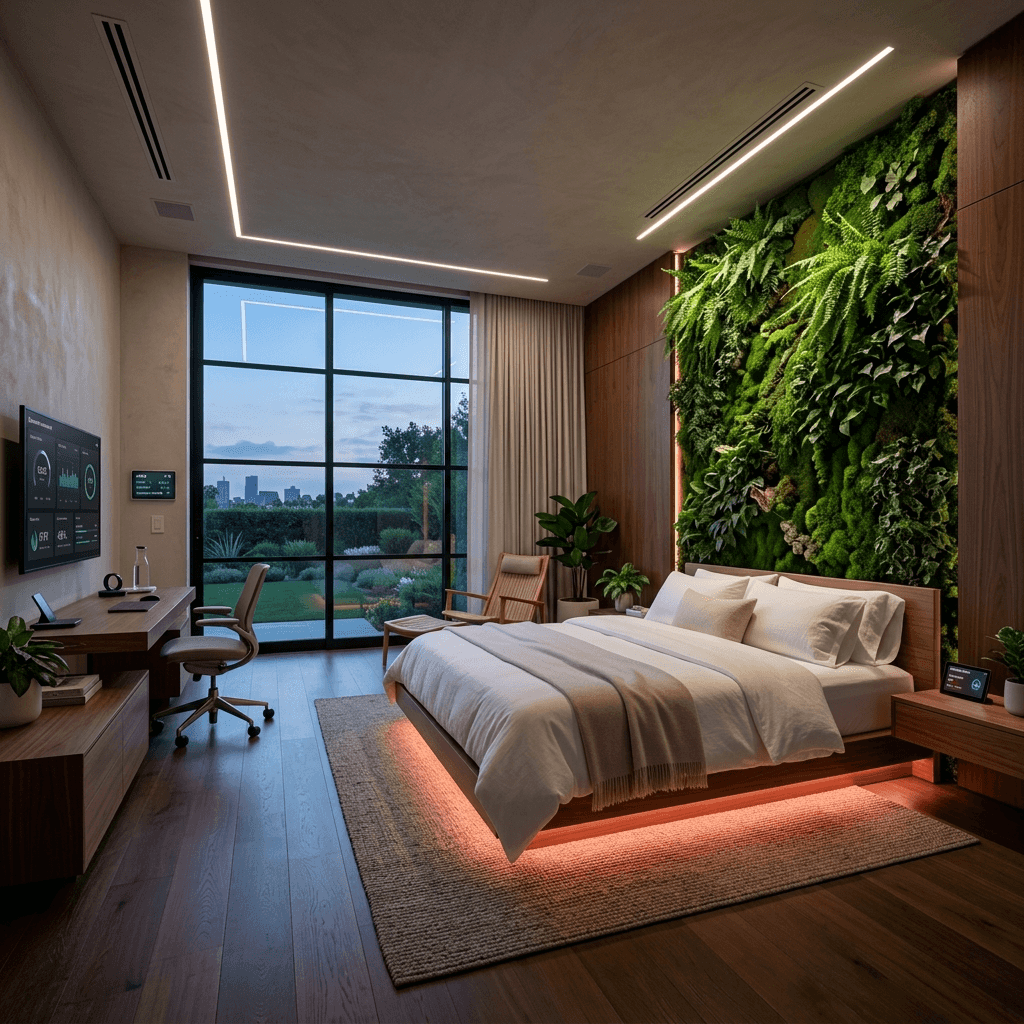
Longevity real estate integrates biophilic design—the inclusion of natural elements, textures, and plants indoors—to actively reduce autonomic nervous system arousal. Studies indicate that viewing green spaces or living plants indoors shifts the balance of the autonomic nervous system from sympathetic (fight-or-flight) to parasympathetic (rest-and-digest) dominance, lowering resting heart rate and arterial pressure.
Furthermore, plants release volatile organic compounds called phytoncides (such as alpha-pinene and limonene) to protect themselves from bacteria. Breathing these phytoncides during sleep has been shown to increase the activity and concentration of human Natural Killer (NK) cells, boosting immune surveillance. By incorporating living green walls, filtered daylight, and natural materials like slate and solid wood into the bedroom design, you lower overnight cortisol levels, promoting deep slow-wave sleep and physical regeneration.
Circadian Dysregulation and Melatonin Pathway Biochemistry
When our eyes are exposed to artificial light at night (ALAN), it immediately halts the pineal gland's synthesis of melatonin. Melatonin is synthesized from the amino acid tryptophan via a two-step pathway: first, tryptophan is converted into serotonin, and second, serotonin is acetylated by the enzyme arylalkylamine N-acetyltransferase (AANAT) and methylated by hydroxyindole O-methyltransferase (HIOMT) to form melatonin. AANAT is the rate-limiting enzyme in this pathway, and its activity is highly sensitive to light.
When blue light (approx. 480 nm) hits intrinsically photosensitive retinal ganglion cells (ipRGCs), the signal travels via the retinohypothalamic tract to the suprachiasmatic nucleus (SCN). The SCN activates GABAergic projections that suppress the sympathetic stimulation of the pineal gland, immediately degrading the AANAT enzyme. Without AANAT, serotonin cannot be converted to melatonin, preventing the overnight drop in core body temperature and disrupting slow-wave deep sleep. By sanitizing your bedroom light environment, you protect AANAT stability, ensuring a natural, robust melatonin peak.
Circadian Lighting Automation and Melanopic Lux Optimization
A critical component of a longevity-optimized home is the integration of automated circadian lighting systems designed around Equivalent Melanopic Lux (EML). The human master clock in the suprachiasmatic nucleus (SCN) is synchronized primarily by intrinsically photosensitive retinal ganglion cells (ipRGCs), which express the photopigment melanopsin. Melanopsin is highly sensitive to short-wavelength blue light (centered around 480 nm). During the morning, home automation systems should deliver high-intensity, blue-enriched light (above 250 EML) to suppress melatonin synthesis and stimulate cortisol, anchoring the circadian rhythm.
Conversely, as solar noon passes, the system must dynamically shift to warm, low-intensity light, completely eliminating blue wavelengths after sunset. High-end longevity properties utilize programmable, multi-channel LED arrays that automatically transition from a bright 6500 Kelvin morning spectrum to a dim 1800 Kelvin copper-toned evening soundscape. This strict control of light exposure prevents evening phase delays, protects autonomic tone, and ensures deep slow-wave sleep cycles, supporting mitochondrial repair and genetic stability.
Peer-Reviewed Clinical Validations & Extended Deeper Reading:
- Indoor Air Quality & Sleep: Strøm-Tejsen et al. (2016). "The effects of bedroom air quality on sleep and next-day performance". Indoor Air. Confirms that lower CO2 levels and higher ventilation rates in the bedroom significantly improve sleep depth and mental concentration. Read Study
- EMFs & VGCC Activation: Pall (2013). "Electromagnetic fields act via activation of voltage-gated calcium channels to produce rapid intracellular calcium elevation and oxidative stress". Journal of Cellular and Molecular Medicine. Details the cellular mechanisms of EMF-induced calcium leakage and free radical generation. Read Study
- Water Contaminants & Chronic Disease: Landrigan et al. (2018). "The Lancet Commission on pollution and health". The Lancet. Comprehensive report detailing the relationship between environmental toxins, water pollution, systemic inflammation, and chronic disease. Read Study
Ultimately, building a home sleep sanctuary is the single most effective environmental biohack you can implement. By systematically eliminating blue light leaks, filtering out industrial VOCs, purifying tap water contaminants, and mitigating electromagnetic wall voltage, you lower the baseline load on your body's detoxification pathways. This structural optimization transforms your bedroom from a source of chronic environmental stress into an active recovery chamber, supporting genomic stability, lower cortisol levels, and physical regeneration over a long life.
Beyond physical and chemical parameters, longevity real estate incorporates the engineering of **acoustic soundscapes and spatial geometry** to optimize mental health and autonomic nervous system tone. Utilizing high-density partitions with a Sound Transmission Class (STC) rating of 55 or higher prevents street decibels and municipal rumbles from triggering startle reflexes during sleep. When structural soundproofing is paired with biophilic interior layouts (such as rounded corners, natural clay finishes, and running water features), it lowers blood pressure and supports parasympathetic dominance, transforming the home into a sanctuary for cellular rejuvenation.