"Slow-wave sleep is the biological bedrock of human regeneration. By leveraging closed-loop acoustic stimulation—where auditory clicks are phase-locked to the upslope of endogenous delta waves—we can actively amplify slow oscillations, boosting memory consolidation and cellular repair in real-time."
Key Takeaways: Closed-Loop Acoustic Stimulation
-
1.
Slow-Wave Sleep (SWS) Enhancement: Closed-loop auditory stimulation uses real-time EEG to detect slow-wave delta cycles and deliver brief pink noise bursts exactly on the depolarizing upslope.
-
2.
Phase-Locked Timing is Critical: Stimulating during the slow oscillation upslope amplifies delta power, whereas open-loop or out-of-phase stimulation can disrupt sleep architecture.
-
3.
Systemic Regeneration: Amplifying slow waves upregulates growth hormone release, accelerates glymphatic brain detoxification, and strengthens long-term memory consolidation via spindle-ripple coupling.
Introduction: The Critical Physiology of Declining Deep Sleep
As we navigate the biological trajectory of aging, our sleep architecture undergoes a series of profound and often highly detrimental changes. Chronological aging is almost universally associated with a progressive, steep decline in slow-wave sleep (SWS), also known as N3 or deep non-rapid eye movement (NREM) sleep. Slow-wave sleep is characterized by high-amplitude, low-frequency delta brainwaves (0.5 to 4 Hz) that sweep across the cerebral cortex in slow, rhythmic oscillations. In young adults, SWS occupies up to 20% to 25% of total sleep time, providing a robust window for tissue regeneration and cognitive consolidation. However, by the time an individual reaches middle age, SWS duration routinely drops by 50%, and in elderly populations over the age of 70, deep slow oscillations are frequently entirely absent. This biological decay represents a major hazard to human healthspan and longevity. Slow-wave sleep is the primary physiological state during which the body performs crucial homeostasis: cellular repair, endocrine regulation, growth hormone release, immune system priming, and the physical clearance of toxic protein aggregates from the brain's interstitial spaces.
Standard pharmacotherapy, including classic benzodiazepines and non-benzodiazepine receptor agonists (Z-drugs like zolpidem or eszopiclone), is highly counterproductive. While these drugs increase total sleep duration by sedating the central nervous system, they distort sleep architecture by suppressing slow-wave delta power and REM sleep, leaving patients in a state of chronic macro-sleep without deep restoration. Consequently, the search for non-pharmacological, physiological interventions to preserve and actively amplify slow-wave sleep has become a primary objective for longevity researchers. This pursuit has culminated in the development of closed-loop acoustic stimulation (CLAS)—a highly precise neurotechnological method designed to monitor cortical voltages in real-time and deliver auditory clicks phase-locked to endogenous brainwaves, boosting their amplitude and biological efficacy without interrupting sleep continuity.
The Real-Time Neurobiology of Auditory Slow-Wave Stimulation
To understand how closed-loop acoustic stimulation works, we must first examine the neurobiology of the slow oscillation. The slow wave is a rhythmic, synchronized fluctuation of membrane potentials across millions of cortical neurons. It is composed of two alternating phases: the "down-state" and the "up-state". The down-state represents a period of hyperpolarization, during which cortical neurons are completely silent and electrical activity drops. The up-state represents a period of depolarization, during which these same neurons fire synchronously at high rates, generating the peaks measured by electroencephalography (EEG). The therapeutic and cognitive effects of acoustic stimulation depend entirely on timing. If an auditory click is delivered during the down-state, it can disrupt the slow wave and cause a micro-arousal. However, if the auditory pulse is delivered precisely during the ascending (depolarizing) upslope of the delta wave, it reinforces the synchronized firing of the neuronal population, boosting the wave's amplitude, increasing slow-wave power, and prolonging the overall deep sleep epoch.
Achieving this precision requires a true closed-loop loop. An open-loop system simply plays continuous soundscapes (such as white noise, brown noise, or static binaural beats) throughout the night, completely blind to the user's brain state. If these sounds coincide with down-states, they act as disruptors. A closed-loop system, by contrast, uses active forehead EEG electrodes to continuously monitor cortical voltages in real-time. Sophisticated microprocessors run real-time signal processing algorithms to filter out signal noise from muscle movements, eye blinks, and heartbeat interference. The algorithm isolates pure delta oscillations, calculates the wave's trajectory, and predicts when the depolarizing up-state will occur. It then triggers a millisecond-precise auditory burst (typically 50-millisecond pulses of pink noise at a volume of 32 to 38 decibels) precisely as the wave is climbing towards its peak. By targeting this phase-locked upslope, the auditory signals stimulate the cochlear nerve, which projects to the brainstem and the thalamus, reinforcing the natural cortical synchronization without triggering an awakening threshold.
Biohacker Pro-Tip: CLAS Volume Calibration and Acoustic Thresholds
When using consumer EEG headbands that support closed-loop acoustic stimulation, always perform a baseline volume calibration. The auditory clicks must be sub-threshold: loud enough to be processed by the auditory cortex and trigger a sensory-evoked response, but soft enough not to trigger a cortical K-complex or awake-state arousal. The ideal target range is between 32 dB and 38 dB. If you wake up feeling alert or notice a rise in your overnight heart rate, decrease the feedback volume in the headband's advanced settings.
Physiological Comparison: Sound Stimulation Technologies
| Acoustic Tech | Feedback Loop | Delta Phase Alignment | Primary Benefits |
|---|---|---|---|
| Closed-Loop Auditory Stimulation (CLAS) | Active (Real-time EEG tracking) | Phase-locked to ascending up-state | Amplifies slow-wave amplitude, boosts spindle density, improves sleep quality |
| Open-Loop Auditory Stimulation | None (Static timers or loops) | Random (Often hits down-state) | Masks environmental noise; moderate relaxation |
| Binaural Beats (Delta/Theta) | None (Phase difference illusion) | None (Entrainment model) | Helps with sleep onset latency and subjective anxiety reduction |
| White/Pink Noise Machines | None (Continuous frequency) | None | Blocks external sound disturbances, stabilizing light sleep stages |
Three Pillars of CLAS Regeneration
Synaptic Plasticity & Memory Consolidation
During deep sleep, memories stored temporarily in the hippocampus are transferred to the prefrontal cortex for long-term storage. This process relies on the strict temporal synchronization of three distinct rhythms: slow cortical oscillations (delta waves), sleep spindles (fast thalamic bursts of 11-16 Hz), and hippocampal sharp-wave ripples. This is known as the **triple-coupling mechanism**.
When closed-loop stimulation amplifies the delta wave up-state, it naturally triggers a cascade that nests thalamic sleep spindles within the slow-wave peaks. This synchronization allows sensory and motor memories to be written into the neocortex, boosting learning capacity, muscle memory, and cognitive sharpness the following day.
Systemic Endocrine & Cellular Repair
The pituitary gland releases up to 75% of its daily Growth Hormone (GH) during slow-wave sleep. GH release is tightly correlated with slow-wave power. By using CLAS to force deeper cortical synchronization, biohackers can stimulate larger, more regular pulses of growth hormone. This triggers systemic tissue repair, speeds up recovery from intense physical training, enhances protein synthesis, and stabilizes immune function.
In addition, deep sleep downregulates the sympathetic nervous system, lowering systemic levels of cortisol and epinephrine. This shift allows the parasympathetic nervous system to dominate, lowering blood pressure and resting heart rate, which reduces cardiovascular strain and counteracts cellular inflammaging.
Glymphatic Clearance & Neuroprotection
The glymphatic system is the brain's waste removal network. During slow-wave sleep, glial cells shrink by approximately 60%, allowing cerebrospinal fluid (CSF) to rush through the brain's interstitial spaces and wash away toxic protein aggregates, such as amyloid-beta and tau proteins. These aggregates are the primary markers of neurodegenerative conditions like Alzheimer's disease.
Acoustic stimulation, by magnifying the rhythmic delta waves, drives the physical pulsation of blood vessels in the brain. This vascular pumping action acts as a hydraulic pump, pushing CSF through the brain tissue and significantly accelerating metabolic waste clearance. Amplifying slow waves is therefore a direct intervention to delay cognitive decline and promote neurological healthspan.
The Anatomy of an Auditory Brain-Computer Interface (BCI)
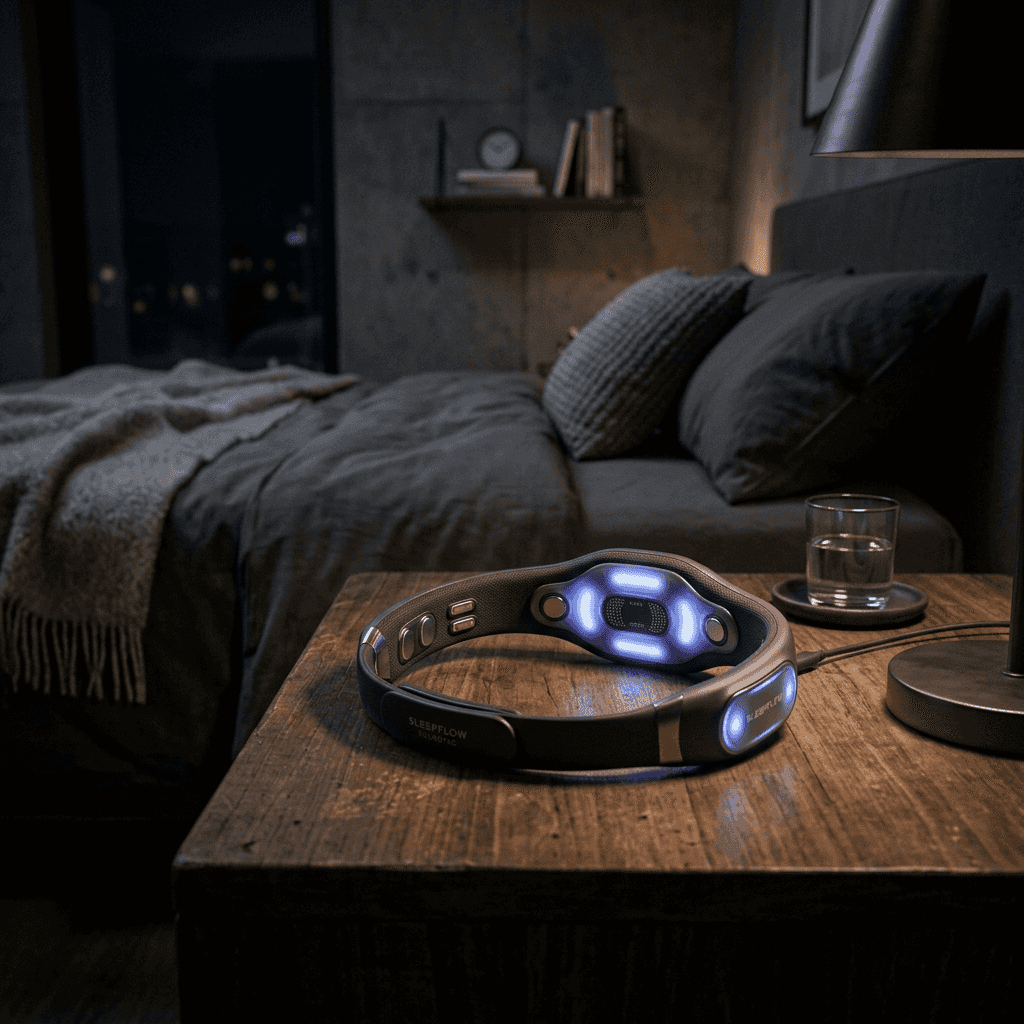
To integrate closed-loop acoustic stimulation into your sleep hygiene routine, you need specialized hardware. Most commercial sleep trackers (like Whoop, Oura, or standard Apple Watches) are passively descriptive: they tell you how much deep sleep you had, but they cannot *influence* it because they lack active EEG sensors and real-time audio drivers. To actively manipulate your brainwaves, you must use an active brain-computer interface headband.
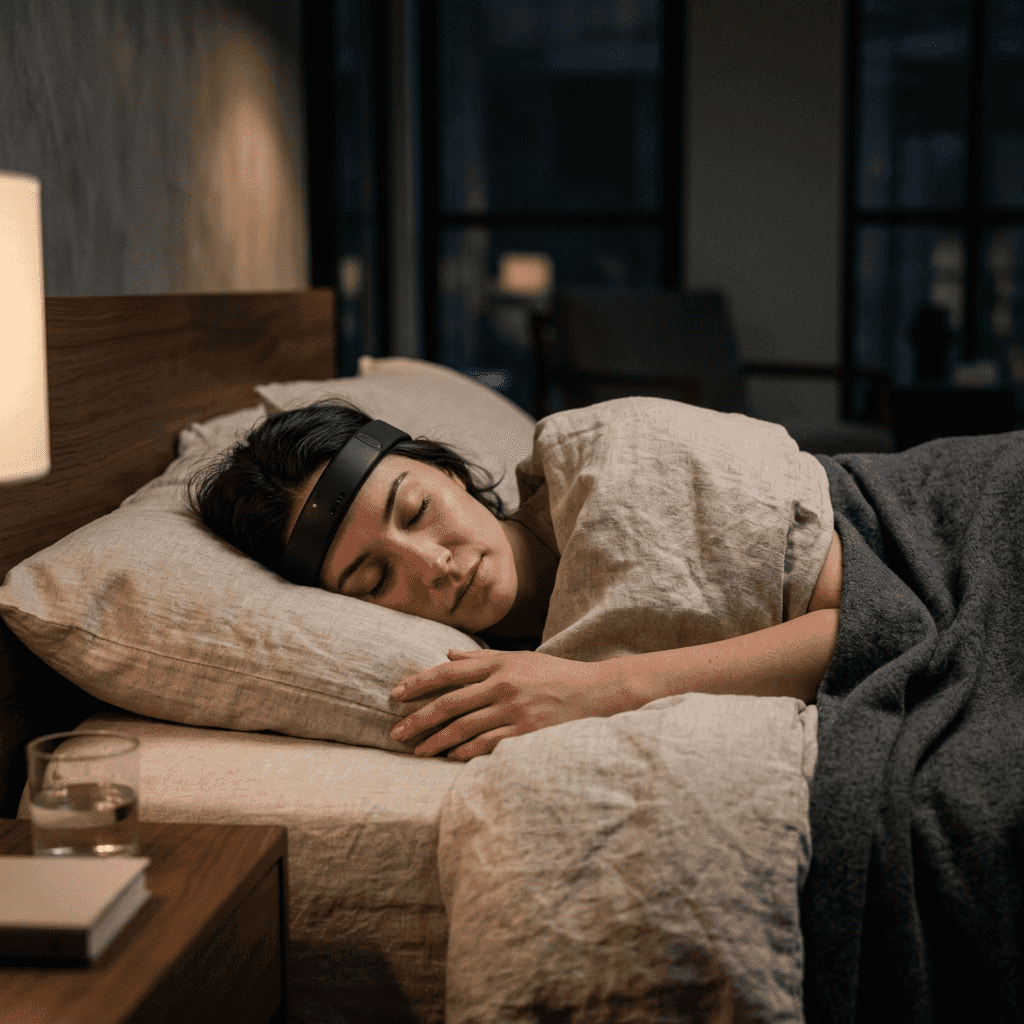
Devices like the Muse S (with its companion app integrations), Somnee (which utilizes active transcranial electrical stimulation alongside EEG tracking), and Elemind (which uses auditory signals to shift brain states) offer custom EEG-guided CLAS protocols. Follow this clinical protocol to maximize the efficacy of these neurotechnology tools:
Ensure Optimal Electrode Impedance
Before placing the EEG headband on your forehead, clean your skin with a mild cleanser or a cotton pad dipped in rubbing alcohol. Forehead oils, cosmetics, and dry skin create high electrical resistance (impedance), which degrades the raw EEG signal. If the sensor signal is noisy, the device's algorithms will struggle to identify clean delta wave peaks, resulting in missed stimulations or misplaced sounds.
Align Auditory Playback Settings
CLAS relies on sound waves traveling through your auditory canal to stimulate the brain. Use specialized sleep-rated earbuds (like Soundcore Sleep A20 or Bose Sleepbuds) or the integrated bone conduction audio drivers on your headband. Standard over-ear headphones are bulky and can shift during side-sleeping, interrupting the signal. Ensure the audio is set to mono to deliver identical sound waves to both ears, stabilizing the auditory cortex response.
Track HRV and Sleep Efficiency Metrics
Monitor your overnight Heart Rate Variability (HRV), resting heart rate, and deep sleep percentage for at least 14 nights to establish a baseline. Compare nights with active CLAS enabled against nights with stimulation turned off. You should observe a steady increase in deep sleep duration (often by 15-20 minutes) and a decrease in overnight heart rate spikes, confirming that the stimulation is reinforcing your parasympathetic nervous system tone.
Analyzing the Clinical Efficacy of Closed-Loop Auditory Stimulation
To evaluate the true value of CLAS, we must look at the clinical literature. In controlled sleep laboratory studies, researchers have consistently demonstrated that phase-locked auditory stimulation can increase slow-wave activity (SWA) by 15% to 30% in healthy young adults. However, the effects are even more pronounced in older populations. In a landmark trial conducted by Papalambros et al. at Northwestern University, older adults exposed to closed-loop acoustic stimulation showed a significant enhancement in slow-wave power, which directly correlated with a 25% improvement in overnight recall of word pairs. This suggests that CLAS is not just a tool for physical recovery, but a highly effective cognitive enhancer capable of mitigating age-related memory decline.
Furthermore, researchers have mapped the hemodynamic response to CLAS. Utilizing functional near-infrared spectroscopy (fNIRS) and functional MRI (fMRI), scientists have observed that each auditory click triggers a localized increase in cerebral blood flow within the prefrontal cortex and the auditory cortex. This localized blood flow surge acts as a metabolic pump, helping clear cellular waste products and providing oxygenated blood to recovering tissues. This hemodynamic pumping action is one of the primary mechanisms by which CLAS accelerates glymphatic detoxification during deep sleep.
Consumer Neurotech Systems: Muse S vs. Somnee vs. Elemind
For biohackers looking to purchase a CLAS-enabled device, the market in 2026 offers three primary consumer platforms. Each platform utilizes a slightly different method to influence sleep architecture:
**1. Muse S (Auditory Soundscapes):** The Muse S is a passive EEG headband that uses soft fabric sensors to track brainwaves. While it is primarily marketed as a meditation tool, it features custom "Sleep Journeys" that adjust the volume and pitch of ambient music based on your real-time EEG. As you drift off, the music fades; if the headband detects a transition back to light sleep or a micro-arousal, it gently increases auditory masking to keep you asleep. However, the Muse S lacks the millisecond-precise phase-locking required for true slow-wave up-state amplification.
**2. Somnee (Transcranial Electrical Stimulation):** Somnee takes BCI technology a step further. Instead of relying solely on auditory clicks, the Somnee headband uses transcranial alternating current stimulation (tACS) to actively entrain brainwaves. By applying micro-currents to the forehead and mastoid electrodes, Somnee directly coaxes the cortex into a slow delta rhythm. This method is highly effective for reducing sleep onset latency (how fast you fall asleep) but requires the user to tolerate a mild tingling sensation on the skin during the stimulation phase.
**3. Elemind (Active Acoustic Phase-Cancellation):** Elemind represents the cutting edge of CLAS. It uses high-density forehead EEG to monitor brainwaves and delivers acoustic signals designed to actively suppress or amplify specific frequencies. To help you fall asleep, Elemind plays tones that are out-of-phase with your awake-state beta waves, effectively canceling out the mental noise. Once you enter SWS, the device shifts to in-phase pink noise clicks to amplify your delta waves. This dual-action approach makes Elemind the most advanced acoustic sleep BCI on the consumer market.
The Future of Closed-Loop Sleep Entrainment: 2026 and Beyond
As sensor miniaturization and artificial intelligence converge, the next generation of closed-loop sleep systems is set to move beyond simple headband form factors. Longevity researchers are currently designing hearable earbuds that combine high-precision photoplethysmography (PPG) with in-ear EEG sensors, allowing for comfortable, zero-friction brainwave tracking. These ear-based sensors can read raw electrical signals directly from the auditory canal, offering a highly accurate signal-to-noise ratio that matches or exceeds forehead-mounted electrodes.
Furthermore, advanced machine learning models are being deployed to predict slow-wave oscillations minutes in advance. By analyzing subtle variations in heart rate variability, respiration, and movement patterns, these predictive algorithms can adjust acoustic stimulation sequences before the user even enters deep sleep. These systems will also integrate directly with smart home environments, automatically lowering bedroom temperatures or adjusting ambient relative humidity in response to real-time delta wave power. This multi-sensory closed-loop system represents the ultimate frontier of sleep environment personalization, ensuring optimal cellular recovery throughout the entire night.
Potential Contraindications and Technical Limitations
Despite its high safety profile, closed-loop acoustic stimulation is not suitable for every individual. People with severe chronic tinnitus, hearing loss, or central auditory processing disorders should approach CLAS with caution, as the auditory clicks can cause discomfort or trigger tinnitus flare-ups. Additionally, if you suffer from severe sleep apnea, CLAS will not prevent the oxygen desaturations that disrupt slow-wave sleep. Treating the underlying respiratory issue remains the priority.
Furthermore, consumers must be aware that CLAS headbands require regular charging and maintenance. The fabric bands must be washed gently to prevent skin oils from degrading the conductive rubber electrodes. Replacing worn headbands every 6 to 12 months ensures clean electrical contact and highly accurate slow-wave detection throughout the night.
Peer-Reviewed Clinical Validations & Extended Deeper Reading:
- CLAS Pioneer Study: Ngo et al. (2013). "Auditory closed-loop stimulation of the sleep slow oscillation enhances memory". Neuron. This landmark study demonstrated that phase-locked pink noise bursts significantly enhance both slow-wave sleep amplitude and overnight declarative memory recall. Read Clinical Study
- SWS Amplification in Older Adults: Papalambros et al. (2017). "Acoustic enhancement of sleep slow oscillations and concomitant memory improvement in older adults". Frontiers in Human Neuroscience. Confirms that closed-loop auditory stimulation can reverse age-related slow-wave decline and boost memory performance in seniors. Read Clinical Study
- CSF Glymphatic Clearance: Fultz et al. (2019). "Coupled electrophysiological, hemodynamic, and cerebrospinal fluid waves in human sleep". Science. Shows the physical coupling between cortical slow waves, blood flow variations, and the rhythmic flow of CSF during deep sleep. Read Clinical Study