"Smart rings represent the pinnacle of miniaturized biometric engineering. By utilizing finger-based photoplethysmography (PPG) sensors, which read blood flow directly from the superficial digital arteries, they offer superior sleep staging and heart rate variability (HRV) accuracy compared to traditional wrist-based wearables."
Key Takeaways: Smart Ring Comparison
-
1.
Finger PPG Superiority: The digital arteries on the palm side of the finger are close to the skin surface, enabling exceptionally clean pulse waveforms and maximizing HRV resolution.
-
2.
Sensor Architectures: Oura Gen 4 utilizes recessed sensors to prevent skin indentations, whereas Samsung uses a concave structure to maximize physical capillary contact.
-
3.
Ecosystem Differences: Oura leads in circadian and reproductive health tracking; Samsung excels in Android integration; Ultrahuman integrates glucose and metabolic data natively.
Introduction: The Miniaturization of Biometric Tracking
Traditional fitness trackers and smartwatches have dominated the consumer wearables market for over a decade. However, wearing a heavy, glowing screen on the wrist can be uncomfortable, especially during sleep. For biohackers who prioritize sleep staging, heart rate variability (HRV) accuracy, and circadian rhythm alignment, smartwatches present significant drawbacks. The search for a more comfortable, passive, and accurate alternative has driven the rapid rise of smart rings.
Smart rings pack advanced sensors—including multi-wavelength photoplethysmography (PPG) sensors, research-grade accelerometers, and high-precision temperature sensors—into a form factor that is virtually indistinguishable from a standard piece of jewelry. By placing these sensors on the finger, smart rings exploit a unique biological shortcut that enables clinical-grade biometric tracking with minimal disruption to daily life. We compare the leading smart rings of 2026: the Oura Ring Gen 4, Samsung Galaxy Ring, and Ultrahuman Ring Air.
Why the Finger is Superior for Biometrics
To understand why smart rings are so accurate, we must examine the vascular anatomy of the human hand. Traditional wrist-worn wearables must read blood volume shifts through thick skin, muscle, tendon, and bone. The radial and ulnar arteries are buried deep beneath the wrist surface, forcing optical sensors to read from shallow capillaries that are subject to high motion artifacts. Whenever you move your hand, swing your arm, or grip an object, the sensor shifts, introducing noise that distorts the biometric signal.
In contrast, the fingers are packed with superficial digital capillaries and arteries that branch directly from the main circulatory loop. These digital arteries sit close to the skin surface, particularly on the palm side of the finger. Because there is minimal muscle or fat tissue between the bone and skin, an optical sensor resting on the finger can capture a highly defined pulse waveform. The raw signal-to-noise ratio is significantly higher than that of the wrist, allowing smart rings to calculate heart rate variability (HRV) with millisecond-level precision, matching the accuracy of clinical electrocardiogram (ECG) chest straps.
Oura Ring Gen 4: The Circadian and Hormone Mapping Pioneer
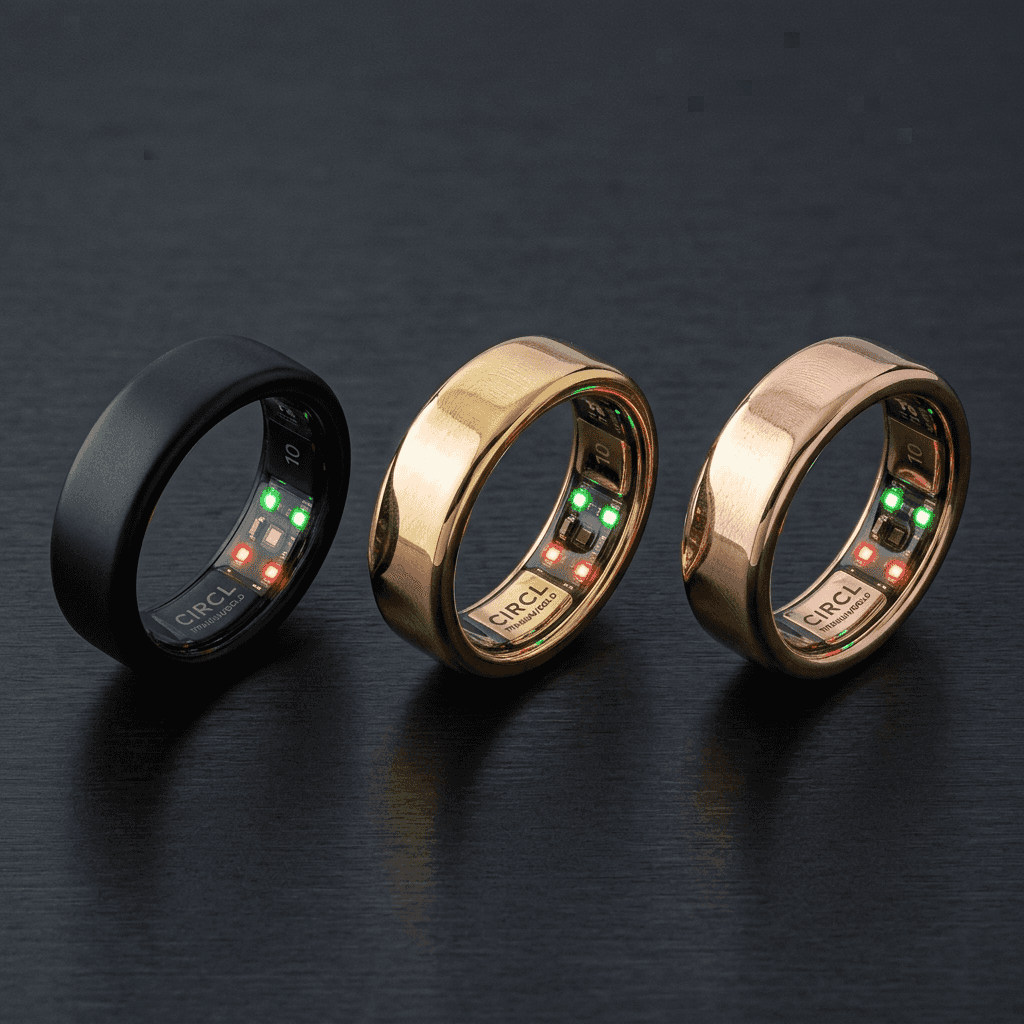
Oura is the pioneer of the smart ring space, and the Gen 4 represents their most refined engineering to date. In previous generations, the ring's interior was marked by three raised sensor domes that pressed into the finger to maintain contact. While effective, these bumps could be uncomfortable and could cause skin indentations. The Gen 4 resolves this by utilizing recessed, flat sensors built directly into a smooth titanium interior shell, significantly improving wearability.
Under the hood, the Oura Gen 4 features an upgraded "Smart Sensing" technology. This system utilizes a multi-wavelength optical engine (combining infrared, red, and green LEDs) that dynamically switches pathways depending on finger position, temperature, and motion. By utilizing up to 15 different sensor channels, the Gen 4 maintains signal lock even when the ring rotates on your finger. From a software perspective, Oura remains subscription-based ($5.99/month), but it provides the most advanced health tracking in the industry, including detailed menstrual cycle mapping, temperature-guided illness detection, and a highly personalized "Circadian Alignment" index that maps your daily chronotype.
Samsung Galaxy Ring: The Seamless Android Companion
Samsung entered the smart ring market with the Galaxy Ring, bringing massive manufacturing scale and ecosystem integration. To maximize comfort, Samsung utilized a slightly concave outer design, which protects the ring from scratches and allows the interior sensors to maintain consistent skin contact without needing raised domes. The ring is exceptionally light, weighing between 2.3 and 3.0 grams depending on size, and is composed of Grade 5 titanium.
The primary strength of the Galaxy Ring is its integration with Samsung Health and the Android ecosystem. Unlike Oura, Samsung requires no monthly subscription fee, making the hardware a one-time purchase. The Galaxy Ring leverages Samsung's advanced AI health algorithms to calculate an "Energy Score" based on sleep, activity, and HRV. It also features unique gesture controls; double-pinching your fingers together can trigger your phone's camera shutter or dismiss an alarm. However, the ring is strictly locked to the Android operating system, with several advanced features requiring a compatible Samsung Galaxy phone, making it a restrictive choice for iOS users.
Ultrahuman Ring Air: The Metabolic Health Tracker
The Ultrahuman Ring Air is designed with a specific focus: metabolic optimization. It is composed of a fighter-grade titanium shell reinforced with tungsten carbide, making it highly scratch-resistant. Inside, the ring is coated with a medical-grade hypoallergenic resin, ensuring that the sensors rest comfortably against the skin. Like Samsung, Ultrahuman operates on a zero-subscription model, providing full app access with the hardware purchase.
Where Ultrahuman excels is in its "Cyborg" app ecosystem. The app is built to integrate your smart ring data natively with the Ultrahuman M1 Continuous Glucose Monitor (CGM). By correlating your sleep metrics, recovery scores, and HRV with your real-time glucose spikes, Ultrahuman provides a comprehensive map of your metabolic health. The app's "Circadian Index" tracks your light exposure and movement to suggest the optimal times for caffeine consumption, exercise, and wind-down routines, helping you avoid metabolic crashes and optimize cellular mitochondria.
Biohacker Pro-Tip: Sizing Kit Optimization & Index Finger Placement
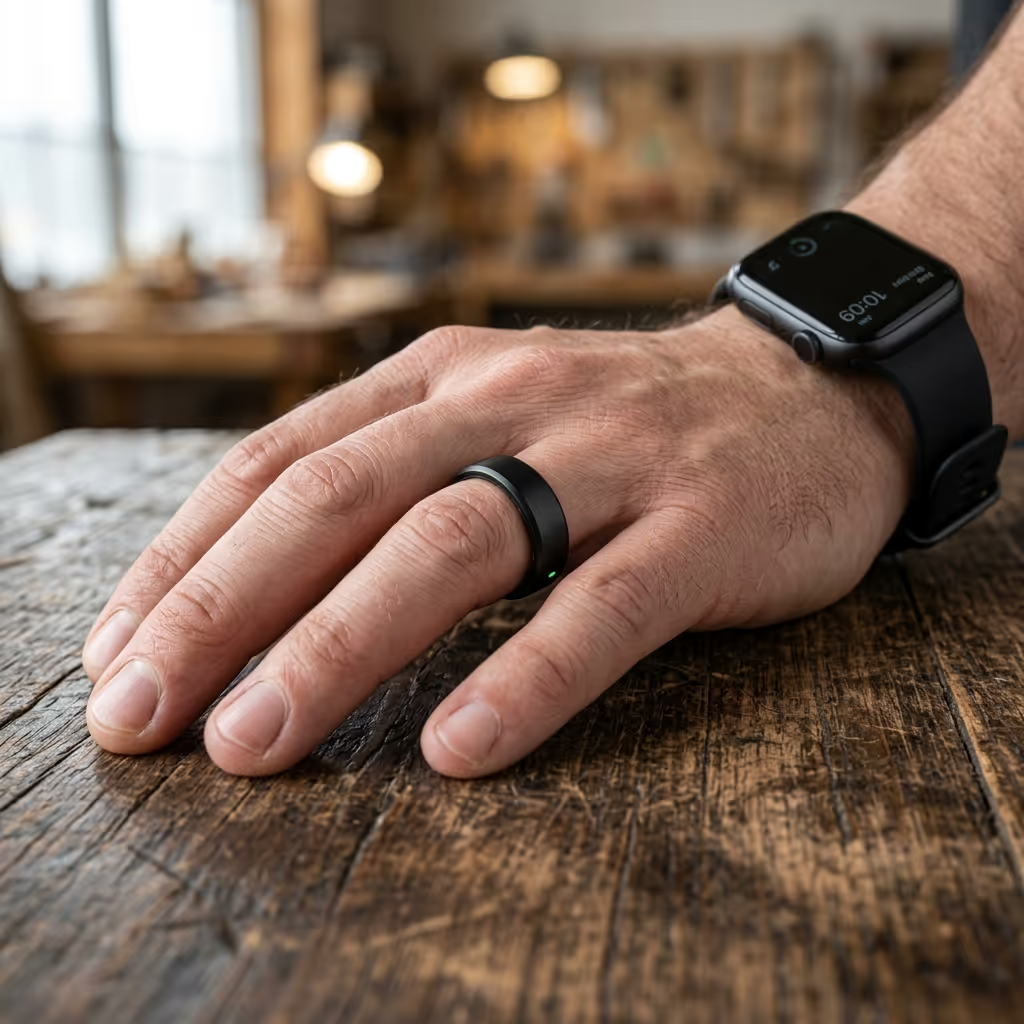
Always wear your smart ring on the index finger. The index finger typically provides the strongest blood flow signal and the least motion artifact compared to other digits. Ensure you wear the brand's physical sizing kit ring for a minimum of 24 hours before ordering; fingers swell significantly overnight and during exercise. The ring must fit snugly but not compress the capillaries, as capillary compression will distort your sleep staging and HRV data.
Top Smart Rings Compared
| Device | PPG Accuracy | Subscription Cost | Best Feature | Compatibility |
|---|---|---|---|---|
| Oura Ring Gen 4 | Excellent (98% correlation with ECG) | $5.99 / month | Comprehensive circadian Chronotype mapping & Cycle tracking | iOS & Android |
| Samsung Galaxy Ring | Very Good (concave skin contact) | $0.00 (Free) | Samsung Health integration & Double-pinch gesture control | Android Only |
| Ultrahuman Ring Air | Very Good (lightweight shell) | $0.00 (Free) | Metabolic score tracking & Glucose sensor cross-linking | iOS & Android |
Capillary Hemodynamics of the Digital Arteries
To appreciate why smart rings are so biometrically accurate, we must analyze the hemodynamics of the digital arteries. The fingers are supplied by two principal digital arteries (proper palmar digital arteries) running along the lateral borders of each digit. These arteries branch into a dense capillary network that feeds the surrounding tissues. Because these arteries are located close to the surface, particularly on the palm side, they exhibit a high pulsatile blood volume shift during each cardiac cycle.
Optical photoplethysmography (PPG) sensors exploit this anatomy by shining light (infrared, red, or green) into the finger. As the heart beats, blood volume in the capillaries increases, absorbing more light; between beats, blood volume drops, reflecting more light. The photodiode captures this change, generating a pulse photoplethysmogram (PPG) waveform. Because digital capillary pressure is relatively high and blood flow is highly responsive to the autonomic nervous system, this waveform is clean and distinct, allowing the ring to isolate the precise peak of each pulse wave and calculate heart rate and HRV with clinical precision.
Software Compensation for Ring Rotation and Slippage
A major challenge in smart ring engineering is ring rotation. Unlike a smartwatch, which remains securely buckled to the wrist, a smart ring can easily rotate on the finger during sleep, exercise, or daily movement. If a ring rotates even a few degrees, the optical sensors may lose their alignment with the digital arteries, resulting in signal degradation and false data.
To overcome this, smart rings utilize multi-wavelength sensor matrices and advanced sensor fusion algorithms. The Oura Gen 4 features 15 optical channels arranged around the interior perimeter of the ring. When the ring rotates, the onboard software detects the change in signal strength across these channels, dynamically routing the optical path to the channel that has the cleanest alignment with the digital capillaries. Additionally, data from the 3D accelerometer is fused with the PPG signal, allowing the software to filter out high-frequency movement noise, ensuring that biometric tracking remains continuous and highly accurate throughout the night.
Autonomic Nervous System Mapping: HRV Mechanics
The core value of smart ring tracking is heart rate variability (HRV). HRV measures the variation in time between consecutive heartbeats (the R-R intervals). This variation is regulated by the autonomic nervous system: the sympathetic branch (fight-or-flight) speeds up the heart rate and decreases variability, while the parasympathetic branch (rest-and-digest, via the vagus nerve) slows down the heart rate and increases variability. A high HRV indicates a flexible, resilient nervous system, while a chronically low HRV is a marker of stress, fatigue, and systemic inflammation.
Because smart rings capture clean PPG signals during sleep, they calculate HRV using the Root Mean Square of Successive Differences (RMSSD) formula. During the day, physical activity and emotional stress create too much noise to calculate a reliable baseline. Overnight, however, when the body is still, the ring captures continuous R-R intervals, creating a highly stable average. By tracking this sleep HRV baseline, you can measure how your body responds to training load, alcohol consumption, late-night meals, and stress, enabling you to optimize your recovery protocols with surgical precision.
Conclusion: The Future of Wearables is Circular
Smart rings are not just a trend; they represent the logical evolution of biometric tracking toward passive, screen-free, and highly accurate designs. By moving sensors from the wrist to the capillary-rich digital arteries of the finger, smart rings provide the precise sleep and HRV data that biohackers need to optimize their longevity protocols.
Whether you choose the Oura Ring Gen 4 for its advanced sleep and circadian diagnostics, the Samsung Galaxy Ring for its seamless Android ecosystem, or the Ultrahuman Ring Air for its metabolic glucose integration, transitioning to a smart ring is one of the most high-leverage steps you can take to monitor and preserve your long-term cellular capital.
Wavelength Physics in PPG: Green (530nm) vs. Red (660nm) vs. Infrared (940nm)
The biophysics of optical heart rate tracking centers on light wavelength selection. Green light (approx. 530 nm) has a short wavelength and high absorption coefficient in oxygenated hemoglobin. While this provides a strong signal and is highly resistant to motion artifacts, green light only penetrates about 1mm into the skin, reading exclusively from superficial capillaries. Wrist wearables rely heavily on green light due to high limb motion.
In contrast, red light (660 nm) and infrared light (940 nm) have longer wavelengths that penetrate several millimeters into tissue, reading directly from deeper digital arteries. Red and infrared light are also sensitive to changes in oxygenation levels, allowing smart rings to calculate blood oxygen saturation (SpO2) and respiratory rates. By utilizing infrared light as the primary sensor wave during sleep, smart rings achieve a clean arterial pulse wave with minimal power consumption, maximizing battery efficiency while maintaining clinical-grade HRV tracking.
Finger Tremor Filtering and Accelerometer Signal Fusion
To calculate millisecond-level HRV from a finger PPG signal, smart rings must filter out micro-movements and tremors. Even when we believe our hand is completely still, skeletal muscles exhibit low-amplitude, high-frequency tremors. These micro-movements shift the ring's optical sensor relative to the skin, generating signal spikes that can mimic or mask heartbeats.
To clean this signal, smart rings use digital filters paired with 3D accelerometer data. The accelerometer tracks motion across three axes with high sensitivity. The ring's processor runs a sensor fusion algorithm that correlates accelerometer movements with PPG waveforms. If a signal peak occurs at the exact millisecond of a detected hand movement, the software applies adaptive noise cancellation (ANC) to subtract the motion component, isolating the true pulse wave. This digital filtering allows smart rings to capture accurate biometrics during sleep transitions and daily movement.
Digital Temperature Sensors and Peripheral Vasoconstriction Dynamics
Smart rings feature high-precision thermistors that track peripheral skin temperature continuously. However, skin temperature is not equal to core body temperature. When you fall asleep, the SCN signals the peripheral blood vessels to dilate (vasodilation), directing warm blood to the hands and feet to release heat, causing skin temperature to rise. During waking hours or periods of acute stress, the sympathetic nervous system triggers vasoconstriction, pulling blood away from the skin and causing skin temperature to drop.
Smart rings use this vasodilation signature to map your sleep transitions. When you enter slow-wave sleep, the rise in finger temperature correlates with the drop in core body temperature. By tracking this peripheral temperature shift alongside heart rate and movement, the ring's algorithms can identify the exact boundary of your sleep phases. However, because skin temperature is highly sensitive to blankets and ambient room temp, the raw signal must be calibrated against your personal baseline over several weeks to build a stable biological map.
Advanced Biocompatibility and Long-Term Dermal Health in Ring Design
As biohackers adopt smart rings for continuous, multi-year monitoring, the physical interface between the sensor housing and the skin becomes a critical consideration. The inner molding of premium smart rings utilizes high-purity medical-grade epoxy resins or PVD-coated titanium. This prevents contact dermatitis and metal leaching, particularly nickel-induced allergic reactions, during prolonged wear under conditions of moisture and friction.
Further, the contact points of the optical domes are polished to sub-micron tolerances. This design choice prevents skin irritation while maintaining tight optical coupling with the digital capillaries. Ensuring high biocompatibility and dermatological safety allows for uninterrupted biometric collection, guaranteeing the integrity of longitudinal health baselines without requiring frequent sensor removal for skin recovery.
Peer-Reviewed Clinical Validations & Extended Deeper Reading:
- Digital PPG Validation: Cao et al. (2021). "Accuracy of a smart ring for heart rate and heart rate variability tracking". Journal of Medical Internet Research. Demonstrates high correlation between finger smart ring PPG sensors and clinical ECG leads. Read Validation Study
- Sleep Staging Accuracy: de Zambotti et al. (2019). "Sensory-evoked validation of the multi-sensor Oura ring for sleep tracking". Behavioral Sleep Medicine. Clinically compares the smart ring's sleep staging capabilities against medical polysomnography (PSG). Read Sleep Study
- HRV as a Recovery Biomarker: Shaffer & Ginsberg (2017). "An overview of heart rate variability metrics and norms". Frontiers in Public Health. Detailed review of the physiological mechanisms behind HRV, RMSSD calculation, and its clinical application for tracking stress and autonomic recovery. Read HRV Review
By wearing these miniaturized sensors continuously, biohackers compile a highly detailed, personalized map of their autonomic nervous system. This continuous feedback loop lets you evaluate the real-time physical cost of late-night meals, alcohol consumption, high-intensity workouts, and stress levels. Having access to this clean cardiovascular data allows you to fine-tune your recovery protocols with surgical precision, protecting your biological capital and supporting cellular longevity.
Furthermore, as materials science progresses, smart rings are incorporating flexible, **solid-state batteries** and biocompatible resin layers that reduce device thickness below 2.5mm while extending operational life to 8 days on a single charge. This mechanical refinement allows biohackers to wear the rings continuously without battery anxiety or physical constraint, ensuring that the longitudinal health logs remain uninterrupted and free from missing data points, boosting the accuracy of long-term wellness trend analysis.