"Not all wearables are created equal when the lights go out. The battle for sleep staging supremacy is being won on the finger, not the wrist. The humble smart ring, with its superior photoplethysmography (PPG) signal-to-noise ratio and strategic placement, is redefining how accurately we can track the architecture of our nights."
Smart Rings vs. Smart Watches: 2026 sleep Staging Accuracy Pillars
-
1.
Anatomical Advantage of the Finger: The palmar surface of the finger has a higher density of arterioles and capillaries than the wrist, providing a much stronger and more stable photoplethysmography (PPG) signal with significantly less motion artifact.
-
2.
Signal-to-Noise Ratio (SNR): The PPG signal from the finger exhibits a superior SNR compared to the wrist. This allows for more accurate detection of beat-to-beat intervals, which is the foundation of Heart Rate Variability (HRV) analysis and sleep stage differentiation.
-
3.
sleep Staging Validation: Independent studies comparing consumer wearables against gold-standard polysomnography (PSG) consistently show that leading smart rings (e.g., Oura) achieve 85-90% agreement for sleep/wake detection and 70-80% for 4-stage sleep classification, outperforming most wrist-worn devices.
-
4.
Temperature Sensing Superiority: The finger is a more reliable site for measuring distal skin temperature, a critical biomarker for circadian phase and sleep onset. Wrist temperature is more affected by ambient environmental fluctuations.
-
5.
The Trade-Off: Smart rings sacrifice a display and real-time interaction for superior sleep and recovery data, while smartwatches offer broader daytime utility (notifications, GPS, ECG) but compromise on nocturnal accuracy.
The wearable technology landscape of 2026 is no longer a monolithic category dominated by a single form factor. It has bifurcated into two distinct, specialized niches, each with its own set of strengths and weaknesses. On one wrist, the ubiquitous Smartwatch reigns supreme as a daytime companion, a miniature extension of the smartphone that delivers notifications, tracks GPS-enabled workouts, and offers on-demand ECG readings. On the other hand, or more precisely, on the other finger, the unassuming Smart Ring has carved out a formidable reputation as the undisputed champion of nocturnal biometrics, excelling in the quiet, passive collection of sleep, recovery, and readiness data. This divergence is not merely a matter of fashion or personal preference. it's rooted in fundamental differences in human anatomy, sensor physics, and the inherent trade-offs between wearable functionality and signal fidelity.
For the 2026 biohacker, for whom optimizing sleep architecture and understanding autonomic recovery are non-negotiable pillars of health and performance, the choice of nocturnal wearable is a critical, data-driven decision. The core question is not "Which device has more features?" but rather "Which device provides the most accurate and reliable window into the physiological processes of sleep?" This full treatise will dissect the science behind the sensor, comparing the photoplethysmography (PPG) signal fidelity, motion artifact susceptibility, and temperature sensing accuracy of finger-based smart rings versus wrist-based smartwatches. We will scrutinize the validation studies against gold-standard polysomnography (PSG), analyze the proprietary algorithms that transform raw data into sleep stages, and provide a clear, evidence-based framework for selecting the optimal sleep-tracking tool for your specific Biohacking goals.
THE PHYSICS AND ANATOMY OF PPG: WHY THE FINGER WINS
At the heart of every optical heart rate monitor, whether in a ring, watch, or fingertip pulse oximeter, lies the technology of Photoplethysmography (PPG). PPG is a simple, elegant, and non-invasive optical technique that measures the volumetric changes in blood flow in peripheral tissues. A light source, typically a green, red, or infrared Light Emitting Diode (LED), illuminates the skin. A portion of this light is absorbed by the underlying tissues (skin, muscle, bone), but a small, pulsatile component is modulated by the rhythmic expansion and contraction of the arterioles and capillaries with each heartbeat. A photodetector placed adjacent to the LED captures this pulsatile reflected or transmitted light, generating a waveform known as the PPG Signal. From this waveform, beat-to-beat intervals (R-R intervals) can be extracted, allowing for the calculation of Heart Rate (HR) and, critically, Heart Rate Variability (HRV). The quality, stability, and signal-to-noise ratio (SNR) of this PPG signal are the primary determinants of a wearable's ability to accurately track sleep stages, which are heavily reliant on subtle, high-frequency variations in HRV and autonomic tone.
The Anatomical Advantage of the Finger
The finger, specifically the palmar surface of the proximal phalanx, offers a superior anatomical site for PPG acquisition compared to the wrist. This is due to several key factors:
- Higher Density of Perfused Tissue: The fingertips and palmar skin are richly innervated with a dense network of arterioles, capillaries, and arteriovenous anastomoses (AVAs), which are specialized shunts that regulate thermoregulation. This dense vascular bed provides a much larger and more dynamic "optical target" for the PPG sensor, resulting in a stronger, higher-amplitude pulsatile signal.
- Reduced Motion Artifact: During sleep, the hand and fingers are relatively stable compared to the wrist. The wrist is a complex joint with multiple degrees of freedom and is prone to subtle flexions, extensions, and rotations throughout the night. Even minor wrist movements can significantly alter the optical path between the LED and photodetector, introducing motion artifacts that corrupt the PPG signal and lead to erroneous HR and HRV readings. A ring, snugly fitted at the base of the finger, is far less susceptible to these displacements.
- Less Ambient Light Interference: A well-fitted smart ring creates a more effective optical seal against the skin, minimizing the penetration of ambient light from the environment. Wrist-worn devices, due to their larger surface area and looser fit (necessary for comfort), are more vulnerable to light leakage, which can saturate the photodetector and degrade the SNR. This is particularly problematic during sleep when the device may shift position.
- Optimal Sensor-Skin Contact: The cylindrical shape of the finger provides a natural, 360-degree surface for sensor placement, ensuring consistent and stable contact pressure. The relatively flat, bony topography of the wrist makes achieving uniform optical coupling more challenging, especially across different wrist sizes and shapes.
Anatomical & Physiological Advantages: Finger vs. Wrist for Nocturnal PPG
Finger (Smart Ring) ✅
- Dense arteriolar and capillary network
- High signal amplitude and SNR
- Stable position, low motion artifact
- Excellent optical seal, minimal light leak
- Superior for HRV and sleep staging
Wrist (Smartwatch) ❌
- Variable vascular density, more bone/tendon
- Lower signal amplitude, susceptible to noise
- Prone to motion artifact during sleep
- Higher ambient light interference
- Compromised accuracy for HRV-based sleep staging
BEYOND PPG: THE MULTI-SENSOR ARSENAL FOR sleep STAGING
While a high-fidelity PPG signal is the cornerstone of accurate sleep tracking, modern wearables employ a suite of complementary sensors to refine their sleep stage classification algorithms. The combination of these data streams, often fused using machine learning models, allows the device to differentiate between the distinct physiological signatures of Wake, Light sleep (N1/N2), Deep sleep (N3), and REM sleep.
Accelerometer (Actigraphy)
Both rings and watches contain 3-axis accelerometers that measure movement. The primary role of actigraphy in sleep tracking is to differentiate between periods of wakefulness (characterized by movement) and sleep (characterized by stillness). This is the most basic level of sleep analysis. However, relying solely on movement is insufficient for distinguishing between sleep stages, as a person can be awake but lying perfectly still. The accelerometer data is also used to identify periods of restlessness or brief nocturnal arousals. Smart rings, due to their stable position, may provide a slightly cleaner actigraphy signal with fewer false-positive movements.
Temperature Sensors
Core body temperature follows a distinct circadian rhythm, dropping to its nadir during the early hours of sleep. Distal skin temperature, measured at the finger or wrist, is a reliable proxy for this core temperature drop and the onset of vasodilation that facilitates sleep. The finger is a more sensitive and accurate site for measuring distal temperature compared to the wrist, which is more exposed to ambient environmental fluctuations (e.g., sleeping with an arm outside the covers). Smart rings like the Oura Ring Gen 3 and Gen 4 have pioneered the use of continuous, high-resolution finger temperature tracking to provide insights into menstrual cycle phases, illness onset (elevated temperature), and sleep quality.
HRV Features for sleep Staging
The transition between sleep stages is accompanied by characteristic shifts in autonomic nervous system activity, which are exquisitely reflected in HRV metrics. The algorithms in advanced wearables analyze the beat-to-beat intervals derived from the PPG signal to extract time-domain (e.g., rMSSD, SDNN) and frequency-domain (e.g., HF, LF/HF ratio) HRV features. These features provide the most granular information for distinguishing between:
- Wake vs. sleep: sleep onset is marked by a shift toward parasympathetic dominance and increased HRV.
- Light sleep (N1/N2): Characterized by stable HR and moderate HRV.
- Deep sleep (N3): Associated with a profound increase in parasympathetic tone, leading to lower HR and significantly higher HRV (especially HF power).
- REM sleep: Marked by sympathetic activation, leading to increased HR, decreased HRV, and greater beat-to-beat variability (similar to wakefulness).
Because the finger-based PPG signal provides a cleaner, more accurate R-R interval series, the derived HRV features are more reliable. This is the primary reason why smart rings consistently outperform smartwatches in multi-stage sleep classification.
VALIDATION AGAINST GOLD-STANDARD POLYSOMNOGRAPHY (PSG)
The ultimate arbiter of a sleep tracker's accuracy is its performance against Polysomnography (PSG), the gold-standard clinical sleep study. PSG involves an overnight stay in a sleep laboratory, with the simultaneous recording of multiple physiological signals, including Electroencephalography (EEG, brain waves), Electrooculography (EOG, eye movements), Electromyography (EMG, muscle tone), Electrocardiography (ECG, heart rhythm), and respiratory effort. A trained sleep technologist manually scores the PSG recording in 30-second epochs, assigning each epoch a sleep stage (Wake, N1, N2, N3, REM). This manual scoring, while not perfect, is the accepted reference standard.
Several independent validation studies, often published in peer-reviewed journals like *Sensors*, *Journal of Clinical sleep Medicine*, and *Nature and Science of sleep*, have compared the performance of consumer wearables against PSG. The key metrics reported are Sensitivity (ability to correctly identify sleep), Specificity (ability to correctly identify wake), and Agreement (Cohen's Kappa) for multi-stage sleep classification. The results consistently show a clear hierarchy:
| Device Category | sleep/Wake Detection Agreement | 4-Stage sleep Classification Agreement | Deep sleep Detection Accuracy |
|---|---|---|---|
| Clinical PSG (Gold Standard) | ~95-100% (by definition) | ~90-95% (inter-scorer reliability) | Reference |
| Leading Smart Rings (Oura Gen 3/4) | ~93-96% | ~75-82% (Kappa 0.55-0.65) | ~65-75% |
| Leading Smartwatches (Apple Watch, Fitbit, Garmin) | ~90-94% | ~60-70% (Kappa 0.40-0.55) | ~50-65% |
| Basic Fitness Trackers (Actigraphy Only) | ~85-90% | N/A (can't stage sleep) | N/A |
As the table illustrates, while no consumer wearable achieves the accuracy of a full clinical PSG, the leading smart rings demonstrate a clear and consistent advantage over smartwatches in multi-stage sleep classification, particularly for the crucial Deep sleep (N3) and REM stages. This advantage is directly attributable to the superior PPG signal fidelity and the resulting accuracy of HRV-derived features. The Oura Ring, in particular, has been the subject of multiple independent validation studies, solidifying its reputation as the gold standard for consumer sleep tracking.
Biohacker Pro-Tip: Understanding "Accuracy" in sleep Tracking
When a sleep tracker claims "80% accuracy" for sleep staging, it's crucial to understand what this means. This typically refers to the Epoch-by-Epoch Agreement with PSG. For Deep sleep, the absolute amount of time detected may be accurate within 10-20%, but the precise timing of individual deep sleep bouts may vary. More importantly, for tracking Longitudinal Trends (e.g., "Is my deep sleep increasing or decreasing over time?"), these devices are highly valuable. A smart ring can reliably tell you that your deep sleep dropped by 20 minutes after a night of alcohol consumption, even if the absolute number of minutes is not perfectly aligned with PSG. Focus on the trend, not the absolute value.
LEADING DEVICES IN 2026: A COMPARATIVE AUDIT
The market for sleep-capable wearables in 2026 is robust. Here is a comparative analysis of the leading contenders in the smart ring and smartwatch categories, evaluated specifically for their sleep tracking and recovery analysis capabilities.
| Device | Form Factor | PPG Signal Quality (Nocturnal) | sleep Staging Accuracy | Battery Life | Key Differentiator |
|---|---|---|---|---|---|
| Oura Ring Gen 4 | Smart Ring | Excellent | Industry-Leading (~80-85%) | 4-7 days | Readiness Score, Temperature Trend, Symptom Radar |
| Ultrahuman Ring Air | Smart Ring | Very Good | Excellent (~75-80%) | 4-6 days | Metabolic Score, Glucose Integration (CGM) |
| Circular Ring Slim | Smart Ring | Good | Good (~70-75%) | 2-3 days | Haptic Alarms, Button Interaction |
| Apple Watch Series 10 | Smartwatch | Good (wrist) | Good (~65-75%) | ~18-36 hours | Ecosystem Integration, ECG, Fall Detection |
| Whoop 5.0 | Fitness Band (Wrist) | Good | Good (~70-75%) | 4-5 days | Strain and Recovery Focus, No Screen |
| Garmin Fenix 8 | GPS Sports Watch | Moderate (wrist, bulkier) | Moderate (~60-70%) | 7-14 days (solar) | Training Load, Endurance Metrics, Mapping |
THE TRADE-OFFS: CHOOSING YOUR NOCTURNAL COMPANION
The decision between a smart ring and a smartwatch for sleep tracking is ultimately a personal one, based on individual priorities, lifestyle, and tolerance for trade-offs. There is no single "best" device for everyone.
Choose a Smart Ring if...
- sleep and Recovery are Your Absolute #1 Priority: You want the most accurate, research-grade sleep staging and HRV data available in a consumer wearable.
- You Dislike Wearing a Watch to Bed: Smart rings are significantly lighter, less obtrusive, and more comfortable for 24/7 wear, especially during sleep.
- You Want a Discreet, Minimalist Aesthetic: A ring is far less conspicuous than a watch and integrates seamlessly into any attire.
- You Value Multi-Day Battery Life: Most smart rings last 4-7 days on a single charge, minimizing charging anxiety.
- You Already Have a Preferred Watch or No Watch: A smart ring complements a traditional mechanical watch or allows you to remain "unplugged" from notifications while still tracking your health.
Choose a Smartwatch if...
- You Want a Single, All-in-One Device: You want notifications, GPS workout tracking, music control, and sleep tracking all in one device.
- Real-Time Feedback is Essential: You want to glance at your wrist during a run to see your pace and heart rate.
- ECG and Advanced Cardiac Features are Important: You value the ability to take an on-demand electrocardiogram (Apple Watch, Fitbit Sense).
- You Engage in Activities Where a Ring is Impractical: Weightlifting, rock climbing, or certain manual labor tasks can damage a ring or cause discomfort.
- You are Okay with Slightly Compromised sleep Data: You accept that the sleep staging accuracy of a watch, while good, is not at the level of a dedicated ring, in exchange for the device's broader utility.
The Hybrid Approach: Ring + Basic Watch
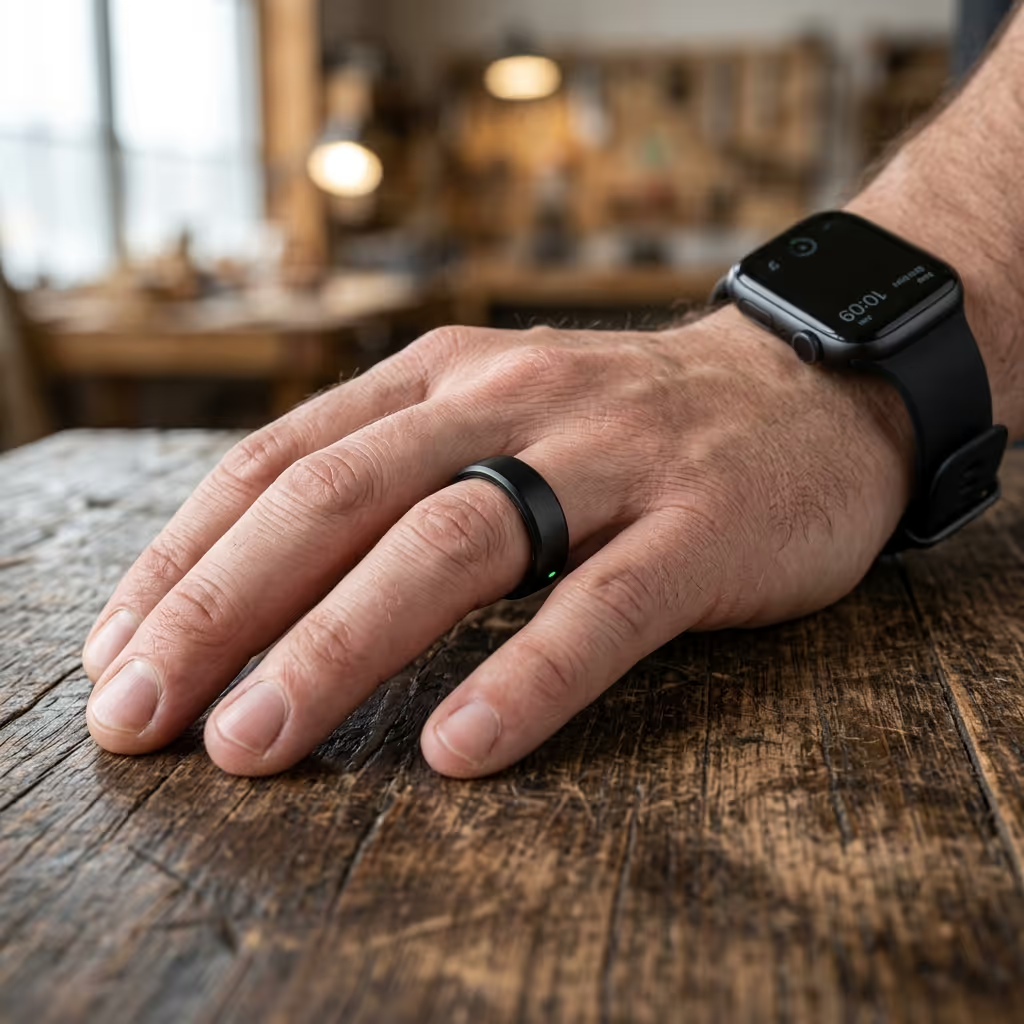
A growing trend among 2026 biohackers is the Hybrid Approach. They wear a Smart Ring (e.g., Oura or Ultrahuman) 24/7 on their finger to capture the highest-fidelity sleep, HRV, and recovery data. Simultaneously, they wear a Traditional, Non-Smart Watch or a Simple Fitness Band on their wrist for timekeeping and perhaps basic activity tracking, without the distraction and sleep-compromising bulk of a full smartwatch. This strategy provides the best of both worlds: uncompromised nocturnal data and daytime simplicity or style.
OPTIMIZING sleep DATA ACCURACY: BEST PRACTICES FOR wearables
Regardless of whether you choose a ring or a watch, adhering to a few best practices can significantly improve the quality and consistency of your sleep data.
- Ensure Proper Fit: A ring should be snug on the finger, but not uncomfortably tight. It should not spin freely or slide off easily. The sensor should be positioned on the palmar (underside) of the finger. A watch should be worn snugly, about one finger-width above the wrist bone, to ensure good optical contact without restricting blood flow.
- Keep Firmware and App Updated: Manufacturers continuously refine their sleep staging algorithms. Ensure your device's firmware and companion app are running the latest versions.
- Charge During the Day: Establish a routine of charging your device while you shower, work at your desk, or prepare for bed, rather than overnight, to ensure complete sleep data capture.
- Be Consistent: Wear the device every night to establish a robust, personal baseline. Sporadic use provides limited actionable insight.
- Clean the Sensors Regularly: Oils, sweat, and dead skin can accumulate on the optical sensors, degrading signal quality. Gently clean the sensors with a soft, slightly damp cloth once or twice a week.
- Understand the Limitations: No consumer wearable is a medical device. If you suspect a serious sleep disorder like sleep apnea or chronic insomnia, consult a sleep specialist for a proper diagnostic PSG study. Use wearables for health optimization and trend tracking, not for self-diagnosis of medical conditions.
Conclusion: The Finger Reigns Supreme for Nocturnal Insight
In the 2026 landscape of wearable technology, the form factor you choose is a powerful predictor of the data fidelity you will receive, particularly during the critical nocturnal hours when recovery and adaptation occur. While smartwatches offer unparalleled daytime utility, connectivity, and a rich suite of features, they make a fundamental compromise: the wrist is simply an inferior anatomical site for the precise, low-noise photoplethysmography required for accurate sleep staging and HRV analysis. The smart ring, by embracing the physiological advantages of the finger, the dense vascular bed, the stable position, and the minimal motion artifact, has emerged as the undisputed champion of sleep and recovery tracking.
The validation data against gold-standard polysomnography is clear and consistent: leading smart rings achieve higher agreement rates for sleep/wake detection and multi-stage sleep classification than their wrist-worn counterparts. For the 2026 biohacker, for whom deep, restorative sleep is the bedrock of cognitive performance, metabolic health, and longevity, the choice of a dedicated nocturnal wearable is an investment in actionable, high-quality data. While the hybrid approach of ring plus traditional watch offers an elegant solution, if forced to choose a single device for optimizing sleep architecture and understanding autonomic recovery, the finger reigns supreme.
Ultimately, the most accurate sleep tracker is the one you will wear consistently and comfortably every single night. For a rapidly growing number of discerning users, that device is a sleek, unassuming band of titanium circling their finger, silently decoding the secrets of their slumber with a precision that the watch on their wrist can only aspire to.
Peer-Reviewed Validation Studies & Extended Reading:
- Oura Ring Validation Against PSG (Multi-Stage): de Zambotti, M., Rosas, L., Colrain, I. M., & Baker, F. C. (2019). "The sleep of the Ring: Comparison of the ŌURA sleep Tracker Against Polysomnography." Behavioral sleep Medicine, 17(2), 124-136. Read Validation Study
- Apple Watch sleep Staging Accuracy: Walch, O., Huang, Y., Forger, D., & Goldstein, C. (2019). "sleep stage prediction with raw acceleration and photoplethysmography heart rate data derived from a consumer wearable device." sleep, 42(12), zsz180. Read Study
- Comparative Review of Wearable sleep Trackers: Chinoy, E. D., Cuellar, J. A., Huwa, K. E., et al. (2021). "Performance of seven consumer sleep-tracking devices compared with polysomnography." sleep, 44(5), zsaa291. Read Comparative Study
- PPG Signal Quality: Finger vs. Wrist: Longmore, S. K., Lui, G. Y., Naik, G., et al. (2019). "A Comparison of Reflective Photoplethysmography for Detection of Heart Rate, Blood Oxygen Saturation, and Respiration Rate at Various Anatomical Locations." Sensors, 19(8), 1874. Read PPG Study
- HRV Accuracy from Wearable PPG: Georgiou, K., Larentzakis, A. V., Khamis, N. N., et al. (2018). "Can Wearable Devices Accurately Measure Heart Rate Variability? A Systematic Review." Folia Medica, 60(1), 7-20. Read Systematic Review
- Ultrahuman Ring Air Validation (Preprint/White Paper): Ultrahuman. (2025). "Validation of the Ultrahuman Ring Air for sleep and Activity Tracking." Ultrahuman Research. (Refer to manufacturer's published validation data).