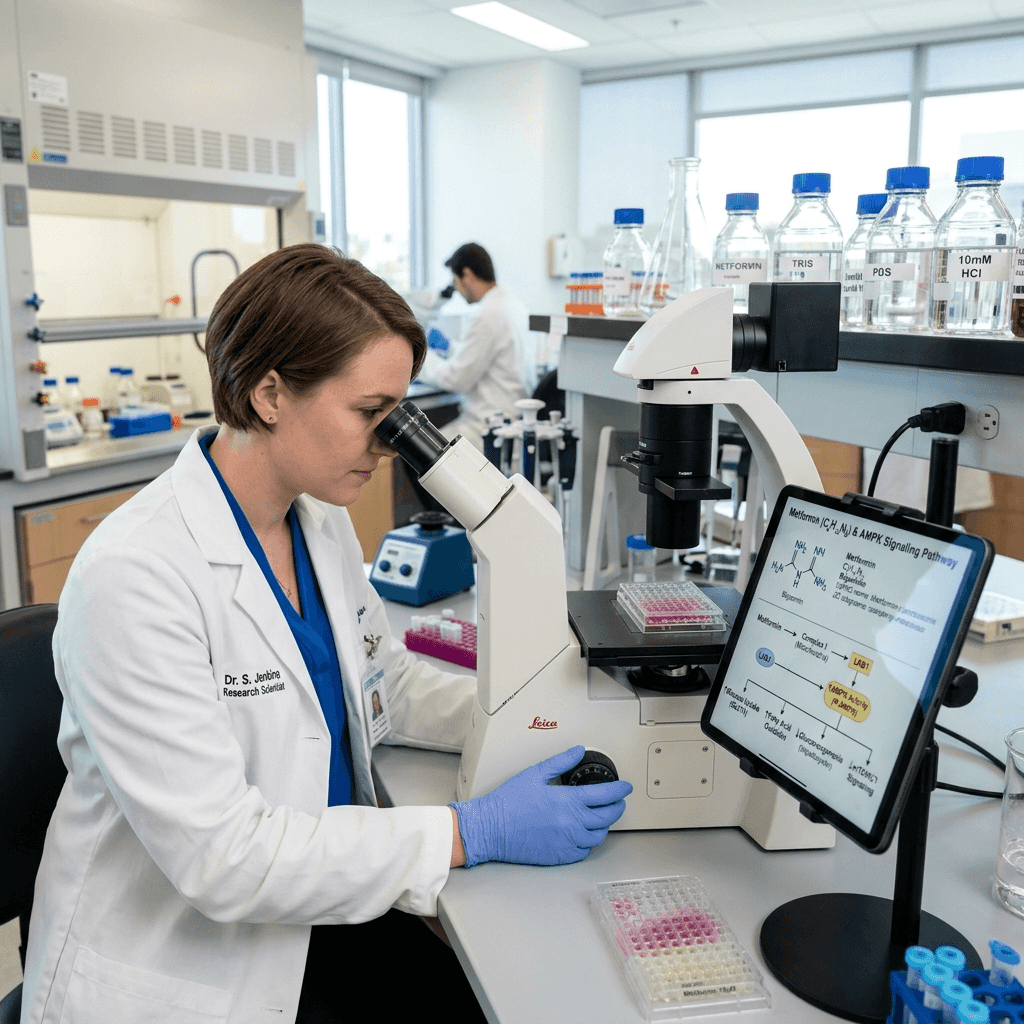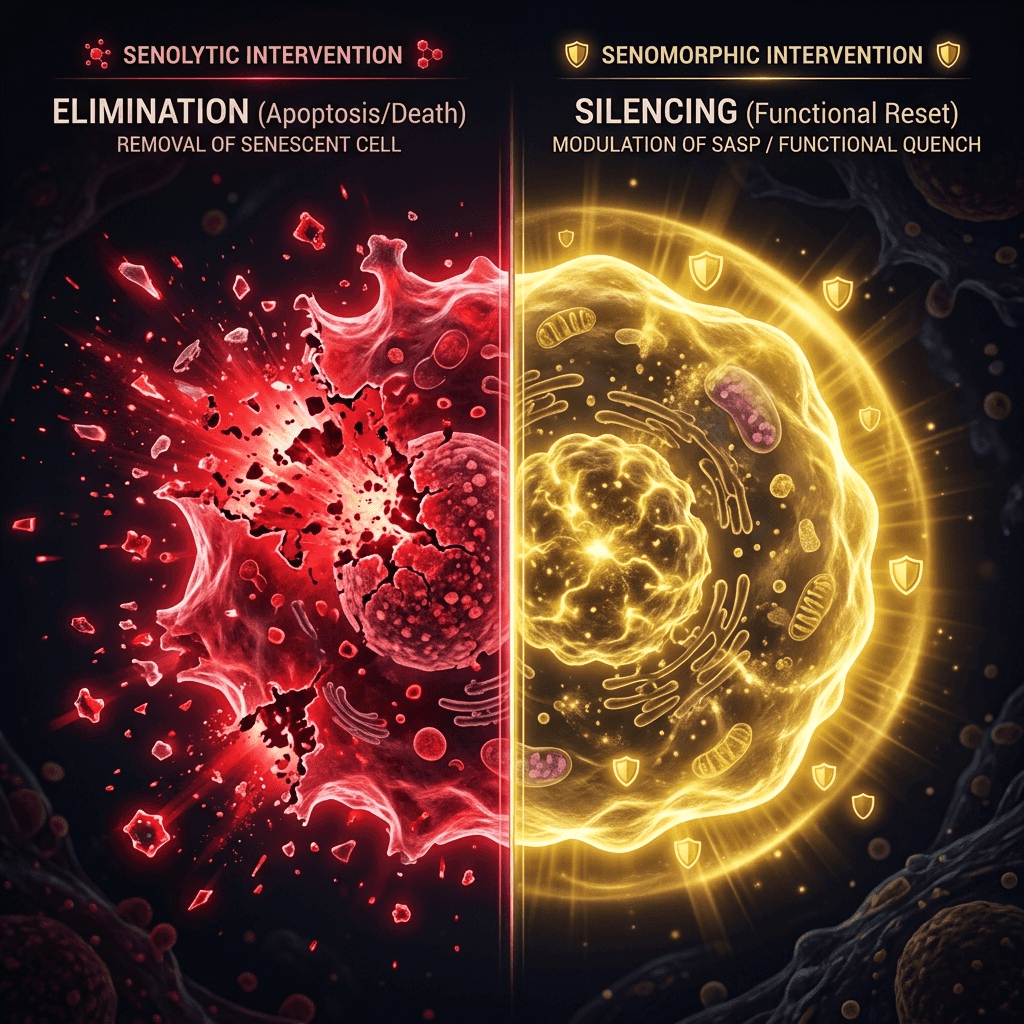
"Killing 'zombie cells' with senolytics was the first strike in the war against aging. But what if we don't need to kill them? Senomorphics represent a more elegant, targeted strategy: silencing the toxic inflammatory signals of senescent cells without the collateral damage of widespread apoptosis. In 2026, the smart money is on modulation, not just elimination."
Senomorphics vs. Senolytics: 2026 Core Pillars
-
1.
Senolytics (The Eliminators): Compounds like Dasatinib + Quercetin, Fisetin, and Navitoclax selectively induce apoptosis in senescent cells, physically removing them from tissues. This is a powerful, but potentially harsh, "search and destroy" approach.
-
2.
Senomorphics (The Silencers): Compounds like Rapamycin, Metformin, and Resveratrol don't necessarily kill senescent cells. Instead, they suppress the Senescence-Associated Secretory Phenotype (SASP), the toxic cocktail of inflammatory cytokines, chemokines, and proteases that senescent cells secrete.
-
3.
The SASP as a Therapeutic Target: The SASP drives chronic inflammation, tissue dysfunction, and even promotes cancer. Silencing the SASP with senomorphics may provide many of the benefits of senolytics with a superior long-term safety profile.
-
4.
Combination Strategies: The future of senotherapeutic intervention likely involves a "hit-and-run" approach: intermittent pulses of senolytics to reduce senescent cell burden, combined with continuous, low-dose senomorphics to keep the SASP of remaining cells suppressed.
-
5.
mTOR as a Central Senomorphic Hub: The mTOR pathway is a master regulator of the SASP. Rapamycin, by inhibiting mTORC1, is arguably the most potent and well-studied senomorphic agent available today.
The discovery that senescent cells, often termed "zombie cells," accumulate in tissues with age and actively drive the aging process through their pro-inflammatory secretome (the SASP) was one of the most transformative breakthroughs in geroscience of the past two decades. This realization ignited a global race to develop Senotherapeutics, drugs and natural compounds capable of targeting these harmful cells. The first wave of this revolution focused almost exclusively on Senolytics, agents designed to selectively kill senescent cells, thereby reducing their absolute number and the total SASP burden. Landmark studies in mice demonstrated that clearing senescent cells could extend lifespan, improve physical function, and reverse or delay multiple age-related diseases. This sparked immense excitement and a surge of self-experimentation within the Biohacking community, with compounds like Fisetin and the Dasatinib+Quercetin cocktail becoming household names.
However, as the field has matured, a more nuanced perspective has emerged. Indiscriminately killing all senescent cells may not always be desirable. Some senescent cells play beneficial, transient roles in wound healing, tissue remodeling, and embryonic development. Plus, the long-term consequences of repeated, potent senolytic pulses in healthy humans are still unknown. This has paved the way for the second wave of senotherapeutics: Senomorphics. These are compounds that don't necessarily kill senescent cells, but instead act as "silencers," modulating their behavior and suppressing the deleterious SASP without eliminating the cells themselves. In 2026, the conversation has shifted from a binary "kill or be killed" mentality to a more sophisticated, multi-pronged strategy of Senotherapeutic Modulation, balancing the power of senolytics with the elegance and potential safety of senomorphics. This treatise will dissect the biology of cellular senescence, compare and contrast the mechanisms and evidence for leading senolytic and senomorphic agents, and provide a rational framework for integrating these powerful tools into a personalized longevity protocol.
THE TWO FACES OF SENESCENCE: THE ZOMBIE CELL AND ITS TOXIC SECRETOME
Cellular senescence is a complex stress response, originally evolved as a potent tumor suppressor mechanism. When a cell experiences significant, irreparable damage (e.g., DNA double-strand breaks, telomere attrition, oncogene activation, oxidative stress), it can enter a state of permanent, irreversible cell cycle arrest. It stops dividing, effectively preventing a potentially cancerous cell from proliferating. This is the beneficial, protective face of senescence. However, unlike apoptotic cells which are neatly cleared by the immune system, senescent cells linger. They become highly metabolically active and develop a characteristic and destructive phenotype: the Senescence-Associated Secretory Phenotype (SASP).
The SASP is a complex and dynamic cocktail of secreted factors, including pro-inflammatory cytokines (IL-6, IL-8, TNF-α), chemokines (MCP-1, Gro-α), growth factors (TGF-β, VEGF), and matrix-degrading proteases (MMPs). While the SASP may initially serve to recruit immune cells for clearance and promote local tissue repair, its chronic, unrelenting production by accumulating senescent cells becomes a primary driver of aging and age-related pathology. The SASP fuels chronic, low-grade systemic inflammation ("inflammaging"), disrupts the function of neighboring healthy cells (paracrine senescence), degrades the extracellular matrix, impairs stem cell niches, and can even promote the growth and metastasis of nearby cancer cells. The goal of both senolytics and senomorphics is to neutralize this SASP-driven damage, albeit through different mechanisms.
Key Components of the Senescence-Associated Secretory Phenotype (SASP)
Pro-Inflammatory Cytokines
IL-6, IL-8, IL-1β, TNF-α. Drive systemic inflammation, insulin resistance, and neurodegeneration.
Chemokines
MCP-1, Gro-α, CXCL1. Attract immune cells, but can also promote chronic inflammation and tissue damage.
Growth Factors
TGF-β, VEGF, HGF. Promote fibrosis, aberrant angiogenesis, and can stimulate nearby precancerous cells.
Matrix Metalloproteinases (MMPs)
MMP-1, MMP-3, MMP-9. Degrade the extracellular matrix, contributing to tissue stiffness, wrinkles, and osteoarthritis.
Extracellular Vesicles (EVs)
Small vesicles containing miRNAs, proteins, and lipids that can spread senescence to neighboring cells.
SENOLYTICS: THE "SEARCH AND DESTROY" ARSENAL
Senolytics are compounds that selectively induce apoptosis (programmed cell death) in senescent cells, while sparing healthy, proliferating cells. They target the specific pro-survival and anti-apoptotic pathways that senescent cells upregulate to avoid their own death. The first-generation senolytics were discovered through bioinformatic analysis of these senescent-cell anti-apoptotic networks (SCAPs). The most well-studied and widely used senolytics in 2026 include:
Dasatinib + Quercetin (D+Q)
This combination was the first senolytic cocktail to demonstrate robust efficacy in clearing senescent cells and alleviating age-related dysfunction in mice. Dasatinib is a tyrosine kinase inhibitor (originally a cancer drug) that targets ephrin receptors and SRC kinases. Quercetin is a natural flavonoid found in apples, onions, and capers that targets PI3K/AKT, BCL-2, and other pathways. Together, they exhibit a broader spectrum of senolytic activity than either alone. The first-in-human pilot studies of intermittent D+Q (e.g., 3 days of dosing, repeated every 2-4 weeks) in patients with idiopathic pulmonary fibrosis (IPF) and diabetic kidney disease showed promising results, improving physical function and reducing senescent cell burden and SASP markers. However, Dasatinib is a potent prescription drug with significant side effects (e.g., pleural effusion, myelosuppression), making it unsuitable for unsupervised, long-term use by healthy individuals.
Fisetin
Fisetin is a naturally occurring flavonol found in strawberries, apples, persimmons, and onions. It has emerged as the most popular and accessible senolytic within the Biohacking community. it's a potent inhibitor of the BCL-2 family of anti-apoptotic proteins and also suppresses the PI3K/AKT/mTOR pathway. Fisetin has a favorable safety profile and is available as an over-the-counter dietary supplement. The Mayo Clinic's ongoing clinical trials (e.g., the ACT and AFFIRM-LITE studies) are evaluating high-dose, intermittent fisetin (~20 mg/kg/day for 2-3 consecutive days, repeated monthly) for reducing frailty and inflammation in older adults. Preliminary results are encouraging, showing reductions in SASP markers and improved functional measures. The "Fisetin pulse" protocol (e.g., 1-2 grams per day for 2-3 days, once a month) is a cornerstone of many 2026 longevity stacks.
Navitoclax (ABT-263)
Navitoclax is a potent, synthetic inhibitor of BCL-2 and BCL-xL, key anti-apoptotic proteins. it's a highly effective senolytic in preclinical models but has a major dose-limiting toxicity: severe, transient thrombocytopenia (drop in platelet count) and neutropenia. This makes it unsuitable for healthy aging applications, though it's being explored in oncology and for severe senescence-driven diseases.
| Senolytic Agent | Mechanism of Action | Typical Human Protocol | Safety Profile / Accessibility |
|---|---|---|---|
| Dasatinib + Quercetin | Inhibits tyrosine kinases (Dasatinib) and PI3K/AKT/BCL-2 (Quercetin) | 100mg Dasatinib + 1000mg Quercetin for 3 days, every 2-4 weeks | Rx only; significant side effect risk; not for unsupervised use |
| Fisetin | Inhibits BCL-2/BCL-xL and PI3K/AKT/mTOR | 20 mg/kg/day (~1.5-2g) for 2-3 days, monthly | OTC supplement; generally well-tolerated; GI upset at high doses |
| Navitoclax (ABT-263) | Potent BCL-2/BCL-xL inhibitor | Not established for healthy aging | Severe thrombocytopenia; investigational only |
| Piperlongumine | Increases ROS, inhibits GSTP1 | Under investigation; limited human data | Natural compound; safety profile not well-characterized |
SENOMORPHICS: THE "SILENCERS" OF THE SASP
Senomorphics represent a fundamentally different, and potentially more subtle and sustainable, approach to managing the senescent cell burden. Instead of killing senescent cells, they act as SASP Inhibitors, dampening the production and secretion of the harmful inflammatory and proteolytic factors without necessarily inducing apoptosis. This strategy avoids the potential risks associated with widespread cell death, such as tissue damage or the release of intracellular DAMPs (damage-associated molecular patterns) that could trigger inflammation. Many of the most promising longevity compounds, which were initially studied for other mechanisms, are now recognized as potent senomorphics.
Rapamycin (Sirolimus)
Rapamycin, the prototypical mTORC1 inhibitor, is arguably the most powerful and well-characterized senomorphic agent. The mTOR pathway is a central integrator of nutrient and growth factor signaling. Its chronic activation drives cellular senescence and is a master regulator of the SASP. By inhibiting mTORC1, rapamycin not only extends lifespan and healthspan across species but also profoundly suppresses the SASP in senescent cells. This includes reducing the secretion of IL-6, IL-8, and other key inflammatory mediators. Critically, rapamycin can achieve this senomorphic effect at low, intermittent doses that minimize the metabolic side effects associated with continuous, high-dose immunosuppression. The weekly rapamycin pulse (e.g., 3-6 mg once weekly) is a foundational senomorphic strategy for many 2026 biohackers.
Metformin
Metformin, the widely prescribed anti-diabetic drug, exerts pleiotropic effects, including the inhibition of mitochondrial Complex I, activation of AMPK, and reduction of hepatic gluconeogenesis. it's also a robust senomorphic agent. Metformin inhibits the NF-κB pathway, a key transcription factor driving SASP gene expression, and reduces the production of pro-inflammatory cytokines by senescent cells. Its excellent long-term safety profile and low cost make it an attractive, accessible senomorphic for continuous, daily use.
Resveratrol and Other Sirtuin Activators
Resveratrol, a polyphenol found in red grapes and wine, is a well-known activator of SIRT1, a longevity-associated deacetylase. SIRT1 activation has been shown to suppress the SASP, in part by deacetylating and inhibiting NF-κB. Other SIRT1 activators, such as Pterostilbene, and NAD+ precursors (NMN, NR), which boost SIRT1 activity, also exert senomorphic effects.
Other Notable Senomorphics
A growing list of compounds, many of them natural products, exhibit senomorphic properties. These include Curcumin (inhibits NF-κB), Apigenin (flavonoid), EGCG (from green tea), and Sulforaphane (activates Nrf2). These compounds are often included in longevity stacks for their broad anti-inflammatory and health-promoting effects.
Key Senomorphic Agents and Their SASP-Suppressing Mechanisms
Rapamycin
mTORC1 inhibition → suppresses NF-κB and IL-1α translation; broad SASP suppression.
Metformin
AMPK activation → inhibits NF-κB; reduces IL-6, IL-8, and TNF-α secretion.
Resveratrol
SIRT1 activation → deacetylates and inhibits NF-κB; reduces SASP.
Curcumin
Direct NF-κB inhibitor; reduces multiple SASP components.
Sulforaphane
Nrf2 activator → upregulates antioxidant genes; indirectly suppresses SASP.
JAK Inhibitors
Block JAK/STAT signaling → potent SASP suppression (e.g., Ruxolitinib).
THE SYNERGY: COMBINING SENOLYTICS AND SENOMORPHICS FOR MAXIMAL EFFECT
The most sophisticated longevity protocols in 2026 don't view senolytics and senomorphics as mutually exclusive options. Instead, they are strategically combined in a "hit-and-run" or "pulse and maintain" approach.
- Senolytic Pulse (The "Hit"): A short, intense course of a senolytic agent (e.g., Fisetin at 20 mg/kg/day for 2-3 days) is administered periodically (e.g., once every 4-8 weeks). The goal is to physically eliminate a significant fraction of the accumulated senescent cell burden. This provides a "reset," reducing the total number of SASP-producing factories.
- Senomorphic Maintenance (The "Run"): Between senolytic pulses, the individual maintains a continuous, low-dose regimen of senomorphic agents (e.g., weekly rapamycin, daily metformin, daily resveratrol). This keeps the SASP of any remaining or newly-formed senescent cells suppressed, preventing the re-accumulation of inflammatory damage and maintaining a more youthful signaling environment.
This combination strategy is theoretically appealing because it addresses both the quantity and the quality (activity) of the senescent cell pool. The senolytic pulse reduces the number of cells that could potentially cause harm, while the senomorphic maintenance ensures that those that remain are in a quiescent, non-inflammatory state. Early preclinical studies suggest that this combined approach is more effective than either strategy alone for extending healthspan and preventing age-related diseases. The optimal timing, dosing, and specific agents for this combination therapy are active areas of investigation and personal n=1 experimentation within the Biohacking community.
Biohacker Pro-Tip: Monitoring the SASP and Senescent Burden
Directly measuring the number of senescent cells in living human tissues is currently impossible outside of a research setting. However, several circulating biomarkers can serve as useful proxies for SASP activity and overall senescent burden. These include hs-CRP, IL-6, TNF-α, PAI-1, MMP-9, and TGF-β. Tracking these markers before, during, and after senolytic pulses or during chronic senomorphic therapy can provide objective feedback on the efficacy of the intervention. A reduction in these inflammatory markers is a strong indication that the senotherapeutic strategy is working. Advanced epigenetic clocks, such as GrimAge, which are heavily weighted toward inflammatory and immune markers, can also provide a more integrated measure of the systemic effect.
SAFETY, RISKS, AND THE UNKNOWNS OF LONG-TERM SENOTHERAPY
While the potential of senotherapeutics is immense, it's critical to acknowledge the significant unknowns and potential risks, particularly with long-term, unsupervised use in healthy individuals.
- Senolytics and Tissue Damage: Widespread apoptosis, even if selective, could theoretically overwhelm the clearance capacity of the immune system, leading to the release of intracellular DAMPs and triggering transient inflammation. This "cytokine release syndrome" is a known side effect of some potent senolytics (e.g., Navitoclax) but is generally mild or absent with Fisetin.
- Impaired Wound Healing and Regeneration: Senescent cells play a transient, beneficial role in the early stages of wound healing and tissue remodeling. Aggressive, continuous senolytic therapy could potentially impair these processes, leading to delayed wound closure or impaired recovery from injury. This is a key rationale for the intermittent, "hit-and-run" dosing strategy.
- Off-Target Effects: No senolytic or senomorphic agent is perfectly selective. They can affect healthy cells and other physiological pathways. Rapamycin's metabolic effects (impaired glucose tolerance, dyslipidemia) are well-known, though largely mitigated by low, intermittent dosing. Metformin can cause GI distress and, rarely, lactic acidosis. Long-term consequences are still being elucidated.
- Long-Term Cancer Risk? While the SASP is pro-tumorigenic and reducing it should lower cancer risk, the long-term effects of manipulating fundamental cellular pathways like apoptosis (senolytics) and mTOR (senomorphics) on cancer incidence are not fully known. Vigilance and regular cancer screening are prudent.
THE 2026 SENOTHERAPEUTIC TOOLKIT: A STRATIFIED APPROACH
Given the current evidence, the following stratified approach provides a rational framework for the 2026 biohacker considering senotherapeutic interventions.
| Risk Profile / Goal | Recommended Senotherapeutic Strategy | Agents & Protocol |
|---|---|---|
| Healthy, Aging Adult (50+); General Healthspan Optimization | Senomorphic Maintenance | Weekly rapamycin (3-6 mg), daily metformin (if tolerated), daily resveratrol/NMN. |
| Evidence of Elevated SASP/Inflammation; Frailty Risk | Senomorphic Maintenance + Quarterly Senolytic Pulse | Add Fisetin pulse (1.5-2g/day x 2-3 days) every 4-8 weeks to the senomorphic base. |
| Diagnosed Senescence-Driven Disease (e.g., IPF, Osteoarthritis, DKD) | Aggressive Senolytic Therapy (under medical supervision) | Consider D+Q or other potent senolytics in a clinical trial or under specialist care. |
| Young, Healthy Adult (<40) with Low Inflammatory Markers | Focus on Senescence Prevention | Prioritize lifestyle (exercise, fasting, sleep) and foundational supplements (Omega-3, Mg). Senotherapeutics likely unnecessary and potentially counterproductive. |
Conclusion: From Killing Zombies to Silencing the Horde
The field of senotherapeutics has matured dramatically over the past five years. We have moved from the initial, exhilarating discovery that we can selectively kill senescent cells to a more nuanced understanding that these "zombie cells" are not a monolithic, uniformly harmful population. The SASP is the true enemy, and our arsenal now includes both the heavy artillery of senolytics and the more precise, sustainable tools of senomorphics. In 2026, the most enlightened approach to managing the senescent cell burden is not an "either/or" proposition, but a strategic integration of both. Intermittent senolytic pulses can reset the cellular landscape, while continuous, low-dose senomorphic therapy can maintain a state of SASP suppression and inflammatory calm.
For the healthy biohacker seeking to optimize healthspan, the emphasis should be on the safe, well-tolerated, and increasingly validated senomorphic agents, particularly low-dose, intermittent rapamycin, and the foundational lifestyle practices that prevent senescence in the first place. Senolytics like Fisetin represent a powerful, but more intense, periodic intervention that may be reserved for times of higher perceived risk or as a targeted "reset." As always, personalization based on biomarkers (inflammatory markers, epigenetic clocks), risk tolerance, and careful n=1 experimentation is paramount. The war on aging has entered a new, more sophisticated phase. We are learning not just to kill the zombies, but to silence their toxic influence and restore a more youthful, harmonious cellular society.
Peer-Reviewed Clinical Validations & Extended Foundational Reading:
- Senolytics in Humans (Dasatinib + Quercetin): Justice, J. N., Nambiar, A. M., Tchkonia, T., et al. (2019). "Senolytics in idiopathic pulmonary fibrosis: Results from a first-in-human, open-label, pilot study." EBioMedicine, 40, 554-563. Read First-in-Human Study
- Fisetin as a Senotherapeutic (Review and Trial Design): Kirkland, J. L., & Tchkonia, T. (2020). "Senolytic drugs: from discovery to translation." Journal of Internal Medicine, 288(5), 518-536. Read Review
- Rapamycin as a Senomorphic/SASP Inhibitor: Laberge, R. M., Sun, Y., Orjalo, A. V., et al. (2015). "MTOR regulates the pro-tumorigenic senescence-associated secretory phenotype by promoting IL1A translation." Nature Cell Biology, 17(8), 1049-1061. Read Mechanistic Study
- Metformin and SASP Suppression: Moiseeva, O., Deschênes-Simard, X., St-Germain, E., et al. (2013). "Metformin inhibits the senescence-associated secretory phenotype by interfering with IKK/NF-κB activation." Aging Cell, 12(3), 489-498. Read Study
- SASP and Inflammaging: Franceschi, C., & Campisi, J. (2014). "Chronic inflammation (inflammaging) and its potential contribution to age-associated diseases." The Journals of Gerontology: Series A, 69(Suppl_1), S4-S9. Read Review
- Combination Senolytic and Senomorphic Strategies (Preclinical): Xu, M., Pirtskhalava, T., Farr, J. N., et al. (2018). "Senolytics improve physical function and increase lifespan in old age." Nature Medicine, 24(8), 1246-1256. Read Preclinical Study