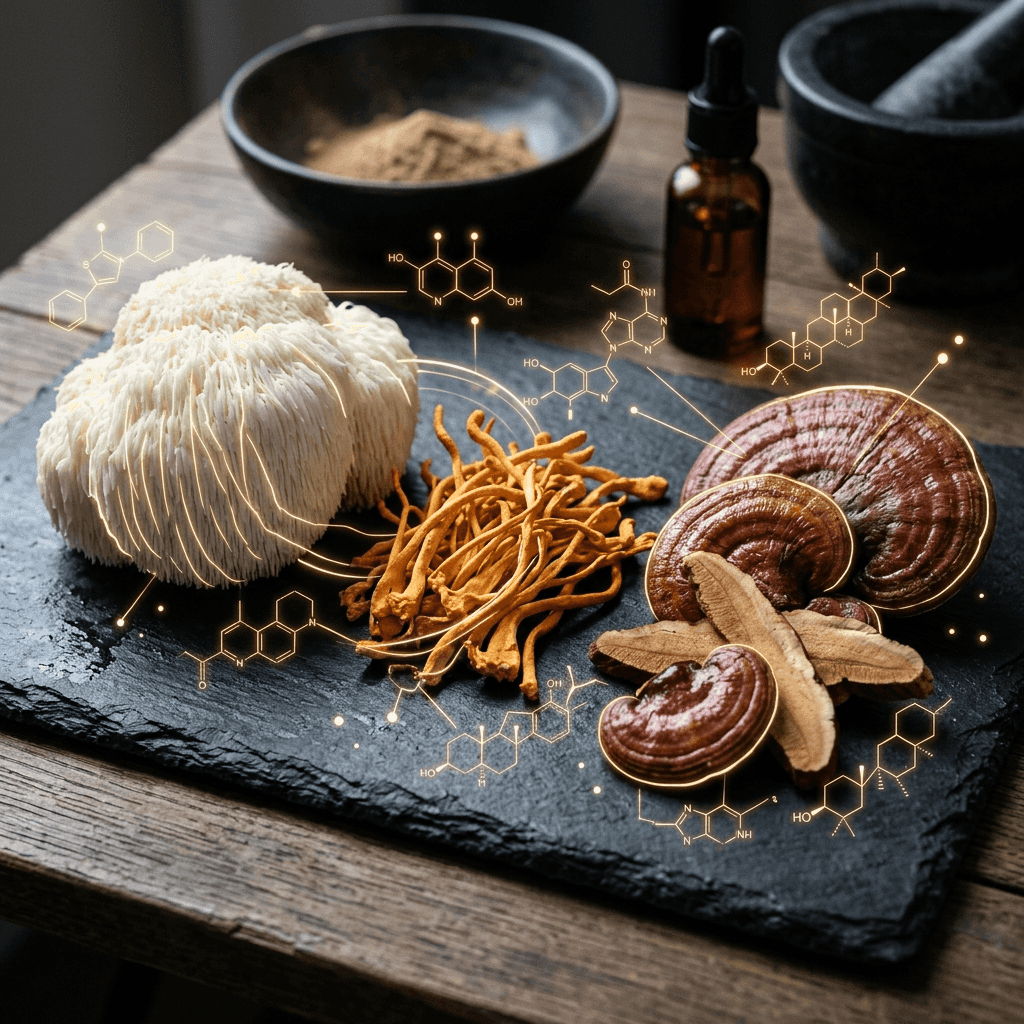
"Functional mushrooms act as biological adaptogens. Stacking specific fungi provides a dual-extraction strategy that simultaneously stimulates BDNF, boosts mitochondrial respiration, and calms HPA stress receptors."
Key Takeaways
-
1.
Neurogenesis Activation: Lion's Mane contains hericenones and erinacines that cross the blood-brain barrier to trigger NGF and BDNF synthesis.
-
2.
ATP and VO2 Max Up-regulation: Cordyceps increases oxygen utilization, enhances mitochondrial ATP synthesis, and speeds up lactate clearance.
-
3.
Endocrine Balance: Reishi blunts excessive cortisol surges, regulates HPA axis sensitivity, and improves slow-wave sleep.
-
4.
The Dual-Extraction Mandate: Only dual-extracted (water and alcohol) mushroom powders capture both water-soluble beta-glucans and alcohol-soluble triterpenoids.
Medicinal mushrooms represent one of the most powerful natural biohacks in functional nutrition. While standard supplements often focus on isolated synthetic chemicals, adaptogenic fungi contain a complex matrix of bioactive compounds—including polysaccharides, beta-glucans, triterpenoids, and nucleosides—that work in harmony to regulate human physiology. By stacking specific species like Lion's Mane, Cordyceps, and Reishi, biohackers can target multiple systems simultaneously: driving neurogenesis, enhancing cellular energy, and balancing the endocrine stress response. This holistic approach addresses the metabolic, neurological, and immunological baselines of longevity, helping prevent chronic organ decline.
Functional mushrooms operate as true adaptogens. This means they do not force a bodily response in a single direction; instead, they work homeostatically to normalize physiological function. If cortisol is too high, adaptogens help lower it; if immune activity is depressed, they stimulate it. This chemical complexity is a result of millions of years of fungal evolution. To successfully stack functional fungi, we must understand the specific molecular mechanisms of each species, their optimal extractions, and circadian scheduling protocols, making the transition from speculative supplementation to data-driven biology, optimizing healthspan.
Lion's Mane (Hericium erinaceus): The Cognitive Regenerator
Lion's Mane is a unique, shaggy mushroom resembling a white waterfall of icicles. In clinical biohacking, it is utilized primarily for its neuroprotective and cognitive-enhancing properties. Standard nootropics like caffeine work by temporarily altering neurotransmitter activity, providing a short-lived focus boost followed by a crash. Lion's Mane, however, targets the structural integrity of the brain itself by stimulating neurogenesis—the growth and repair of brain cells. This supports long-term memory formation, neural plasticity, and cognitive recovery.
This neurogenic effect is driven by two classes of active compounds: hericenones, found in the mushroom's fruiting body, and erinacines, concentrated in the root-like mycelium. These low-molecular-weight molecules successfully cross the blood-brain barrier and stimulate the synthesis of Nerve Growth Factor (NGF) and Brain-Derived Neurotrophic Factor (BDNF) via the MAPK/ERK pathway in the dentate gyrus of the hippocampus. NGF is a protein vital for the survival, maintenance, and growth of sensory and cholinergic neurons. By promoting NGF, Lion's Mane supports myelin sheath health—the protective sleeve around nerve fibers—improving signal transmission speeds and protecting against age-related cognitive decline, showing deep clinical utility in reversing brain fog.
Furthermore, the activation of the MAPK/ERK (Mitogen-Activated Protein Kinase/Extracellular Signal-Regulated Kinase) pathway by erinacines triggers a phosphorylation cascade that activates transcription factors in the cell nucleus. This up-regulates the genes responsible for neural growth, axon elongation, and synaptic plasticity. This structural remodeling has been shown to improve spatial mapping and associative learning in animal models, offering a promising therapy for cognitive decline.
Biohacker Pro-Tip: Fruiting Body vs. Mycelium on Grain
Avoid supplements that list "Mycelium on Grain" (MOG) or "Oat Biomass" in their ingredients. These products are grown on sterile grains, resulting in a product that is up to 60-70% starch (filler) and very low in active beta-glucans. Only purchase products containing 100% hot-water-extracted fruiting bodies.
Cordyceps (Cordyceps militaris): The Mitochondrial Powerhouse
Cordyceps is an adaptogenic fungus that, in nature, grows on insects in high-altitude regions, though clinical extracts are cultivated on organic grain bases. In biohacking, Cordyceps is the ultimate physical performance adaptogen. Its primary active compound is cordycepin (3'-deoxyadenosine), a molecular analog of adenosine. Because of its structural similarity to adenosine, the body easily utilizes cordycepin to accelerate the synthesis of adenosine triphosphate (ATP)—the fundamental energy currency of our cells, bypassing standard rate-limiting metabolic steps, promoting mitochondrial health.
Upregulating ATP synthesis has a direct impact on physical and cardiovascular metrics. Clinical studies show that continuous Cordyceps supplementation increases VO2 Max (the maximum amount of oxygen an athlete can utilize during intense exercise) and improves the ventilatory threshold. It also activates AMPK (adenosine monophosphate-activated protein kinase) and stimulates endothelial nitric oxide synthase (eNOS), dilating blood vessels and accelerating lactic acid clearance, which delays the onset of muscle fatigue during endurance tasks. By enhancing mitochondrial respiration, Cordyceps provides clean, non-stimulatory cellular energy, making it an excellent pre-workout or morning cognitive focus booster, supporting skeletal muscle cells.
At the mitochondrial level, cordycepin triphosphate acts as an analog of ATP. When cellular kinases phosphorylate cordycepin, it interacts with mitochondrial complex I and complex IV of the electron transport chain. This improves the flow of electrons, reducing the leakage of reactive oxygen species (ROS) and increasing the membrane potential. The resulting increase in ATP output provides the cellular energy needed for glycogen synthesis and protein translation, enhancing physical endurance and recovery speeds.
Reishi (Ganoderma lucidum): The Endocrine Regulator
Often referred to as the "Mushroom of Immortality," Reishi is a woody, bitter bracket fungus with a shiny red cap. While Lion's Mane and Cordyceps stimulate the brain and body, Reishi acts as a biological stabilizer, regulating the immune and endocrine stress systems. Its therapeutic effects are driven by ganoderic acids—highly active triterpenoids that share structural similarities with steroid hormones, binding to glucocorticoid receptors in the HPA axis.
Reishi regulates the hypothalamic-pituitary-adrenal (HPA) axis, blunting excessive cortisol surges during chronic stress. It also interacts with the brain's GABAergic pathway, acting as an agonist at GABA-A receptors, which calms the nervous system, decreases sleep latency, and significantly increases slow-wave deep sleep. Additionally, its high concentration of beta-(1,3/1,6)-D-glucans binds to Dectin-1 receptors on macrophages, modulating the immune system and promoting the activity of natural killer (NK) cells and T-lymphocytes, protecting the body against chronic systemic inflammation. This immunomodulation prevents chronic low-grade inflammation.
The binding of Reishi's beta-glucans to Dectin-1 receptors on immune cells triggers a intracellular signaling cascade via the Syk (Spleen Tyrosine Kinase) pathway. This pathway coordinates the activation of macrophages and dendritic cells without triggering an inflammatory cytokine storm. Instead, it promotes the clearance of cellular debris and senescent cells, functioning as a natural senolytic support agent. This immune balancing action is why Reishi is prized for autoinflammatory conditions and chronic immune fatigue, stabilizing systemic biomarkers.
Mushroom Bioactive Profiles
The Morning and Afternoon Activation Stack
For morning and afternoon focus, stack Lion's Mane (NGF/BDNF activation) with Cordyceps (ATP generation). This combination targets both structural brain health and cellular energy, providing clean focus without blood pressure spikes. It is best taken with a source of healthy fats, like MCT oil or avocado, as some active triterpenoids require lipids for optimal intestinal absorption.
This stack can also be taken pre-workout to improve endurance. Cordyceps relaxes the airways (bronchial tubes), increasing oxygen utilization during intense training, while Lion's Mane keeps the mind focused on muscle recruitment patterns, maximizing motor unit signaling during lift phases, correcting posture during load bearing exercises.
The Evening Stabilization and Recovery Protocol
Reishi is best reserved for the evening. By taking it 1 to 2 hours before bed, you allow its ganoderic acids to calm your autonomic nervous system, preparing the body for sleep. It blunts late-day cortisol surges, allowing the natural melatonin curve to take over and promoting restorative deep sleep, stabilizing sleep architecture.
It also supports nocturnal immune recovery. As you sleep, your body relies on immune cells to repair tissue micro-damage. Reishi's beta-glucans optimize macrophage and natural killer cell activity during the night, ensuring you wake up fully recovered and reducing chronic cell inflammation, supporting musculoskeletal healing.
Comparing Adaptogenic Mushroom Properties
| Mushroom | Active Bio-Molecules | Primary Target | Optimal Extraction Method |
|---|---|---|---|
| Lion's Mane (Hericium erinaceus) | Hericenones & Erinacines | NGF/BDNF synthesis, neural myelination, memory retention | Dual-extraction (Water/Ethanol) |
| Cordyceps (Cordyceps militaris) | Cordycepin & Adenosine | Mitochondrial respiration, ATP generation, VO2 Max improvement | Hot water extraction |
| Reishi (Ganoderma lucidum) | Ganoderic Acids & Beta-glucans | GABA pathways, cortisol suppression, immune modulation | Dual-extraction (Water/Ethanol) |
Synergistic Adaptogenic Stacking: The Biochemistry of Co-Supplementation
When stacking Lion's Mane, Cordyceps, and Reishi, the physiological outcomes exceed the sum of their individual mechanisms. This biological synergy is driven by the interaction of different polysaccharide structures and secondary metabolites. While Lion's Mane focuses on neurogenic growth factors and Cordyceps targets mitochondrial ATP output, Reishi dampens autonomic over-arousal. By reducing systemic inflammation and lowering serum cortisol, Reishi creates a cellular environment that is highly receptive to neuroplastic changes. High levels of circulating cortisol are neurotoxic, suppressing BDNF production and inhibiting hippocampal neurogenesis. By introducing Reishi to regulate HPA axis activity, the brain can more effectively utilize the NGF and BDNF stimulated by Lion's Mane's erinacines, leading to accelerated synaptic repair and improved memory consolidation.
When stacking adaptogenic fungi, the immunological effects of these mushrooms follow a synergistic pathway. The beta-(1,3/1,6)-D-glucans found in all three fungi have slightly different molecular weights and branch structures. When co-administered, they bind to different receptors on the surface of immune cells. While Reishi beta-glucans exhibit a high affinity for Dectin-1 receptors, Cordyceps polysaccharides interact more heavily with Toll-like receptor 2 (TLR2) and TLR4. This dual binding stimulates a more comprehensive, balanced immune response. Instead of over-stimulating a single pathway, the combination helps program macrophages and natural killer cells to operate in an active, vigilant state while simultaneously secreting anti-inflammatory cytokines like IL-10. This prevents the immune system from entering a pro-inflammatory loop, which is vital for preventing the neuro-inflammation that drives brain fog and age-related brain atrophy.
Additionally, the cardiovascular and metabolic synergy of Cordyceps and Lion's Mane is significant for cognitive endurance. Cordyceps-stimulated nitric oxide production increases cerebral blood flow, dilating microcapillaries in the prefrontal cortex. This increased blood flow delivers higher amounts of glucose and oxygen to active brain tissues. Simultaneously, Lion's Mane stimulates the synthesis of acetylcholine, the primary neurotransmitter involved in focus, learning, and executive function. With more oxygen and nutrients available to support cholinergic neural activity, cognitive processing speed increases and mental fatigue is delayed, allowing for extended focus during complex tasks.
Chitin Degradation and Fungal Bioavailability in the Human Gut
Understanding the biology of the human digestive system explains why raw, unextracted mushroom powders are largely ineffective. Fungal cell walls are composed of chitin—a tough, crystalline polymer of N-acetylglucosamine that is structurally similar to the shells of lobsters and crabs. Humans do not produce significant amounts of active acidic mammalian chitinase (AMCase) in the stomach to break down this matrix. Consequently, if a supplement contains simple raw mushroom powder or ground-up mycelium, the active compounds (like beta-glucans and triterpenes) remain locked inside the indigestible chitin shell, passing through the gastrointestinal tract without entering systemic circulation.
To bypass this barrier, professional extraction methods use high-pressure hot water and ethanol. Hot water extraction breaks down the chitin structure, dissolving the water-soluble beta-glucans and making them bioavailable. Alcohol extraction is then used to dissolve the hydrophobic triterpenoids, such as the ganoderic acids in Reishi or the hericenones in Lion's Mane. When a dual-extract is consumed, these pre-dissolved compounds are absorbed directly through the intestinal wall, entering the bloodstream and reaching target tissues without requiring enzymatic digestion. This is why standardized extracts are the only reliable option for clinical biohacking protocols.
Interestingly, the intestinal tract interacts with these complex mushroom fibers in a prebiotic manner. The gut microbiome ferments these complex fibers into short-chain fatty acids (SCFAs), particularly acetate, propionate, and butyrate. Butyrate is a key energy source for colonocytes and helps maintain gut barrier integrity, preventing leaky gut syndrome. Furthermore, SCFAs enter circulation and cross the blood-brain barrier, where they promote the health of microglia—the brain's resident immune cells—and stimulate the expression of BDNF in the frontal cortex. This gut-brain axis pathway works alongside the direct neurogenic mechanisms of erinacines, showing how functional mushrooms support cognitive health through multiple, interconnected biological pathways.
The Importance of Bioavailability: Dual Extraction
To get the therapeutic value from functional mushrooms, they must undergo extraction. Fungal cell walls are made of chitin—a tough, fibrous substance that humans cannot digest. If you consume raw mushroom powder, the active compounds remain locked inside the chitin walls, passing through the digestive tract unabsorbed. Extraction dissolves chitin, releasing the bio-active molecules, maximizing bioavailability.
Furthermore, different active compounds require different solvents. Beta-glucans (water-soluble polysaccharides) are isolated using hot water extraction. Triterpenes (alcohol-soluble compounds like ganoderic acids in Reishi) require ethanol/alcohol extraction. A true "dual-extracted" product combines the liquids from both extractions, concentrating all active compounds into a highly bioavailable powder or tincture. When building a mushroom stack, verify that each ingredient has undergone the correct extraction to ensure optimal biological impact, avoiding cheap single-extracted substitutes.
Dosage and timing are also critical when stacking adaptogenic fungi. A standard clinical dose ranges from 500mg to 1000mg of a concentrated 10:1 extract of each species per day. To establish a therapeutic baseline, it is highly recommended to start with a single species (such as Lion's Mane) for 7 days before introducing Cordyceps and Reishi. This sequential introduction allows you to isolate the physiological impact of each adaptogen and monitor for any idiosyncratic sensitivity. Once the baseline is established, co-supplementation can proceed. Vitamin C can be added to the stack, as it has been shown to increase the absorption of high-molecular-weight beta-glucans in the gut by breaking down the viscous polysaccharide matrix in the small intestine. Furthermore, some active compounds like triterpenes require lipid carriers for optimal intestinal absorption. Therefore, consuming your morning stack alongside healthy fats—such as extra virgin olive oil, MCT oil, or organic eggs—can significantly increase systemic bioavailability.
Timing your doses in alignment with your body's natural circadian rhythm is equally vital to maximize efficacy. Cordyceps and Lion's Mane should be scheduled during the early morning or mid-day hours when natural cortisol levels are high and cognitive demand is rising. Taking Cordyceps late in the evening can interfere with sleep onset due to its positive impact on cellular ATP synthesis and microcapillary dilation. Conversely, Reishi is highly effective when consumed 60 to 90 minutes before bed, aligning with the brain's natural transition into a parasympathetic dominance state. By implementing these structured protocols, biohackers can ensure that their mushroom stacks provide maximum biological support for their cellular, neurological, and immunological systems, avoiding useless under-dosed products and timing mismatches.
Finally, when sourcing functional mushrooms, look for third-party lab testing results. These certificates of analysis (COAs) verify the exact beta-glucan percentage (which should exceed 15-20%) and confirm the absence of heavy metals, pesticides, and microbial contaminants. High-quality extraction brands provide these reports transparently, ensuring that your longevity supplements support your health without introducing toxic chemical residues to your tissues.
Peer-Reviewed Clinical Validations & Extended Deeper Reading:
- Lion's Mane Neurogenesis: Mori et al. (2009). "Improving effects of the mushroom Yamabushitake (Hericium erinaceus) on mild cognitive impairment: a double-blind placebo-controlled clinical trial". Phytotherapy Research. Leer el estudio Clínico
- Cordyceps Exercise Performance: Hirsch et al. (2017). "Chronic supplementation of a mushroom blend on exercise performance in active adults". Journal of Dietary Supplements. Studies VO2 Max and ATP upregulation. Leer el estudio Clínico
- Reishi Adrenal Modulation: Tang et al. (2005). "A double-blind, randomized, placebo-controlled study of a Ganoderma lucidum extract in neurasthenia". Journal of Medicinal Food. Proves drop in mental fatigue and stress indexes. Leer el estudio Clínico
- NGF Stimulation Pathways: Lai et al. (2013). "Neurotrophic properties of the Lion's Mane medicinal mushroom, Hericium erinaceus from Malaysia". International Journal of Medicinal Mushrooms. Maps cellular pathways of NGF synthesis. Leer el estudio Clínico
- Immunomodulatory Beta-Glucans: Wasser (2002). "Medicinal mushrooms as a source of antitumor and immunomodulating polysaccharides". Applied Microbiology and Biotechnology. Discusses the therapeutic actions of fungal beta-glucans. Leer el estudio Clínico