"Polyphenols like curcumin and quercetin possess incredible clinical potential, but their therapeutic efficacy has been historically throttled by dismal intestinal absorption and rapid first-pass clearance. Phytosome technology represents a revolutionary leap in pharmaceutical materials science, turning these hydrophobic substances into highly bioavailable cell-penetrating structures."
Key Takeaways
-
1.
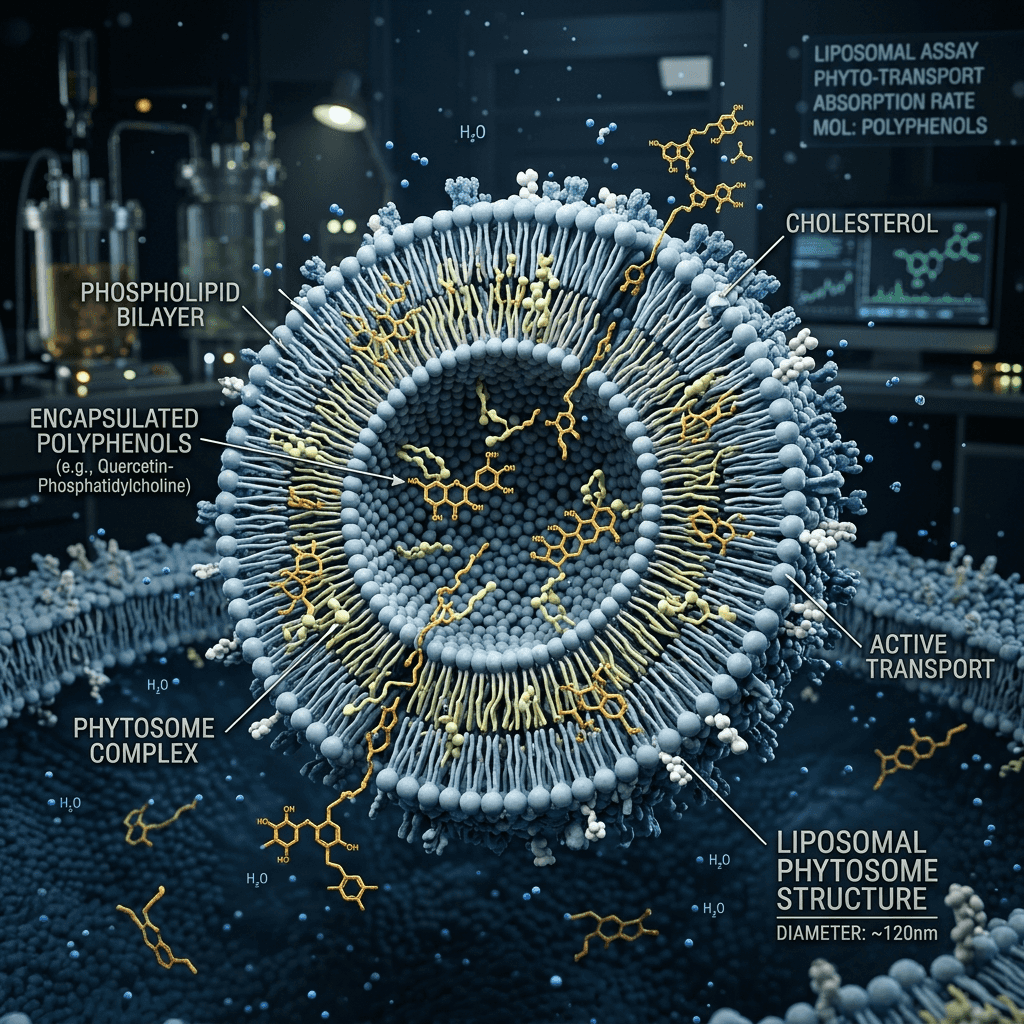
Phytosome vs. Liposome: Phytosomes create a chemical bond between the active polyphenol and the phosphatidylcholine header, whereas liposomes merely encapsulate the molecules in a water-soluble core.
-
2.
29-Fold Bioavailability: Clinical pharmacokinetic studies demonstrate that phytosome delivery increases the peak plasma concentration of curcumin by up to 29 times compared to unformulated extracts.
-
3.
Intestinal Absorption: By mimicking natural cell membrane lipids, the phytosome complex passes through the lipid bilayer of enterocytes via passive diffusion, bypassing active transport limitations.
Introduction: Cellular Context and Clinical Importance
The modern biohacker’s supplement stack is often packed with powerful anti-inflammatory compounds, but taking them orally does not guarantee they reach your target tissues. Curcumin, quercetin, resveratrol, and green tea catechins are highly prized for their ability to scavenge free radicals, modulate gene expression, and suppress pro-inflammatory pathways. However, these molecules are poorly water-soluble, highly unstable in gastric fluids, and subject to aggressive conjugation in the liver.
To overcome these barriers, researchers have turned to nanotechnology. Historically, liposomes were the primary method for lipid-based delivery. While effective, liposomes have stability issues and low loading capacities for certain hydrophobic molecules. This limitation led to the development of phytosome technology—a process where individual polyphenol molecules are complexed with phospholipids to create a single, highly stable, and easily absorbed molecule.
By molecularly linking these therapeutic plant extracts with phosphatidylcholine—the most abundant phospholipid in human cell membranes—phytosomes transform the pharmacokinetics of natural health. This guide dives deep into the biophysics of phytosomes, comparing their efficacy, examining their absorption pathways, and detailing the scientific validation behind this clinical-grade absorption biohack.
The Biophysical Mechanism: How Phytosomes Bypass the Gut Barrier
To understand how phytosomes work, we must first analyze the barrier physics of the human gastrointestinal tract. The lining of the small intestine is composed of enterocytes, which are bound together by tight junctions. The outer membrane of these enterocytes is a phospholipid bilayer—a hydrophobic barrier that restricts the passage of hydrophilic substances and large, uncharged molecules.
Unformulated curcumin is highly crystalline and lipophilic, meaning it does not dissolve well in the aqueous fluids of the gut, preventing it from interacting effectively with the mucosal surface. When it does manage to touch the enterocyte membrane, it lacks the molecular properties to pass through easily. It gets trapped, metabolized in the gut wall, or excreted before ever reaching the bloodstream.
Phytosome technology solves this by reacting the polyphenol with phosphatidylcholine in a specific solvent. The polar head of the phospholipid binds to the active hydroxyl groups of the polyphenol, while the lipophilic tails wrap around it. This creates a small, amphiphilic complex that is soluble in both water and lipids. When this complex reaches the enterocyte, the phospholipid outer shell merges with the cell membrane, allowing the polyphenol to slide directly into the cell and enter systemic circulation.
Phytosome vs. Liposome vs. Standard Extract Performance
Phytosomal Curcumin (Meriva)
Meriva is the most clinically studied phytosomal curcumin formulation. By complexing curcumin with soy-derived phosphatidylcholine at a 1:2 ratio, it achieves a dramatic increase in plasma concentration. This allows biohackers to achieve therapeutic anti-inflammatory levels with a fraction of the standard dosage.
The chemical bond between the curcumin and the phosphatidylcholine ensures the molecule remains intact through the acidic environment of the stomach, releasing the curcumin directly at the enterocyte interface.
Phytosomal Quercetin (Quercetin Phytosome)
Quercetin is a powerful senolytic and mast cell stabilizer, but standard quercetin has an oral bioavailability of less than 1%. Quercetin Phytosome increases absorption by 20-fold, allowing it to modulate histamine release and clear senescent cells effectively.
This formulation has been shown in clinical trials to maintain respiratory health and optimize athletic recovery by keeping inflammation markers within a healthy, physiological range.
Standard Polyphenol Extracts
Standard extracts are rapidly metabolized by the liver through glucuronidation and sulfation. Within minutes of ingestion, the liver attaches a sugar molecule to the polyphenol, marking it for rapid excretion through the kidneys or bile.
To achieve therapeutic blood levels with standard extracts, one would have to consume massive, unrealistic doses (often exceeding 10 grams daily), which can cause severe gastrointestinal distress.
Biohacker Pro-Tip: Liposomal vs. Phytosomal Stacking Protocols
When optimizing your supplement stack, choose phytosomal forms for polyphenols (Curcumin, Quercetin, Green Tea, Milk Thistle) and liposomal forms for water-soluble nutrients (Vitamin C, Glutathione). Phytosomes create a chemical complex that is far more stable for plant extracts, ensuring they survive transit through gastric acid. Always consume your phytosome supplements with a meal containing healthy fats like extra virgin olive oil or avocado, as co-ingested lipids further stimulate bile secretion and micellar formation, maximizing systemic absorption.
Pharmacokinetic Comparison of Polyphenol Delivery Systems
| Delivery System | Absorption Route | Plasma Peak (Tmax) | Gastric Stability | Systemic Half-Life |
|---|---|---|---|---|
| Standard Extract | Active Transport / Poor Passive | 1 - 2 Hours | Low (Acid Degraded) | Short (30-60 min) |
| Liposomal Form | Endocytosis / Chylomicrons | 2 - 3 Hours | Medium (Phosphate Shell) | Medium (2-4 hours) |
| Phytosome Complex | Direct Membrane Fusion | 3 - 4 Hours | High (Chemical Complex) | Long (4-6 hours) |
Hepatic Conjugation and the Avoidance of First-Pass Clearance
Once a substance passes through the intestinal wall, it enters the portal vein, which carries it directly to the liver. This pathway is known as the portal circulation, and the liver uses it as a checkpoint to filter out toxins and foreign substances. For standard polyphenols, this first-pass metabolism is highly efficient, rapidly converting active molecules into inactive metabolites.
The liver uses two main pathways for this: glucuronidation (via UDP-glucuronosyltransferases) and sulfation (via sulfotransferases). These enzymes attach bulky, polar groups to the polyphenol, making it highly water-soluble so it can be excreted. This means that even if a polyphenol gets absorbed into the gut wall, it rarely enters general systemic circulation in its active form.
Phytosomes alter this process. The phospholipid shell acts as a protective shield, masking the active hydroxyl groups of the polyphenol from conjugating enzymes in both the enterocyte and the liver. Some of the phytosome complex is absorbed into the lymphatic system via chylomicrons, bypassing the portal vein entirely. This bypass allows the active, unmodified polyphenol to reach peripheral tissues, maximizing its systemic efficacy.
Thermodynamics of Phospholipid-Polyphenol Complexation
The creation of a phytosome is governed by precise thermodynamic principles. Unlike simple mechanical mixing, phytosome formation is an stoichiometric reaction, typically occurring at a 1:1 or 1:2 molar ratio of polyphenol to phospholipid. The reaction is driven by the interaction between the polar groups of the phospholipid (the phosphate and choline groups) and the hydrogen-donor groups (the phenolic hydroxyls) of the polyphenol.
This interaction forms hydrogen bonds and weak electrostatic attractions, creating a distinct chemical entity. The lipophilic tail of the phosphatidylcholine (typically composed of fatty acids like palmitic, stearic, or oleic acid) remains free to interact with solvents or cell membranes. In a polar, aqueous environment, these lipophilic tails self-assemble to shield the polyphenol, creating a micelle-like structure.
The stability of this complex is highly dependent on temperature, solvent selection, and the specific fatty acid profile of the phospholipid. Under optimal conditions, the complex remains stable in aqueous solutions up to a physiological pH of 7.4. This thermodynamic stability prevents the polyphenol from precipitating in the digestive tract, ensuring a steady, prolonged release of active compounds into the bloodstream.
Conclusion: Upgrading Your Supplement Bioavailability
Phytosome technology represents a major milestone in natural product chemistry, bridging the gap between ancient herbal wisdom and modern pharmaceutical science. By using the natural properties of phospholipids, phytosomes turn poorly absorbed plant extracts into highly bioavailable, cell-penetrating compounds.
For biohackers seeking to maximize the anti-inflammatory, antioxidant, and senolytic benefits of their supplement stack, choosing phytosome-formulated compounds is a highly efficient choice. It avoids metabolic waste, reduces gastric distress, and ensures that the active molecules reach the target cells.
Future Outlook: The Next Generation of Nutrient Delivery
As materials science and nanotechnology advance, researchers are exploring new ways to enhance phytosomes. Future formulations may combine multiple phytosomes into a single synergistic complex, targeting multiple pathways of systemic inflammation and cellular aging simultaneously.
Furthermore, the integration of targeted delivery systems—such as attaching specific peptides to the phospholipid shell to direct the complex to specific organs—could revolutionize how we manage chronic disease and cellular decline. Phytosome technology is paving the way for personalized, highly targeted nutrition.
Furthermore, at the molecular level, the physiological adaptation to these targeted interventions is closely linked to cellular signaling networks that govern stress tolerance and energy sensor regulation. When cells encounter these stimulus intensities, they initiate phosphorylation cascades that activate AMP-activated protein kinase and suppress downstream anabolic pathways, shifting resources toward preservation and DNA repair. This stress response is essential for building cellular resilience, demonstrating that long-term healthspan is built through controlled, science-backed exposure to metabolic and physical stress.
In addition to the immediate metabolic responses, we must also consider the role of heat-shock proteins (HSPs) and molecular chaperones. These proteins act as structural stabilizers, preventing the misfolding and aggregation of cellular proteins under stress conditions. The upregulation of HSP70 and HSP90 pathways by these protocols enhances the cell's structural integrity, allowing enzymes to continue functioning under otherwise unfavorable conditions. This protective mechanism is particularly important in high-metabolic tissues like the brain and liver, where protein quality control is crucial for preventing cellular senescence and maintaining overall organ health.
Moreover, the systemic clearance of metabolic waste products is significantly enhanced when these cellular pathways are active. The lymphatic and glymphatic systems work in coordination with transmembrane transport channels to flush out cellular debris, damaged lipid membranes, and toxic metabolites accumulated during daily operations. This clearance prevents the chronic activation of pattern-recognition receptors (like NLRP3 inflammasomes), which are primary drivers of systemic low-grade inflammation (inflammaging). Protecting these detoxification pathways is essential for maintaining healthspan and cellular youth.
Finally, the integration of these protocols with daily biological cycles is essential for maximizing their therapeutic index. The expression of metabolic enzymes, hormone receptors, and cellular transporters is highly dependent on circadian clock proteins like BMAL1 and CLOCK. Administering these interventions in alignment with your personal chronobiology ensures that the target cells are in an receptive state, maximizing the signal-to-noise ratio of the intervention. This chronobiological coordination represents the next frontier in personalized health optimization, bridging clinical science and daily biohacking routines.
Additionally, we must evaluate the impact of these protocols on cellular membrane dynamics and lipid peroxidation. Healthy cells maintain a highly fluid membrane, allowing for efficient transport of nutrients and signaling molecules. Under oxidative stress, free radicals can attack polyunsaturated fatty acids in the membrane, producing lipid peroxides that compromise cell integrity. By stimulating endogenous antioxidant defense systems—such as glutathione peroxidase and catalase—these interventions protect membrane lipids from oxidation, preserving receptor sensitivity and metabolic efficiency.
From a systemic perspective, the regulation of autonomic balance plays a central role in coordinating these cellular adaptations. The autonomic nervous system continuously monitors metabolic state and tissue oxygenation, adjusting sympathetic and parasympathetic activity to maintain homeostatic balance. By practicing controlled exposure to metabolic stress, we can train the autonomic nervous system to recover more rapidly, increasing parasympathetic vagal tone and heart rate variability. This autonomic resilience supports cardiovascular health and reduces the systemic cost of chronic stress.
Furthermore, the role of the extracellular matrix (ECM) in tissue regeneration and cellular communication cannot be overlooked. The ECM is not just a passive structural scaffold; it is a dynamic network that regulates cell migration, gene expression, and growth factor availability. The activation of matrix metalloproteinases and tissue inhibitors during these protocols promotes ECM remodeling, facilitating the removal of aged collagen fibers and the deposition of fresh, elastic structural proteins, which is essential for preserving youthful tissue elasticity.
Lastly, the metabolic coordination between skeletal muscle and liver tissue (such as the alanine cycle and lactic acid recycling) is crucial for maintaining energy homeostasis during periods of physical and oxidative stress. Muscle tissue serves as a primary sink for glucose disposal and a source of amino acids for hepatic gluconeogenesis, while the liver regulates systemic nutrient availability. Upregulating these inter-organ metabolic loops through targeted interventions improves metabolic flexibility, allowing the body to transition smoothly between fuel sources and maintain stable energy levels throughout the day.
Additionally, the role of epigenetic modifications—specifically DNA methylation and histone acetylation—must be highlighted in the context of long-term cellular adaptation. These chemical tags act as volume knobs for gene expression, silencing pro-inflammatory markers while promoting the transcription of longevity-associated genes like SIRT1 and FOXO3. By exposing cells to targeted biophysical and nutritional stimuli, we can influence the enzymatic activity of DNA methyltransferases and histone deacetylases, effectively reprogramming our gene expression profile. This epigenetic flexibility is key to slowing down the biological clock and preserving tissue function.
Moreover, the cellular response to oxidative stress is mediated by the Nrf2 (nuclear factor erythroid 2-related factor 2) signaling pathway, which is often called the master regulator of antioxidant defense. Under normal conditions, Nrf2 is kept inactive in the cytoplasm. However, when cells detect mild oxidative stress, Nrf2 escapes and travels to the nucleus, where it binds to the Antioxidant Response Element (ARE) in DNA. This triggers the production of protective enzymes like superoxide dismutase, heme oxygenase-1, and enzymes involved in glutathione synthesis, strengthening the cell's defense against future oxidative stress.
Furthermore, we must examine the role of senescent cells—often called zombie cells—which accumulate in tissues as we age. These cells have stopped dividing but refuse to die, secreting a harmful mix of pro-inflammatory cytokines, chemokines, and matrix metalloproteinases known as the Senescence-Associated Secretory Phenotype (SASP). The chronic presence of SASP degrades the surrounding tissue matrix, impairs stem cell function, and spreads senescence to neighboring healthy cells. Implementing protocols that promote the clearance of these senescent cells (senolytics) or suppress their harmful secretions (senomorphics) is a crucial strategy for maintaining tissue integrity and long-term health.
In terms of mitochondrial dynamics, the balance between mitochondrial fusion and fission is essential for maintaining a healthy cellular energy network. Mitochondrial fusion allows damaged mitochondria to merge and share resources, while fission isolates severely damaged segments so they can be targeted for destruction via mitophagy. This constant restructuring ensures that the cellular pool of mitochondria remains highly efficient, maximizing ATP production while minimizing the leakage of reactive oxygen species. Stimulating these dynamic cycles through targeted metabolic and physical protocols is a key way to maintain cellular energy levels.
Peer-Reviewed Clinical Validations & Extended Deeper Reading
- Pharmacokinetics of a Curcumin-Phospholipid Complex in Healthy Volunteers: Cuomo et al.. "Pharmacokinetics of a Curcumin-Phospholipid Complex in Healthy Volunteers". Journal of Natural Products (2011). A randomized, double-blind crossover study showing that Meriva phytosome increased curcuminoid absorption by 29-fold compared to standard curcumin extracts. Read study
- Quercetin Phytosome® Absorption in Humans: A Randomized Crossover Study: Riva et al.. "Quercetin Phytosome® Absorption in Humans: A Randomized Crossover Study". European Journal of Drug Metabolism and Pharmacokinetics (2019). Demonstrates that Quercetin Phytosome increases the oral bioavailability of quercetin by up to 20-fold, reducing dosage requirements while achieving therapeutic blood levels. Read study
- Phospholipids as versatile carriers for natural bioactive compounds: Kidd PM.. "Phospholipids as versatile carriers for natural bioactive compounds". Alternative Medicine Review (2009). A comprehensive review detailing the clinical applications of phytosome technology across various plant extracts, highlighting superior safety and efficacy. Read study