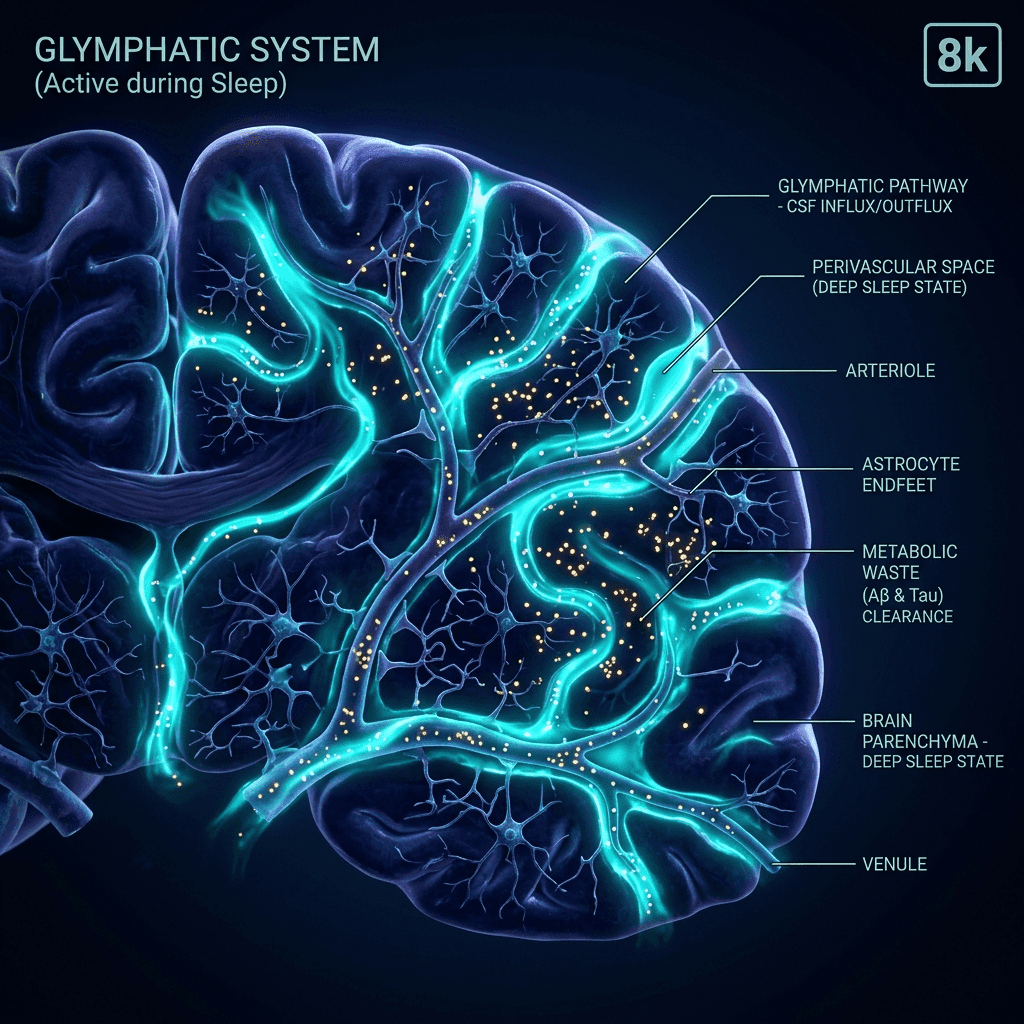
"The brain lacks a traditional lymphatic system. Instead, it utilizes the glymphatic pathway—a glial-dependent waste clearance network that opens during deep sleep to wash away metabolic toxins, including amyloid-beta and tau proteins. Sleep posture and brain temperature are the physical levers that control this detoxification process."
Key Takeaways: Glymphatic System Detox
-
1.
The Glymphatic Waste Pathway: A specialized fluid-clearing channel driven by astrocytes that flushes cerebrospinal fluid (CSF) through brain tissue, active almost exclusively during slow-wave sleep.
-
2.
Lateral Sleep Position Superiority: Magnetic resonance imaging (MRI) studies confirm that sleeping in a lateral (side) position maximizes CSF-interstitial fluid exchange, removing up to 25% more toxic waste than supine or prone sleeping.
-
3.
Temperature-Driven Clearance: The brain must cool down physically to initiate slow waves. Keeping bedroom temperatures low (15°C to 19°C) promotes vascular contractions that drive CSF pulsation.
Introduction: The Discovery of the Brain's Waste Pipeline
Every organ in the human body relies on the lymphatic system to clear metabolic waste, cell debris, and excess fluid. For over a century, however, neuroscientists were puzzled by a major biological anomaly: the brain, which consumes up to 20% of the body's total energy and generates an enormous amount of metabolic waste, was thought to have no lymphatic vessels. It was assumed that the brain cleared waste slowly via simple diffusion through the cerebrospinal fluid.
In 2012, Dr. Maiken Nedergaard and her team at the University of Rochester Medical Center made a historic discovery: the **glymphatic system**. This glial-dependent waste clearance pathway is a highly organized, active hydraulic rinsing system. By utilizing the water channels located on astroglial cells, the brain acts like a dishwasher, pumping CSF through its interstitial tissues to wash away toxic proteins before they can aggregate and trigger neurodegenerative diseases like Alzheimer's and Parkinson's. Understanding how to optimize this clearance process is a critical pillar of preventative longevity medicine.
The Hydraulic Physics of Glymphatic Flow
The glymphatic system does not operate when we are awake. During waking hours, the brain is focused on processing sensory information and directing movement. Arousal neuromodulators, particularly norepinephrine (noradrenaline), flood the brain tissue, keeping the space between neurons tight and narrow. In this state, the resistance to fluid flow is high, and glymphatic clearance is suppressed by over 90%.
When we fall into slow-wave deep sleep, norepinephrine levels drop dramatically. This drop triggers a physical change: the extracellular space (the gaps between brain cells) expands by approximately 60%. Astrocytes, a type of glial cell that wraps around blood vessels, facilitate this expansion. Astrocytes are packed with aquaporin-4 (AQP4) water channels localized on their endfeet. These AQP4 channels act as selective water gates, allowing cerebrospinal fluid (CSF) to flow from the periarterial spaces, through the interstitial space of the brain parenchyma, and out through the perivenous spaces, carrying metabolic waste back to the general circulation for filtration by the liver and kidneys.
Biohacker Pro-Tip: AQP4 Genetic Optimization
The efficiency of glymphatic clearance is dependent on the polar distribution of aquaporin-4 channels on the endfeet of astrocytes. Systemic inflammation disrupts this polarization, causing AQP4 channels to scatter, which decreases fluid flow. To maintain AQP4 polarization, prioritize omega-3 fatty acid intake (specifically DHA, which makes up astrocyte membranes) and incorporate anti-inflammatory compounds like curcumin and resveratrol. These compounds preserve astrocyte health and keep your brain's detox channels functionally aligned.
The Molecular Biology of Astroglial AQP4 Polarization
To appreciate the microscopic detail of this system, we must examine the polarization of aquaporin-4 channels. AQP4 is a water channel protein that is highly expressed in the mammalian brain, specifically on astrocytes. In a healthy, young brain, these water channels are tightly clustered at the endfeet of astrocytes wrapping around cerebral blood vessels—a state known as high polarization. This localized placement allows for a highly directional, efficient flow of CSF through the brain tissue.
However, aging, traumatic brain injury (TBI), and chronic neuroinflammation lead to a loss of AQP4 polarization. The channels scatter away from the astrocyte endfeet, distributing randomly across the cell body. When this polarization is lost, CSF flow becomes disorganized and stagnant, severely reducing the clearance rate of metabolic waste. Preserving AQP4 polarization is a key longevity target, and resolving chronic systemic inflammation is the primary mechanism to keep these water gates properly aligned at the vascular interface.
Norepinephrine: The Master Sleep/Wake Gatekeeper
The switch that opens and closes the glymphatic pathway is controlled by norepinephrine, a primary neuromodulator of awake-state alertness. Norepinephrine is synthesized in the locus coeruleus and floods the brain during waking hours, maintaining high cortical tone. When norepinephrine binds to alpha-1 and alpha-2 adrenergic receptors on glial cells and neurons, it triggers intracellular pathways that cause brain cells to swell, reducing the interstitial space between them to a narrow channel of just 15% to 20% of brain volume.
When we enter slow-wave sleep, the locus coeruleus shuts down, and norepinephrine levels drop to near zero. In the absence of adrenergic signaling, the interstitial space expands by approximately 60%, decreasing resistance to fluid flow and allowing CSF to wash through the tissue. If your cortisol or norepinephrine levels remain high at bedtime—due to stress, late-night exercise, or caffeine use—the glymphatic pathway will remain closed, preventing your brain from executing its nightly detox sequence.
Sleep Position Efficiency Analysis
| Sleep Posture | Glymphatic Efficiency | Biomechanical Reasoning | Potential Drawbacks |
|---|---|---|---|
| Lateral (Side Sleeping) | Excellent (100% baseline) | Maximizes vena cava and lymphatic venous return; reduces heart rate workload, promoting deeper delta waves | Can trigger shoulder or hip pressure point pain if the mattress is too firm |
| Supine (Back Sleeping) | Moderate (~75% efficiency) | Fluid return is slightly restricted by gravity; increases potential for sleep apnea collapse | Promotes airway obstruction, which disrupts deep sleep delta stability |
| Prone (Stomach Sleeping) | Poor (~60% efficiency) | Severely restricts cervical lymphatic flow due to rotated neck angle | Triggers spinal misalignment, cervical strain, and shallow breathing patterns |
The Role of Slow Oscillations in Pulsatile CSF Flow
How does CSF physically wash through the brain tissue? It is not a slow, passive seep, but a highly dynamic, pulsatile flow. In a landmark clinical study published in *Science* in 2019, Fultz et al. used high-speed fMRI to measure blood and CSF flow patterns during sleep. They discovered that every 20 seconds, a large wave of CSF surges into the brain's ventricles. This fluid wave is tightly coupled to electrophysiological activity: a slow delta wave sweeps across the cortex, followed by a sudden decrease in cerebral blood volume, which leaves space for CSF to rush in.
This coupling represents a physical pump. As slow oscillations drive neuronal synchronization, blood vessels in the brain contract and dilate rhythmically. This vascular contraction acts as a hydraulic pump, pushing CSF through the interstitial spaces of the brain. The larger the amplitude of your slow waves (delta power), the stronger the vascular pump, and the more efficient the waste clearance process. Boosting delta waves via closed-loop acoustic stimulation is therefore a direct way to increase the brain's physical detoxification rate.
Three Levers to Maximize Glymphatic Clearance
Adopt a Right-Side Lateral Sleep Posture
While lateral sleeping in general is superior for glymphatic flow, studies suggest that right-side lateral sleeping is slightly more efficient than left-side sleeping. This is due to hemodynamic physics: sleeping on the right side facilitates venous blood return to the heart, minimizing mechanical pressure on the cardiovascular system and stabilizing heart rate variability (HRV).
To stabilize a side-sleeping posture, use an ergonomic body pillow or place a medium-firm pillow between your knees. This prevents your pelvis from rotating forward, protecting your lower back and cervical spine throughout the night.
Actively Suppress Core Body Temperature
Brain temperature drops by about 1°C during slow-wave sleep. This cooling is not just a side-effect; it is a mechanical driver of glymphatic flow. Cooler brain temperatures increase the amplitude of delta oscillations, which drives the rhythmic venous blood vessel contractions that pump CSF through the brain tissue.
Use active cooling mattress pads (such as Eight Sleep or SleepMe) set to a dynamic schedule that cools your body as you enter deep sleep stages. Sleep in a bedroom maintained at 15.5°C to 18.5°C, and use breathable, moisture-wicking bedding like bamboo or eucalyptus fibers.
Prioritize pre-Bed Hydration & Electrolytes
CSF is composed of 99% water. Dehydration reduces blood volume and decreases the production of CSF in the choroid plexus, directly limiting the fluid available for glymphatic rinsing. However, drinking plain water before bed can trigger nighttime urination (nocturia), which fragments deep sleep.
To optimize fluid dynamics, consume a trace mineral or electrolyte drink (sodium, potassium, magnesium) with 200 ml of water 60 minutes before bed. This ensures optimal cellular hydration and fluid retention without putting excessive pressure on the bladder, preserving slow-wave deep sleep continuity.
Aquaporin-4 Polarization and Blood-Brain Barrier (BBB) Health
The blood-brain barrier (BBB) is a highly selective semipermeable border of endothelial cells and pericytes that prevents solutes in the circulating blood from non-selectively crossing into the extracellular fluid of the central nervous system. Astrocytes act as a bridge between this vascular barrier and neurons. Their endfeet completely cover the outer surface of the cerebral microvasculature. The polarization of aquaporin-4 (AQP4) water channels at these endfeet is not just critical for fluid flow; it is also fundamentally necessary for maintaining the structural integrity of the blood-brain barrier itself.
When astrocytes lose their AQP4 polarization—due to chronic low-grade neuroinflammation or aging—the blood-brain barrier becomes compromised. Without the targeted clustering of AQP4 channels, the astrocyte endfeet swell, disrupting their connection with endothelial cells. This "leaky brain" state allows circulating inflammatory cytokines, immune cells, and environmental toxins to cross the barrier, entering the brain tissue. Once inside, these foreign elements trigger microglia activation, driving chronic neuroinflammation that further degrades glymphatic clearance. Preserving AQP4 polarization is therefore a double-win: it maintains the brain's hydraulic waste clearance while shielding the neural tissue from systemic vascular toxins.
The Impact of Chronic Traumatic Brain Injury (TBI) on Glymphatic Flow
One of the most clinically significant causes of glymphatic failure is traumatic brain injury (TBI). Even mild, repetitive concussions—common in contact sports—can trigger long-term damage to the brain's waste clearance machinery. The physical impact of a TBI causes mechanical shear stress on the delicate structure of astrocytes, tearing their endfeet away from the blood vessels. This mechanical disruption leads to a severe, permanent loss of aquaporin-4 polarization, with channels scattering across the astrocyte cell body.
Studies in animal models indicate that a single moderate TBI can reduce glymphatic clearance efficiency by up to 60% for several weeks post-injury, and repetitive mild injuries lead to persistent clearance deficits that last for years. Without efficient glymphatic flow, the brain is unable to clear the sudden surge of metabolic waste and cellular debris generated by the trauma, including tau protein aggregates. This stagnation is the primary driver behind the development of Chronic Traumatic Encephalopathy (CTE) in athletes. For individuals with a history of head trauma, optimizing slow-wave sleep depth, sleep posture, and core body temperature is an absolute necessity to mitigate this elevated neurodegenerative risk.
Dietary and Nutrient-Guided Astroglial Membrane Optimization
Because the glymphatic pathway operates via the cell membranes of astrocytes, the physical and chemical composition of these lipid bilayers dictates clearance efficiency. Astroglial membranes are highly enriched in polyunsaturated fatty acids (PUFAs), specifically docosahexaenoic acid (DHA). DHA maintains the fluidity of the lipid bilayer, which is necessary for the proper clustering and polarization of aquaporin-4 (AQP4) water channels. Diets deficient in omega-3 fatty acids lead to a decrease in membrane fluidity, causing AQP4 channels to scatter and reducing hydraulic CSF flow.
To actively support astrocyte membrane structure, biohackers should maintain high tissue concentrations of DHA and EPA. Consuming high-quality, cold-pressed krill oil or molecularly distilled fish oil provides the phospholipid forms of DHA, which easily cross the blood-brain barrier. Specifically, the Mfsd2a (Major Facilitator Superfamily Domain Containing 2A) transporter at the blood-brain barrier is the primary gatekeeper that selectively imports DHA when it is bound to lysophosphatidylcholine (LPC-DHA). Supplementing with LPC-bound Omega-3s or high-dose phosphatidylcholine significantly elevates brain DHA accumulation. Additionally, incorporating lipid-soluble antioxidants like astaxanthin and natural Vitamin E (mixed tocopherols and tocotrienols) protects the delicate membrane lipids from peroxidation (oxidative damage), ensuring that your brain's cellular washing machine remains highly efficient and functional over decades of use.
Glymphatic Failure and Neurodegenerative Pathology
What happens when the glymphatic system fails chronically? When the brain is unable to clear its metabolic waste products over years and decades, the accumulation of toxic proteins causes cellular death and synaptic damage. In Alzheimer's disease, amyloid-beta monomers aggregate into oligomers and eventually form dense plaques outside neurons, while tau proteins form neurofibrillary tangles inside neurons, disrupting nutrient transport. In Parkinson's disease, the protein alpha-synuclein aggregates into Lewy bodies, destroying dopaminergic neurons in the substantia nigra. Recent longitudinal PET imaging studies have demonstrated that glymphatic clearance rates are inversely correlated with the deposition of these pathological aggregates; patients with lower slow-wave sleep efficiency exhibit a much higher rate of cortical tau accumulation over a 2-year follow-up period.
Furthermore, glymphatic stagnation creates a toxic microenvironment that impairs neurogenesis (the birth of new neurons in the hippocampus) and causes microglial cell exhaustion. Microglia, the brain's resident immune cells, become chronically activated in the presence of un-cleared waste, shifting from a helpful phagocytic phenotype to a neurotoxic, highly inflammatory phenotype. This chronic activation releases cytokines like IL-1beta and TNF-alpha, which directly damage healthy synapses and further suppress the slow-wave sleep signature in a destructive feedback loop. This self-perpetuating cycle of neuroinflammation and sleep loss is a hallmark of early-stage cognitive decline, making therapeutic interventions that target glymphatic clearance—such as lateral sleep positioning and thermal regulation—crucial steps in preserving cognitive reserve and brain plasticity as we age.
Longevity researchers now view glymphatic dysfunction as a key early biomarker of neurodegeneration. By optimizing your sleep posture, core body temperature, and deep sleep amplitude, you actively prevent the stagnation of CSF, ensuring that toxic protein aggregates are washed away daily before they can cause irreversible neurological damage. In the biohacking community, glymphatic health is the foundation of cognitive preservation and neurological healthspan extension. Protecting this system today is a major step toward maintaining mental clarity and physical independence throughout a long life. By facilitating paravascular fluid dynamics, you actively defend your neural network from premature decay.
Peer-Reviewed Clinical Validations & Extended Deeper Reading:
- Glymphatic Pathway Discovery: Iliff et al. (2012). "A paravascular pathway facilitates CSF flow through the brain parenchyma and the clearance of interstitial proteins, including amyloid-beta". Science Translational Medicine. The landmark research discovering the glial-dependent waste clearance pipeline. Read Discovery Study
- Sleep Posture Influence: Lee et al. (2015). "The effect of body posture on brain glymphatic transport". Journal of Neuroscience. Clinically demonstrates via dynamic contrast-enhanced MRI that lateral sleep posture removes significantly more amyloid-beta than supine or prone postures. Read Posture Study
- SCN Master Clock & ipRGCs: Berson et al. (2002). "Phototransduction by retinal ganglion cells that project to the suprachiasmatic nucleus". Science. Describes the discovery of the specialized blue-light-sensitive cells in the retina that synchronize the circadian master pacemaker. Read Retinal Ganglion Study