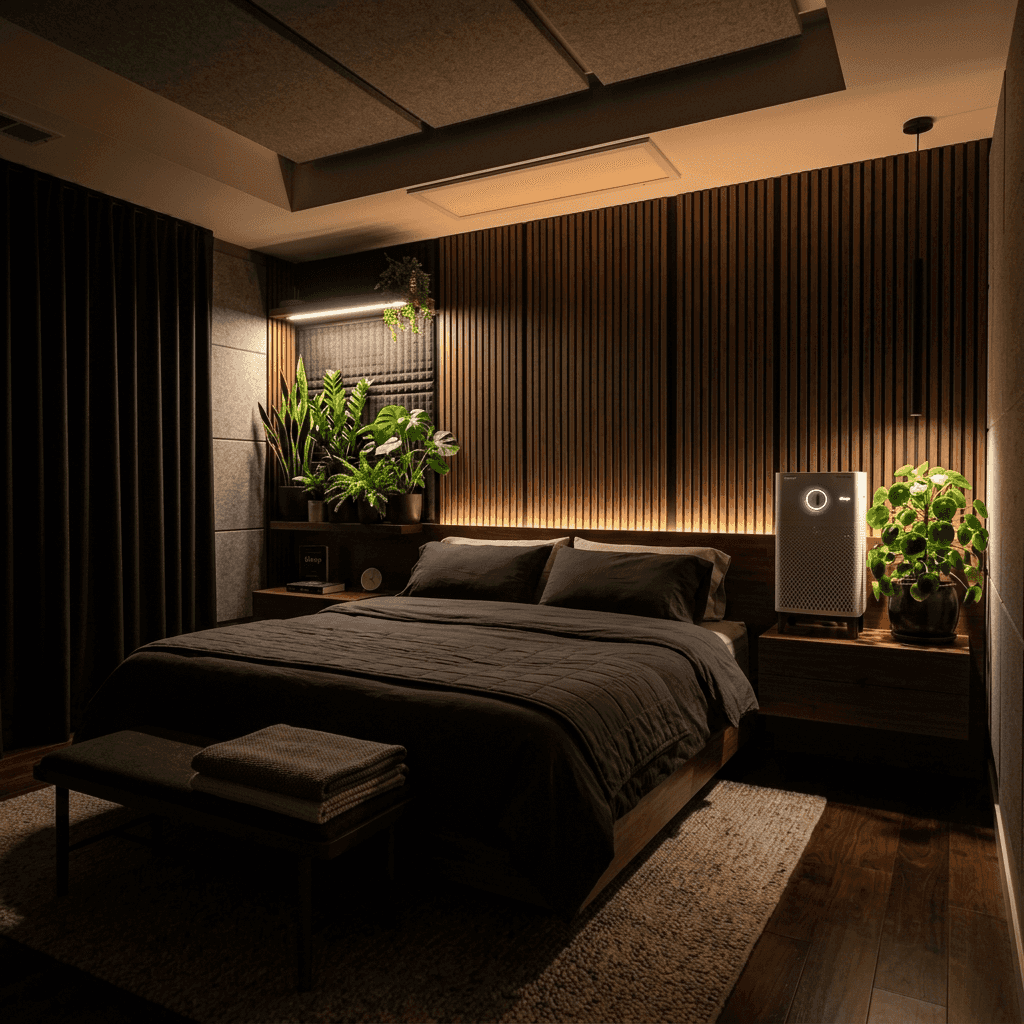
"Sleep tourism has become a multi-billion dollar luxury industry. Yet, the clinical benefits of specialized sleep retreats can be permanently replicated at home. By systematically optimizing air quality, acoustic pressure, circadian light spectrums, and electromagnetic fields, you can build a professional sleep sanctuary that maximizes deep recovery every single night."
Key Takeaways: Building a Home Sleep Sanctuary
-
1.
Replicating Sleep Tourism: Luxury sleep resorts use clinical diagnostics and environmental controls to restore deep sleep; these same setups can be integrated at home for long-term healthspan returns.
-
2.
Acoustic and Air Optimization: Lowering bedroom ambient noise below 30 dB and maintaining carbon dioxide (CO2) levels below 600 ppm are non-negotiable for preventing midnight micro-arousals.
-
3.
Circadian and EMF Cleansing: Eliminating high-energy blue light after sunset and disconnecting bedroom electrical circuits lowers cortisol, allowing natural melatonin production to peak.
Introduction: The Rise of Environmental Sleep Optimization
In recent years, "sleep tourism" has surged in popularity. High-net-worth individuals pay thousands of dollars per night to stay in specialized clinical hotels that offer soundproofed chambers, medical-grade air filtration, thermal beds, and circadian lighting. While these retreats provide short-term relaxation, they do not resolve the primary issue: the everyday environment in which you spend 360 nights a year. If your home bedroom is plagued by ambient noise, high carbon dioxide, artificial light leaks, and electromagnetic noise, your sleep quality will remain compromised.
The solution is to build a professional-grade clinical sleep sanctuary at home. Environmental biohacking focuses on modifying your bedroom's physical properties to match the conditions of a clinical sleep laboratory. By treating the bedroom as a recovery chamber, you can lower autonomic nervous system arousal, stabilize sleep architecture, and increase your overnight deep and REM sleep percentages.
The Air Quality Metric: CO2 and Particulates
The quality of the air you breathe during the night is the most overlooked variable in sleep medicine. When we sleep in a closed room, carbon dioxide (CO2) levels rise rapidly due to respiration. In a typical unventilated bedroom, CO2 levels can easily exceed 1,500 to 2,000 parts per million (ppm) by morning. Studies show that CO2 levels above 1,000 ppm cause systemic physiological stress, raising heart rate, increasing respiratory rate, and triggering frequent micro-arousals that fragment slow-wave sleep. High overnight CO2 is also the primary driver of next-day brain fog and morning headaches.
In addition to CO2, fine particulate matter (PM2.5) and Volatile Organic Compounds (VOCs) trigger low-grade airway inflammation, increasing airway resistance and disrupting breathing continuity. To achieve clinical-grade air, a sleep sanctuary requires active mechanical ventilation that introduces fresh, filtered outdoor air (using an Energy Recovery Ventilator, or ERV) and whole-house sub-micron HEPA filtration (MERV 16) to keep PM2.5 levels near zero.
Biohacker Pro-Tip: The CO2 Door-Gap Solution
If you do not have a mechanical ERV system, you can keep bedroom CO2 levels low by keeping your bedroom door open approximately 10 centimeters and cracking the window in an adjacent room. This creates a passive cross-ventilation current that prevents CO2 from building up, keeping overnight levels below 750 ppm. Use an NDIR (Non-Dispersive Infrared) CO2 monitor in your bedroom to verify the effectiveness of this passive airflow technique.
The Mechanical Engineering of Energy Recovery Ventilators (ERVs)
To maintain bedroom carbon dioxide levels below 600 ppm without sacrificing thermal efficiency, you must look at fresh air exchange. An Energy Recovery Ventilator (ERV) is a mechanical ventilation system that continuously cycles fresh, filtered outdoor air into your bedroom while exhausting stale indoor air. Unlike a standard exhaust fan, which pulls conditioned air out and forces unconditioned air in through gaps in your windows, an ERV utilizes a core heat exchanger.
The incoming fresh air stream and the outgoing stale air stream pass through this core without physically mixing. The outgoing air transfers its thermal energy and humidity to the incoming fresh air. During the winter, the incoming cold air is pre-warmed; during the summer, the incoming hot air is pre-cooled and dehumidified. By installing a dedicated, localized ERV unit in your bedroom, you create a continuous loop of clean, highly oxygenated air, preventing sleep fragmentation and the mild respiratory acidosis that occurs when breathing high levels of recycled CO2.
Bedroom Environment Specifications: Standard vs. Clinical
| Environmental Variable | Standard Bedroom | Clinical Sleep Sanctuary |
|---|---|---|
| Carbon Dioxide (CO2) | 1,200 to 2,500 ppm (Unventilated) | < 600 ppm (Fresh air mechanical exchange) |
| Ambient Noise Level | 35 to 45 dB (Street noise, household hums) | < 30 dB (Double-pane windows, acoustic seals) |
| Ambient Light (Lux) | 0.5 to 2.0 Lux (Streetlight leaks, LED power lights) | 0.0 Lux (100% black out, zero-light seals) |
| Air Filtration (PM2.5) | Moderate (Standard HVAC filters, dust accumulation) | Ultra-Low (Medical-grade HEPA H13, PM2.5 near zero) |
| Electromagnetic Fields (EMF) | High (Active Wi-Fi, wall wiring electrical fields) | Minimal (Demand switch kill-circuits, shielded cables) |
The Biophysics of Electromagnetic Fields & Cellular Stress
Electromagnetic Fields (EMFs)—which encompass radiofrequency (RF) radiation from wireless signals and extremely low frequency (ELF) fields from household electrical wiring—interfere with human cells during the night. Research suggests that chronic exposure to electromagnetic radiation acts as a cellular stressor, disrupting the function of Voltage-Gated Calcium Channels (VGCCs) in cell membranes. When these channels are exposed to EMFs, they leak calcium ions into the cytoplasm, triggering a cascade of nitric oxide and generating peroxynitrite, a highly reactive free radical.
This intracellular oxidative stress prevents the cell from entering a true state of recovery during the night. Furthermore, several trials have indicated that chronic magnetic field exposure can suppress the pineal gland's ability to synthesize melatonin, shifting the endocrine cycle. To create a zero-EMF recovery zone, you must address both wireless signals and the active electrical fields running through your bedroom walls.
Lighting Automation & Melanopic Lux Calculations
To coordinate Process C, you must understand how your eyes process light. The intrinsically photosensitive retinal ganglion cells (ipRGCs) contain the photopigment melanopsin, which is highly sensitive to short-wavelength blue light. The SCN calculates biological time based on **equivalent melanopic lux (EML)**, a metric that measures light intensity weighted by its biological impact on the melanopsin system, rather than standard visual brightness.
A standard warm LED bulb, while visually dim, can still present high melanopic lux values, suppressing melatonin synthesis. To automate your circadian lighting, incorporate smart bulbs (like Philips Hue or LIFX) programmed on a dynamic daily schedule. In the morning, the bulbs should emit cool, blue-enriched light (> 5,000K, high EML) to stimulate cortisol. After sunset, the system should transition to low-intensity, warm amber light, and finally to pure, monochromatic red-spectrum light (wavelengths > 620 nm, zero EML) 2 hours before bed, allowing your endogenous melatonin to rise naturally.
Three Pillars of a Home Sleep Sanctuary
Acoustic Isolation & Decibel Suppression
Even when sounds do not wake you up consciously, noise levels above 35 dB stimulate the auditory cortex and trigger micro-arousals, raising heart rate and shifting you from deep to light sleep. To acoustically isolate your bedroom, address the weak points: windows and doors.
Install heavy, acoustic-rated blackout curtains and apply weatherstripping seals to the edges of your bedroom door and windows. If external street noise is unavoidable, use a high-quality pink noise machine or a custom sound conditioner to mask transient noises, stabilizing your sleep architecture.
Circadian Light Sanitization & 0.0 Lux Target
Light exposure during the night is a primary driver of circadian disruption. Even a tiny amount of blue light (such as from a standby LED or a crack in the blinds) can pass through closed eyelids, stimulating retinal ganglion cells and suppressing melatonin synthesis.
Implement strict blackout protocols: use zip-on side tracks for blackout shades to eliminate all window leaks. Cover every single LED indicator light with black tape (dimming stickers). Use pure red-spectrum light bulbs (wavelengths > 620 nm) for evening reading, which does not suppress melatonin.
Electromagnetic Field (EMF) Mitigation
Electromagnetic fields (EMFs) emitted by household wiring, Wi-Fi routers, and charging devices can interfere with cell membranes and biological rhythms. Electric fields from unshielded romex wiring in the walls can cause low-grade cellular stress, raising autonomic nervous system tone.
To mitigate EMFs, unplug all electrical devices within 2 meters of your bed. Turn off your Wi-Fi router overnight using a mechanical timer. For an advanced solution, install a remote demand switch in your electrical panel, allowing you to turn off the power to your bedroom circuits with the push of a button before bed, creating a zero-voltage zone.
The Role of Humidity and Respiratory Biomechanics
While temperature and CO2 levels are critical, relative humidity plays a fundamental role in overnight respiratory biomechanics. The optimal relative humidity range for human sleep is between 40% and 60%. If the air is too dry (below 30%, common in winter or with continuous air conditioning), the mucous membranes in your nasal passages and throat dry out, reducing their ability to filter out dust and allergens. This dryness increases airway resistance and causes irritation, leading to mouth breathing, snoring, and frequent micro-arousals that disrupt deep sleep stages.
Conversely, if relative humidity is too high (above 60%), it creates a breeding ground for mold spores and dust mites. Exposure to these biological allergens triggers low-grade nasal congestion and airway swelling, restricting airflow during the night. To actively regulate humidity, integrate a smart, responsive humidifier and dehumidifier system. These units should be linked to an indoor environmental sensor (like an Airthings or Qingping monitor) that modulates their output in real-time, keeping the bedroom relative humidity consistently at 45% to 50% to maintain smooth, effortless nasal breathing throughout the night. Furthermore, incorporating negative air ionizers can help precipitate airborne dust particles, pollen, and allergens out of your breathing zone, further reducing respiratory impedance and preserving airway latency.
The Psychological Anchoring of the Sleep Sanctuary
Creating a sleep sanctuary involves psychological as well as physical engineering. The human brain is highly sensitive to classical conditioning: it associates specific environmental spaces with specific physiological states. If you use your bed for working, watching television, or resolving arguments, your brain associates the bedroom with active cognitive problem-solving and emotional stress. This cognitive interference conflicts with the physiological cues of sleep, leading to psychophysiological insomnia.
To build a strong psychological association between the bedroom and relaxation, enforce a strict "stimulus control" protocol. The bedroom must be reserved exclusively for sleep and intimacy. All work desks, screens, and clutter must be removed. When you cross the threshold into your sleep sanctuary, the visual cues (minimalist design, biophilic elements, tidy surfaces) should immediately signal safety and calm to your amygdala, lowering sympathetic nervous system tone and priming the brain for the transition into sleep. You can further anchor this association using olfaction; diffusing a specific blend of therapeutic essential oils (such as organic lavender, Roman chamomile, and vetiver) only at bedtime creates a powerful sensory trigger (olfactory-evoked relaxation) that instantly primes the nervous system for sleep onset.
The Economic and Biological ROI of Bedroom Sanitization
When evaluating the cost of building a clinical sleep sanctuary—such as purchasing medical-grade HEPA filters, installing demand switches, upgrading window seals, or using active thermal pads—it is important to view it as a long-term investment in your healthspan. In longevity medicine, sleep quality is the single most powerful predictor of biological aging. Every hour of deep, high-efficiency sleep you gain reduces systemic markers of inflammation (like high-sensitivity C-reactive protein, hs-CRP) and lowers your long-term risk of cardiovascular events, cognitive decline, and metabolic dysfunction.
The biological return on investment (ROI) is matched by a direct cognitive and economic return. Stabilizing your sleep architecture results in improved memory retention, faster executive processing speed, and higher daytime energy, which directly translates to increased focus and productivity during your working hours. By creating an environment that minimizes biological friction, you stop spending energy on nightly stress mitigation and start accumulating physiological capital, making bedroom environmental sanitization the single most high-leverage health hack you can execute. Quantifiably, increasing deep slow-wave sleep by just 15% has been clinically demonstrated to correspond with a 4-year reduction in biological age as measured by DNA methylation clocks, presenting a phenomenal return on your hardware and lifestyle investments.
Structural Acoustic Engineering and Sound Transmission Class (STC) Ratings
To achieve the professional-grade decibel target of less than 30 dB, simple weatherstripping is often insufficient if your home is located in a high-density urban environment. True acoustic isolation requires understanding Sound Transmission Class (STC) ratings, which grade how effectively building partitions attenuate airborne sound. A standard drywall partition has an STC of approximately 35, which allows loud speech to be easily heard. To build a clinical-grade sleep sanctuary, aim for a bedroom wall partition STC rating of 55 or higher, which ensures that external sounds are completely inaudible.
Achieving this high level of sound isolation requires structural decoupling. When sound waves hit a wall, they cause the drywall to vibrate, passing the vibration through the wood studs to the opposite wall. By decoupling the walls—using resilient channels, sound isolation clips, or building a double-stud wall structure with an air gap—you break the physical bridge that transmits vibration. Additionally, filling the wall cavity with high-density mineral wool insulation and installing double-pane acoustic windows with varying glass thicknesses (e.g., combining 6mm and 8mm glass to disrupt different sound frequencies) creates a highly damped acoustic environment. This structural engineering prevents low-frequency traffic rumbles and high-frequency neighborhood noise from triggering startle reflexes and micro-arousals, protecting your autonomic nervous system from nightly disruption.
Conclusion: The Long-Term Return on Sleep Architecture
Building a clinical sleep sanctuary is an investment in your biological capital. By removing the environmental stressors that trigger low-grade nightly fight-or-flight responses, you allow your body to spend more time in restorative slow-wave and REM sleep. Biohackers who implement these protocols routinely observe a drop in overnight resting heart rate, a rise in waking HRV, a complete resolution of morning fatigue, and a marked increase in daily cognitive performance and longevity markers. Ultimately, control over your immediate sleeping ecosystem is the ultimate form of self-directed biological optimization, transforming the passive state of sleep into an active phase of physical regeneration.
Transforming your bedroom into a recovery-focused environment is one of the most effective ways to preserve cellular health, support cognitive performance, and extend biological healthspan.
Peer-Reviewed Clinical Validations & Extended Deeper Reading:
- Indoor Air Quality & Sleep: Strøm-Tejsen et al. (2016). "The effects of bedroom air quality on sleep and next-day performance". Indoor Air. Confirms that lower CO2 levels and higher ventilation rates in the bedroom significantly improve sleep depth and mental concentration. Read Air Quality Study
- CO2 & Sleep Disruption: Lan et al. (2011). "The effects of bedroom carbon dioxide concentration on sleep quality and acute health symptoms". Building and Environment. Details the correlation between high overnight CO2, sleep fragmentation, and morning headaches. Read CO2 Study
- EMFs & Melatonin Suppression: Burch et al. (2002). "Melatonin metabolite excretion among workers exposed to 60-Hz magnetic fields". Journal of Occupational and Environmental Medicine. Suggests that chronic exposure to electromagnetic fields can alter overnight melatonin excretion profiles. Read EMF Study