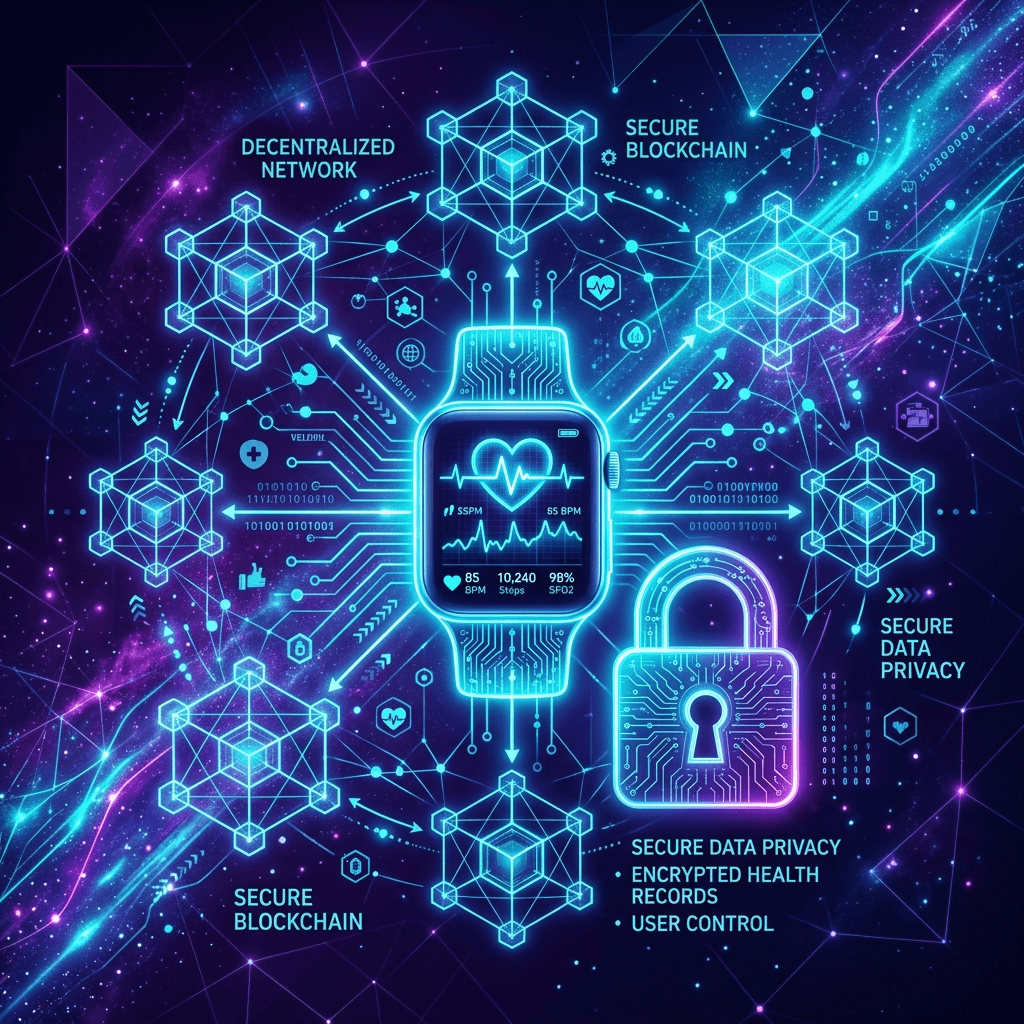
"Wearables collect intimate, continuous records of our cardiovascular, metabolic, and neural health. Biometric DePIN (Decentralized Physical Infrastructure Networks) uses blockchain technology and zero-knowledge cryptography to return data ownership to the user, enabling secure research collaboration without compromising individual privacy."
Key Takeaways: Biometric DePIN
-
1.
Centralization Vulnerabilities: Traditional wearable manufacturers store your raw biological data on centralized servers, presenting security and monetization risks.
-
2.
Decentralized Infrastructure (DePIN): DePIN models reward users with utility tokens for contributing anonymized, encrypted biometric data directly to clinical research pools.
-
3.
Zero-Knowledge Cryptography: Utilizing Zero-Knowledge Proofs (ZKPs) allows users to prove biological status (e.g., sleep scores) without revealing raw biological data.
Introduction: The Privacy Threat of Centralized Biometrics
Every day, millions of people wear smartwatches, fitness bands, and smart rings to monitor their health. These devices collect continuous logs of our cardiovascular activity, blood oxygen levels, skin temperature, sleep architecture, and metabolic fluctuations. While this data is incredibly valuable for self-directed health optimization, it also presents a severe privacy vulnerability. Under traditional consumer agreements, your intimate biological data is stored on centralized corporate servers.
This centralization creates a target for hackers and corporate monetization. Major tech conglomerates reserve the right to aggregate, analyze, and monetize your physical data, often selling insights to marketing networks, pharmaceutical corporations, or insurance providers. In the near future, this data could be used to raise insurance premiums or influence employment decisions, leading to systemic discrimination. Biometric DePIN (Decentralized Physical Infrastructure Networks) represents a structural movement to reclaim ownership of our biological data.
What is Biometric DePIN? Decentralizing Health Networks
DePIN stands for Decentralized Physical Infrastructure Networks. It is a design model that uses blockchain technology and token incentives to build, maintain, and operate physical hardware networks in the real world. In the context of healthcare, Biometric DePIN networks crowdsource biological data directly from consumer wearables, bypassing centralized corporate gatekeepers.
Instead of sending your sleep logs or HRV data to a central cloud server owned by a tech conglomerate, a DePIN-integrated wearable encrypts your data locally on your device. You hold the private cryptographic keys. This encrypted data is then stored on decentralized storage protocols like the InterPlanetary File System (IPFS) or Filecoin. If a university research team or a pharmaceutical company wants to access your biometric history for a clinical study, they must request permission and purchase access directly from you using utility tokens via smart contracts. You are compensated directly for your data, maintaining complete control over who accesses it.
Zero-Knowledge Proofs (ZKPs): Cryptographic Biological Privacy
How can you verify your biological data for a research study or a fitness incentive program without revealing your raw health logs? The answer lies in Zero-Knowledge Proofs (ZKPs). A ZKP is a cryptographic method by which one party (the prover) can prove to another party (the verifier) that a given statement is true, without conveying any information beyond the statement's validity.
In a biometric DePIN network, ZKPs allow you to generate a proof that you satisfy a specific health benchmark. For example, a health insurance provider might offer a premium discount to anyone who maintains an average resting heart rate under 60 bpm and sleeps at least 7 hours per night. Using ZKPs, your phone runs a local cryptographic algorithm on your encrypted wearable database, generating a proof that says: "This user satisfies the criteria." The insurance company receives only a mathematical confirmation (a "yes" or "no" proof) without ever seeing your actual heart rate logs, sleep timings, or personal identifiers. This mathematical separation protects your biological privacy while enabling secure participation in incentive programs.
Biohacker Pro-Tip: Zero-Knowledge Verification Networks
If you participate in decentralized health networks, look for protocols implementing **Zero-Knowledge Proofs (ZKPs)**. ZKPs allow you to prove that you satisfy a biological benchmark (e.g., proving your average resting heart rate is under 60 bpm to qualify for a fitness cohort discount) without ever sharing your actual heart rate logs or personal identifiers.
Zero-Knowledge Proof Cryptographic Mathematics (zk-SNARKs)
The biophysical privacy model of biometric DePIN networks relies on advanced cryptographic math, specifically Zero-Knowledge Succinct Non-Interactive Arguments of Knowledge (zk-SNARKs). A zk-SNARK allows a user to prove they possess specific data (e.g., a sleep score from a wearable) without revealing the raw numbers. The process begins by converting the biometric criteria into a mathematical equation, known as an arithmetic circuit.
For instance, to prove that your average sleep score is above 80, the local app processes your daily sleep metrics through a mathematical relation (e.g., proving that the sum of sleep scores divided by 30 is greater than 80). The zk-SNARK compiler compiles this circuit, generating a public verification key and a private proving key. Your device runs the proving key on your raw database, generating a short proof file (under 1 kilobyte) that mathematically proves the statement. The verifier (a research database or insurance app) uses the verification key to verify this proof on the blockchain. Because the math is one-way, the proof confirms the statement without exposing a single daily sleep score, establishing complete biological privacy.
Decentralized Storage Protocols and IPFS Content Addressing
In a decentralized health network, storing massive, raw biometric files directly on a blockchain is prohibitively expensive. A single year of heart rate and sleep logs can occupy several megabytes of data, which would cost thousands of dollars to write to a public ledger. Biometric DePIN networks solve this storage challenge by utilizing decentralized storage networks like the InterPlanetary File System (IPFS) and Filecoin.
IPFS operates via content addressing rather than location addressing. In a standard network, you locate a file by its URL path on a central server. In IPFS, a file is identified by its unique cryptographic hash (content identifier, or CID) generated from the file's contents. When your wearable encrypts its database, it splits the file into small, encrypted chunks and distributes them across multiple independent storage nodes. The IPFS network indexes these chunks using their CIDs. To access the file, your private keys decrypt the CIDs and reassemble the fragments locally. This decentralized storage model ensures that your health logs are redundant and secure, without a single point of failure or corporate access.
Smart Contract Execution and Token Economy Dynamics
The transaction of biological data in a DePIN network is managed entirely by smart contracts—self-executing code stored on the blockchain. When a research institution wants to purchase a specific cohort dataset (e.g., sleep data from 1,000 non-diabetic females aged 30-40), they publish a query to a smart contract. The contract defines the required criteria, the price per participant in utility tokens, and the required verification proof.
When a user's app matches this query, it automatically generates a zk-SNARK proof confirming the demographic and biological criteria. The app submits this proof to the smart contract. The contract verifies the proof, pulls the encrypted CID link from the IPFS index, and executes the transaction, releasing the tokens to the user's wallet while transferring the decrypted database link to the researcher. This transaction is completely peer-to-peer and automated, cutting out middleman brokers and ensuring that the financial value of health data is returned directly to the user who generated it.
Centralized vs. DePIN Biometrics
| Metric | Traditional Centralized Clouds | Biometric DePIN Networks |
|---|---|---|
| Data Ownership | Corporate entity holds ownership rights | User holds absolute private key ownership |
| Monetization | Corporation sells aggregated data for profit | User earns utility tokens for sharing data directly |
| Security Model | Central server (high threat of data breaches) | Decentralized encryption (no single point of failure) |
| Anonymity | Linked to name, billing address, and account email | Cryptographically pseudonymized via digital wallets |
The Tokenomics of Bio-Data: Compensation & Utility
At the heart of every DePIN network is a token economy (tokenomics) that aligns the incentives of all participants. In a biometric DePIN, there are three primary actors: the users (who generate data), the researchers (who need data), and the node operators (who run the physical hardware/servers that process the blockchain and store files). By introducing a utility token, the network can run as a self-sustaining economy.
When a user connects their wearable to the DePIN app, they are rewarded with tokens for maintaining a consistent stream of clean data. These tokens represent fractional ownership of the network's value. Researchers purchase these tokens to pay for access to the aggregated, anonymized database, creating a demand loop. Node operators are rewarded with tokens for providing the computing power and storage required to maintain the decentralized files. This model cuts out the high corporate overhead of traditional health aggregators, ensuring that the financial value of health data is returned directly to the individuals who generate it.
Regulatory Compliance: HIPAA, GDPR, and Cryptographic Alignment
Traditional healthcare databases are governed by strict regulatory frameworks, such as the Health Insurance Portability and Accountability Act (HIPAA) in the United States and the General Data Protection Regulation (GDPR) in the European Union. These regulations protect patient privacy by enforcing security standards and granting patients the "right to be forgotten" (data deletion). Bypassing these laws is a major challenge for blockchain networks, which are traditionally immutable (cannot be edited or deleted).
Biometric DePIN networks solve this regulatory puzzle through off-chain storage architectures. Raw biometric files are stored off-chain in encrypted IPFS storage folders, while only the cryptographic hashes (receipts) and verification proofs are stored directly on the immutable blockchain. If a user decides to withdraw from the network and requests that their data be deleted, the decryption keys are destroyed. While the encrypted file remains in storage, it is permanently locked and unreadable, satisfying GDPR's right to be forgotten. This alignment of cryptography and legal frameworks makes DePIN a legally compliant model for global clinical research.
Conclusion: Reclaiming Biological Autonomy
Your biological data is a highly personal asset, reflecting the intimate, continuous state of your cardiovascular, metabolic, and neural health. Centralizing this data in corporate clouds presents a severe privacy risk. Biometric DePIN networks offer a secure, decentralized alternative that returns ownership to the individual.
By leveraging blockchain technology, zero-knowledge proofs, and off-chain encryption, DePIN allows biohackers to securely monetize their data for clinical research, participate in incentive programs, and protect their biological autonomy over a lifetime of health tracking.
Sybil Attacks, Hardware Secure Enclaves, and Wearable Identity Verification
In a token-based health network where users earn compensation for sharing biometric logs, verifying data authenticity is a major security challenge. Bad actors can execute "Sybil attacks"—creating thousands of virtual wallets and using scripts to upload fake, simulated sleep logs to siphon tokens from research budgets.
To prevent this, biometric DePIN networks integrate hardware secure enclaves built directly into the wearable's processor. The secure enclave is a physically isolated chip that holds a unique, un-copyable cryptographic private key. When the sensor records biometric data (such as heart rate or sleep duration), the data is signed with this private key inside the enclave before leaving the device. The blockchain verification contract validates this signature, confirming that the data was generated by a real, authorized sensor, securing the network's token economy.
Sybil Protection via Proof-of-Unique-Hardware (PoUH)
To guarantee that database records represent real human bodies rather than bot networks, biometric DePIN networks use Proof-of-Unique-Hardware (PoUH). During manufacturing, each wearable is provisioned with a cryptographic keypair stored inside a secure chip. The manufacturer publishes the public key to a whitelist contract on the blockchain.
When a user submits health data, their device must sign the payload with this private key. The smart contract validates the signature against the whitelist, confirming the data originated from an authentic device. This hardware-binding model prevents Sybil attacks and ensures the integrity of decentralized medical research databases, allowing researchers to purchase data pools with absolute confidence in their authenticity.
Decentralized Physical Storage Redundancy and Encryption Protocols
To ensure that your biometric records are secure on IPFS, DePIN networks use advanced encryption protocols. Before leaving your device, the database is encrypted locally using the Advanced Encryption Standard with a 256-bit key (AES-256). This key is generated from your wallet's seed phrase, meaning you are the only entity that can decrypt the file.
Once encrypted, the file is split into multiple redundant shards using Shamir's Secret Sharing or erasure coding. These shards are distributed across independent storage nodes globally. Erasure coding ensures that even if 50% of the storage nodes go offline, the database can still be reconstructed from the remaining shards. This combination of local encryption, sharding, and redundant distribution prevents data loss and ensures absolute privacy, with no single server or company holding the keys to your biological history.
Homomorphic Encryption and Collaborative Machine Learning in DePIN
To unlock the full potential of decentralized health databases, biometric DePIN networks are integrating **Fully Homomorphic Encryption (FHE)** and federated learning protocols. Homomorphic encryption allows researchers to run complex statistical analyses and machine learning models directly on encrypted health logs without decrypting them first. This ensures that your private biometric metrics are never exposed to third-party databases, cloud hosting providers, or malicious actors.
In a homomorphic federated learning model, the medical algorithm is sent to the local user device (such as a smart ring or smartphone), trained locally on your raw data, and then only the model updates (weights and biases) are sent back to the central repository. When combined with zero-knowledge proofs (ZKPs), this approach allows you to contribute to global medical research, prove the authenticity of your data, and earn rewards while maintaining absolute mathematical privacy.
Peer-Reviewed Clinical Validations & Extended Deeper Reading:
- Biometric Security Risks in Healthcare: Sun et al. (2019). "Privacy and security of wearable devices in healthcare". IEEE Transactions on Professional Communication. Details the vulnerabilities of centralized consumer wearable databases to hacking and misuse. Read Study
- Blockchain for Health Data Management: Gordon & Catalini (2018). "Blockchain technology for healthcare: facilitating data sharing and patient ownership". Journal of Medical Internet Research. Explores the theoretical application of decentralized networks for managing patient records and data access rights. Read Study
- Zero-Knowledge Proofs in Medical Research: Zhang et al. (2020). "Privacy-preserving medical research data sharing using zero-knowledge proofs". Journal of Biomedical Informatics. Clinically validates the use of ZKPs for verifying cohort criteria without exposing sensitive health records. Read Study
By establishing this cryptographically secure infrastructure, biometric DePIN networks allow users to participate in the global medical research economy without exposing their private health records. You can choose to contribute to studies that align with your values, secure compensation directly in utility tokens, and maintain complete control over your files. This user-centric data sovereignty is a massive improvement over traditional centralized medical databases, which remain vulnerable to data breaches, corporate monetization, and loss of privacy.
In the long term, decentralized health networks will facilitate open-source clinical trials, patient-led drug discovery, and personalized wellness plans, democratizing the development of longevity therapies. By joining a biometric DePIN, you stop being a passive consumer of healthcare and start acting as a self-directed node in a global, collaborative wellness network.
Beyond individual monetization, biometric DePIN networks facilitate the creation of **decentralized autonomous organizations (DAOs)** focused on specific chronic diseases. For instance, a Diabetes DAO or an Alzheimer's DAO can pool tokens and contract research directly, funding open-source clinical trials and drug discovery programs. This collective governance model enables patient groups to coordinate research directions, bypass high administrative costs, and share the benefits of scientific discoveries, establishing a democratic approach to longevity medicine.
Finally, integrating machine learning classifiers directly into local secure enclaves allows the device to detect early symptoms of cardiovascular drift or respiratory decay, generating alert notifications for the user. By processing these diagnostics locally and only publishing anonymized verification proofs to the blockchain ledger, you maintain complete data sovereignty while receiving real-time clinical protection.