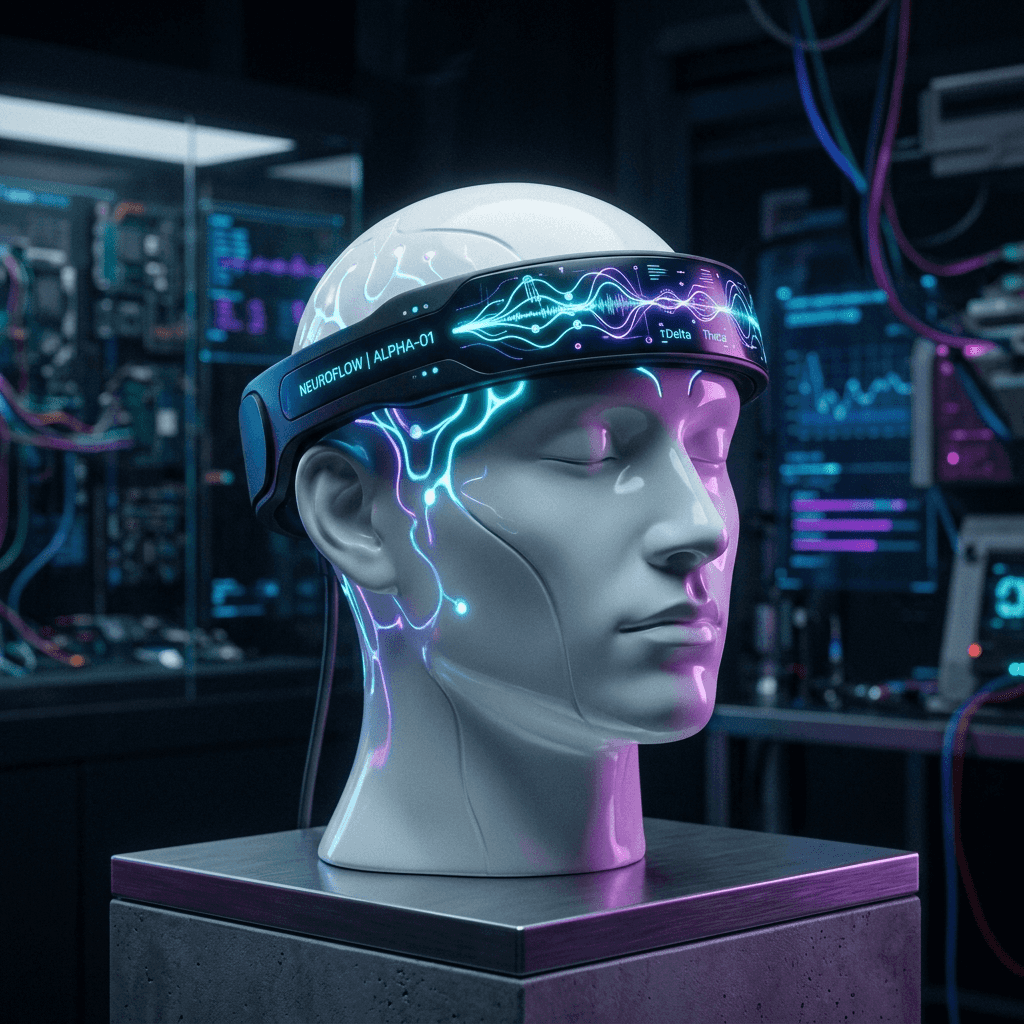
"Brain-Machine Interfaces (BMIs) are no longer locked in clinical neuroscience labs. Modern dry-sensor EEG headbands allow users to monitor electrical brainwaves at home, actively train focus states, and trigger deep sleep via closed-loop sensory or electromagnetic stimulation."
Key Takeaways: Consumer BMIs
-
1.
Dry Electrode Tech: Modern consumer headbands utilize dry silicone or conductive fabric sensors that capture microvolt brain activity without conductive gels.
-
2.
Brainwave Frequency Bands: Isolating Alpha (calm focus) and Delta (slow-wave sleep) waves allows software to provide targeted biofeedback and sleep tracking.
-
3.
Active Neuromodulation: Advanced headbands (Somnee, Elemind) go beyond monitoring, using transcranial Alternating Current Stimulation (tACS) or targeted sound to guide brainwaves.
Introduction: The Rise of Consumer Brain-Machine Interfaces
For nearly a century, reading the electrical signals of the human brain was a complex, expensive process restricted to clinical labs and university research facilities. Setting up an electroencephalogram (EEG) required a trained technician to apply sticky, conductive paste to the scalp, position up to 25 wet electrodes, and connect the user to a massive, stationary amplifier. This setup made real-time brainwave monitoring impossible for daily use. Today, consumer brain-machine interfaces (BMIs) have completely transformed the field.
Modern consumer headbands utilize advanced material science—specifically dry, flexible sensors made of conductive silicone or silver-threaded fabrics—to read microvolt electrical currents through the hair and skin. These comfortable, wireless headbands connect to smartphones, running advanced digital signal processing algorithms to filter out muscle noise and deliver real-time brainwave tracking. We review the leading consumer BMIs: the Muse S, Somnee, and Elemind headbands.
The Biophysics of EEG: Dry Sensors and Scalp Impedance
To understand how consumer BMIs operate, we must look at the biophysics of electroencephalography. The human brain consists of approximately 86 billion neurons. When these neurons fire, they generate tiny electrical currents that flow through the surrounding extracellular fluid. When millions of neurons fire in synchronization (such as during sleep or deep focus), their combined electrical activity is strong enough to pass through the skull and be detected at the surface of the scalp.
These electrical signals are exceptionally weak, typically ranging between 10 and 100 microvolts (millionths of a volt). Furthermore, the outer layer of the skin (stratum corneum) acts as a resistor, creating high electrical impedance that blocks the signal. Clinical setups bypass this by using conductive gel to lower impedance. Consumer headbands rely on high-precision dry sensors and advanced software algorithms. These sensors must maintain consistent contact with the forehead and behind the ears (where skin impedance is lowest). The companion apps filter out the massive electrical noise generated by eye blinks, facial muscle movements, and surrounding household electrical wiring, isolating the true neural signal with remarkable accuracy.
Decoding Brainwaves: The Frequency Spectrum
EEG headbands work by separating the raw electrical signal into distinct frequency bands using a mathematical formula called a Fast Fourier Transform (FFT). These frequency bands correspond to different states of consciousness:
Alpha (8 - 12 Hz) & Beta (12 - 30 Hz) Waves
Alpha waves signify relaxed alertness and calm focus, commonly observed during meditation or light relaxation. Beta waves represent active, alert cognitive processing, decision-making, and critical thinking. High-frequency Beta waves can also indicate stress and anxiety. Balancing the Alpha/Beta ratio is a primary target of focus-training biofeedback protocols.
Theta (4 - 8 Hz) & Delta (0.5 - 4 Hz) Waves
Theta waves are associated with deep relaxation, dreaming (REM sleep), and creative states. Delta waves are the slowest and highest-amplitude waves, representing slow-wave deep sleep (N3). Delta power is the primary marker of cellular brain repair and waste clearance, and boosting it is essential for physical recovery.
Muse 2 & Muse S: The Passive Biofeedback Standard
Muse is the pioneer of consumer EEG, and the Muse S represents their most comfortable, sleep-focused design. Made of a soft, flexible fabric band that wraps around the forehead, the Muse S utilizes 4 frontal EEG sensors and 2 reference sensors behind the ears. It is a passive monitoring device, meaning it does not send electrical signals into the brain; instead, it reads your natural brainwaves and provides real-time biofeedback.
During meditation or wind-down sessions, the Muse S translates your brainwaves into natural sounds (known as "soundscapes"). If your mind is busy (high Beta waves), you hear wind or rain sounds. As you calm your thoughts and shift into Alpha waves, the weather sounds fade, replaced by quiet birds or calm waves. This real-time loop acts as a mirrors for your brain, helping you learn to self-regulate and enter calm states. For sleep, the Muse S tracks your sleep stages throughout the night, calculating a detailed Sleep Efficiency score based on your brainwave architecture.
Biohacker Pro-Tip: Forehead Wiping and Impedance Reduction
Dry EEG sensors are highly sensitive to skin oils, sweat, and dry skin flakes. Before putting on your headband (especially Muse or Somnee), wipe your forehead and the skin behind your ears with a damp cloth or a gentle, alcohol-free wipe. If your skin is too dry, it creates high electrical impedance, leading to signal dropouts and incorrect feedback. Dampening the sensor touchpoints slightly with a drop of water can improve signal lock immediately.
Somnee: Active Neuromodulation for Sleep Entrainment
While Muse is a passive monitoring tool, Somnee is an active neuromodulation device. It is designed specifically for individuals who struggle with sleep onset. The Somnee headband features two large carbon-silicone electrodes that rest on the forehead and the back of the neck. It uses a technology called **transcranial Alternating Current Stimulation (tACS)** to help guide the brain into sleep.
tACS works by sending a tiny, imperceptible electrical current (under 2 milliamperes) through the skull at a specific frequency. This current creates a weak electromagnetic field that coaxes the brain's neurons to fire in synchronization with the device. When you put on the Somnee headband before bed, it runs a 15-minute tACS session that mimics the slow, rhythmic oscillations of falling asleep. By actively entraining these slow waves, the device helps suppress wakefulness and accelerate sleep onset. Clinical trials run by Somnee demonstrated a 50% reduction in sleep latency (time to fall asleep) and a significant improvement in overnight sleep continuity, making it a powerful medical-grade option for biohackers.
Elemind: Closed-Loop Acoustic Stimulation
Elemind represents the latest innovation in consumer brain-machine interfaces: closed-loop acoustic stimulation. Rather than using electrical currents like Somnee, Elemind uses sound. The headband contains highly sensitive dry EEG sensors that continuously monitor your brainwaves in real-time. As you lie in bed, the device identifies the specific frequency of your neural signals.
When the SCN and cortex begin to fire in high-frequency patterns (associated with racing thoughts and anxiety), Elemind immediately emits short, targeted acoustic tones (pure sine waves) through bone-conduction speakers. These tones are timed with millisecond precision to land on the peak of your brain's electrical waves. By introducing these acoustic pulses out-of-phase, Elemind physically disrupts the high-frequency brainwaves, forcing them to collapse and shift into slow-wave Delta patterns. This acoustic intervention acts as a biological "mute button" for racing thoughts, triggering sleep onset naturally without introducing electrical current into the skull.
Top EEG Headbands Compared
| Device | Technology | Electrode Type | Primary Target | Subscription Cost |
|---|---|---|---|---|
| Muse S | Passive EEG Biofeedback | Conductive Fabric (Frontal/Temporal) | Meditation focus, sleep staging, relaxation tracking | Optional Premium App Subscription |
| Somnee Smartband | Active tACS Neuromodulation | Carbon-Silicone (Forehead/Occipital) | Sleep latency reduction, deep sleep entrainment | $0.00 (Free) |
| Elemind Headband | Closed-Loop Acoustic Neuro-stimulation | Conductive Silicone (Frontal) | Racing thought suppression, natural sleep onset | $0.00 (Free) |
Biophysical Impedance of Dry Electrodes
The primary technological challenge in consumer electroencephalography (EEG) is maintaining low impedance at the contact interface without conductive gels. Scalp impedance acts as a resistor, dampening the microvolt electrical potentials generated by the brain and introducing noise into the signal. Dry electrodes must overcome this resistor by using specialized materials and contact mechanics.
Consumer headbands like Muse and Somnee utilize flexible, carbon-loaded silicone or silver-plated nylon fabric electrodes. These dry materials rely on the natural moisture of the skin to establish a conductive pathway. When the headband is applied to the forehead, a micro-layer of sweat forms at the contact interface, which lowers impedance. Additionally, the headband must exert a consistent, gentle physical pressure to compress the hair and ensure direct skin contact. Advanced dry sensor systems integrate active noise cancellation circuits directly into the electrode housing, pre-amplifying the signal at the scalp to prevent noise accumulation along the wire, ensuring a clean EEG lock.
Fast Fourier Transform (FFT) Algorithm and Brainwave De-noising
Once the raw microvolt signal is captured by the dry sensors, it must be processed to separate neural signals from environmental noise. The raw EEG stream is a complex, chaotic waveform that includes brain activity, muscle movements (electromyography, EMG), eye blinks (electrooculography, EOG), and 50/60 Hz electrical hums from surrounding wall outlets. The headband's processor uses digital signal processing (DSP) to clean this signal in real-time.
First, the raw signal passes through high-pass and low-pass filters to isolate frequencies between 0.5 Hz and 50 Hz. Next, the algorithm runs a **Fast Fourier Transform (FFT)**—a mathematical formula that decomposes the complex signal into its individual frequency components. By analyzing the power spectral density (PSD) of these frequencies, the software calculates the relative strength of Delta, Theta, Alpha, and Beta waves. Advanced machine learning filters identify the specific electrical signature of eye blinks and muscle contractions, subtracting these artifacts from the raw signal to ensure that the final brainwave score reflects true, undisturbed neural activity.
Safety and Long-Term Considerations of Neuromodulation
Because devices like Somnee and Elemind actively alter brainwave activity, safety is a primary consideration for biohackers. Electrical neuromodulation (tACS) has been studied in clinical trials for over 20 years. The micro-currents used by Somnee are extremely low, operating below the threshold that triggers neuronal action potentials; instead, the current simply nudges the brain's baseline excitability, making it highly safe and non-addictive.
However, individuals with active medical implants (such as pacemakers or deep brain stimulators) or a history of epilepsy must avoid electrical neuromodulation. For these individuals, acoustic neuro-stimulation (Elemind) or passive biofeedback (Muse S) represent safe, effective alternatives. By tracking your brainwave responses to these devices, you can monitor your neural recovery and protect your long-term cognitive capital without systemic disruption.
Conclusion: Reclaiming Control of the Mind
Consumer brain-machine interfaces represent a major step forward for self-directed health optimization. By transitioning from simple tracking to active, closed-loop neuromodulation, these headbands allow biohackers to directly influence their neural state, accelerating focus training and sleep onset.
Whether you choose the Muse S for passive meditation biofeedback, the Somnee Smartband for active tACS sleep entrainment, or the Elemind Headband for acoustic racing-thought suppression, brainwave optimization is a powerful tool to preserve cognitive function and support long-term neurological healthspan.
Scalp Topography and the International 10-20 EEG System
To understand how consumer headbands isolate specific brain regions, we must review scalp topography. Clinical EEG uses the International 10-20 System—a standardized method that maps electrode positions relative to anatomical landmarks on the skull (the nasion, inion, and preauricular points). The "10" and "20" represent the percentages of distance between these landmarks where electrodes are placed.
Consumer headbands like Muse S position their sensors at key frontal (Fp1, Fp2) and temporal (T3, T4) positions. The frontal sensors capture activity from the prefrontal cortex—the seat of executive function and focus—making them ideal for tracking meditation states. The temporal sensors sit above the ear, capturing auditory and memory consolidation signatures. Somnee positions its neuromodulation electrodes at the frontal pole and the occipital cortex (O1, O2) at the back of the head, allowing current to flow directly through the brain's sleep centers and entrain slow oscillations.
Closed-Loop Audio Entrainment vs. Binaural Beats
When optimizing sleep via auditory pathways, it is important to distinguish closed-loop audio entrainment from standard binaural beats. Binaural beats present two slightly different frequencies to each ear (e.g., 400 Hz and 404 Hz), relying on the brainstem to perceive a third "beat" (4 Hz Delta frequency). While popular, binaural beats are open-loop, meaning they present a static signal regardless of the user's real-time brainwave state.
In contrast, closed-loop audio entrainment (used by Elemind) is dynamic. The headband's EEG sensors monitor the exact phase of your slow-wave Delta oscillations. The software calculates when the electrical wave is rising, emitting a brief acoustic click that lands precisely on the wave peak. This acoustic stimulation amplifies the slow-wave amplitude (delta power), reinforcing the synchronization of cortical neurons. This closed-loop alignment is significantly more effective at increasing deep sleep and promoting slow-wave memory consolidation than static auditory tracks.
Electromagnetic Safety of At-Home Active BMIs: SAR Limits
Active brain-machine interfaces (such as Somnee) utilize low-voltage electrical currents (tACS) to entrain brainwaves. To guarantee safety, these devices must operate well below the Specific Absorption Rate (SAR) limits set by international regulatory bodies. SAR measures the rate at which energy is absorbed by human tissue when exposed to an electromagnetic field, with a standard consumer limit of 1.6 Watts per kilogram (W/kg).
Somnee's tACS current is extremely low (under 2mA), generating a maximum SAR that is hundreds of times lower than standard mobile phones. The electrical stimulation does not cause tissue heating or damage the delicate blood-brain barrier. Furthermore, the electrodes are composed of biocompatible, conductive carbon-silicone that distributes the current evenly across the skin, preventing localized charge accumulation (current crowding) that could cause skin irritation, ensuring a safe, clinical-grade sleep entrainment.
Signal Processing Algorithms and Artifact Mitigation in Sleep EEG
The technical bottleneck of consumer EEG headbands is the isolation of microvolt-level cortical signals from a noisy home environment. Standard sleep monitoring is subject to massive artifacts, including muscle tension (electromyographic noise), eye movements (electrooculographic noise), and electrical line interference (50/60 Hz noise). To deliver clean data, consumer BMIs utilize active shield electrodes and onboard signal processing units that run real-time blind source separation algorithms, such as Independent Component Analysis (ICA).
By dynamically filtering out movement artifacts and power-line hum, these devices isolate pure delta (0.5–4 Hz) and theta (4–8 Hz) bands. This high-fidelity signal allows the companion apps to calculate accurate sleep metrics and trigger closed-loop acoustic pulses at the exact peak of slow-wave oscillations, maximizing the neuroprotective benefit of sleep neuromodulation protocols.
Peer-Reviewed Clinical Validations & Extended Deeper Reading:
- EEG Biofeedback Efficacy: Gruzelier (2014). "EEG-neurofeedback for optimising performance". Neuroscience & Biobehavioral Reviews. Analyzes how active biofeedback training alters brain plasticity and enhances cognitive control. Read Study
- tACS and Sleep Slow Waves: Fröhlich et al. (2015). "Transcranial alternating current stimulation (tACS) entrains cortical oscillations". Frontiers in Human Neuroscience. Explores the biophysics of how low-voltage alternating currents entrain biological brainwaves. Read Study
- Closed-Loop Acoustic Sleep Enhancement: Ngo et al. (2013). "Auditory closed-loop stimulation of the sleep slow oscillation enhances memory". Neuron. Landmark study demonstrating that auditory pulses timed with slow-wave peaks significantly amplify delta power and support cognitive function. Read Study
Ultimately, consumer brain-machine interfaces represent a major step forward for self-directed neurological health. By transitioning from passive monitoring to active neuromodulation (tACS and closed-loop acoustic stimulation), these headbands allow biohackers to directly influence their neural oscillations. This self-directed neurofeedback lets you reduce sleep latency, suppress racing thoughts, and train deep focus states, preserving cognitive reserve and supporting brain plasticity as you age.
In addition to consumer sleep bands, the next wave of BMIs is integrating **transcranial Direct Current Stimulation (tDCS)** and low-intensity focused ultrasound (LIFU) to target deeper brain structures like the hippocampus and amygdala. By modulating neuronal excitability with millimetric precision, these advanced devices hope to accelerate motor skill learning, improve cognitive processing speed, and treat chronic mood disorders at home, marking the start of a new era of personal neuro-engineering.