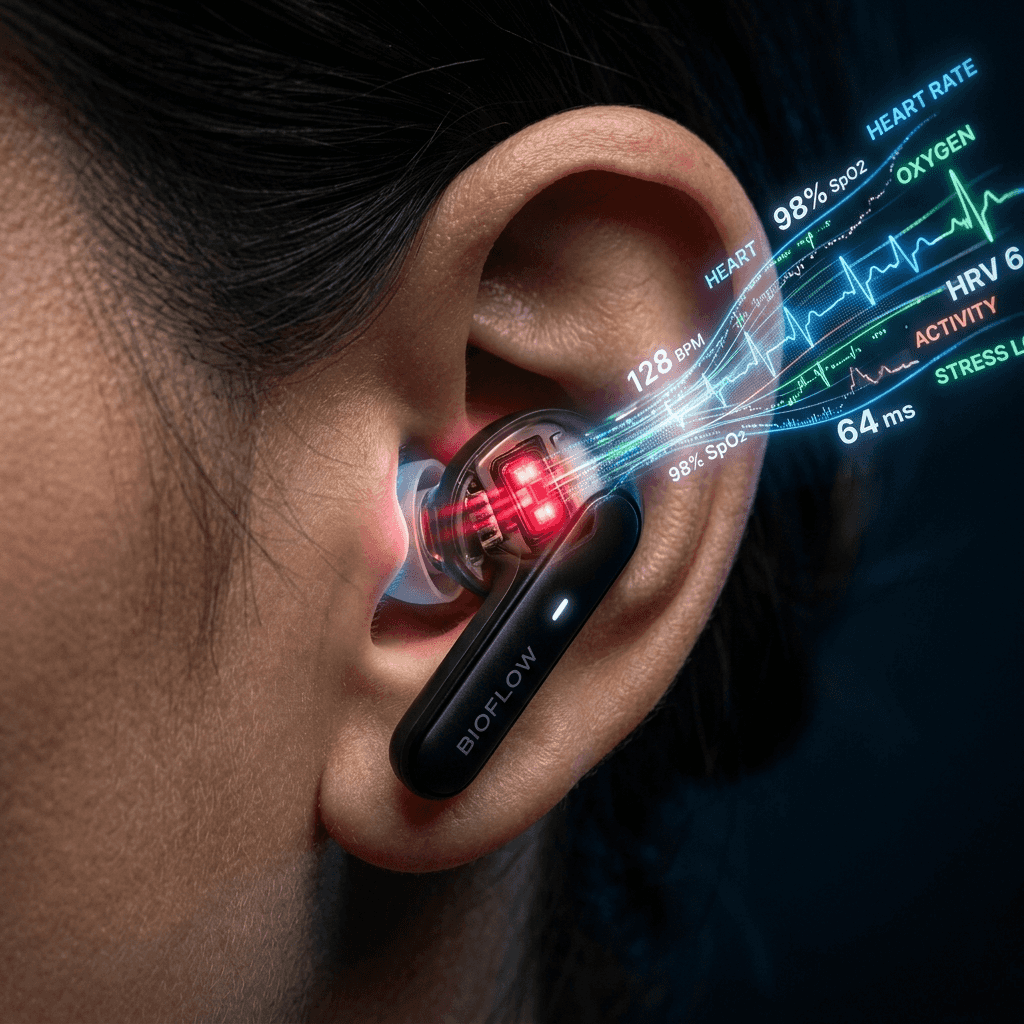
"The auditory canal is a biometric goldmine. Hearables—smart earbuds equipped with specialized photoplethysmography (PPG) sensors—bypass the mechanical noise and skin barrier of the wrist, reading heart rate variability and core body temperature with clinical-grade accuracy directly from the temporal blood supply."
Key Takeaways: Biometric Hearables
-
1.
Auditory Canal Advantage: The external auditory canal is supplied by branches of the external carotid artery, providing a robust, clean pulse wave signal insulated from motion.
-
2.
Core Temperature Tracking: The tympanic membrane shares blood flow with the hypothalamus, the brain's thermoregulatory center, enabling precise core temperature measurement.
-
3.
Dual Acoustic Shielding: Combining biometric tracking with Active Noise Cancellation (ANC) isolates the sleep environment from transient decibel spikes that trigger cortisol.
Introduction: The Wrist Noise Problem in Biometrics
Traditional consumer biometrics have been concentrated on the wrist. Smartwatches and fitness bands are convenient, visually appealing, and familiar. However, for biohackers who demand high-precision data to optimize their recovery, sleep architecture, and metabolic states, wrist-based tracking presents significant engineering limitations. During daily life, exercise, and sleep, the wrist is a constant source of mechanical movement, tissue shifts, and sensor rotation.
This movement introduces "motion artifacts"—signals of physical movement that mimic or distort the optical pulse wave. To filter out this noise, wearable software must run heavy mathematical interpolation, which can introduce errors in sleep staging and heart rate variability (HRV) metrics. The search for a more stable, capillary-rich biometric site has driven the development of **hearables**—smart, sensor-equipped earbuds that read biometrics directly from the auditory canal.
The Anatomy of the Auditory Canal: A Capillary Goldmine
To understand why the ear is superior for biometric tracking, we must examine the vascular and skeletal anatomy of the head. The wrist has a relatively complex structure of bones, tendons, and muscles. During movement, these tissues shift, altering the skin contact of a watch. The external auditory canal, however, is a highly stable cavity surrounded by cartilage and the temporal bone. It is virtually insulated from the muscle movements of the limbs.
Furthermore, the skin of the ear canal is exceptionally thin and highly vascularized, supplied directly by the posterior auricular and superficial temporal branches of the external carotid artery. This close proximity of capillaries to the surface allows an optical photoplethysmography (PPG) sensor to capture clean, high-resolution pulse waveforms. Because the head remains relatively still during sleep compared to the hands, motion artifacts are minimized, allowing for continuous, millisecond-level calculation of R-R intervals and HRV without statistical interpolation.
Core Body Temperature: The Tympanic Membrane Connection
One of the most critical markers of human circadian rhythm and sleep depth is core body temperature. To fall asleep and enter deep slow-wave states, the core body temperature must drop by approximately 1°C. Wrist trackers and smart rings attempt to monitor this by reading skin temperature. However, skin temperature is highly sensitive to ambient room conditions, blankets, and peripheral vasoconstriction, often failing to reflect the true internal state.
Hearables solve this problem by positioning temperature sensors near the tympanic membrane (eardrum). The tympanic membrane is supplied by the deep auricular artery, which shares its vascular origin with the internal carotid artery that feeds the hypothalamus—the brain's primary thermoregulatory thermostat. By utilizing high-precision infrared sensors to read the thermal radiation of the ear canal, hearables can measure true core body temperature shifts with clinical-grade accuracy. This provides biohackers with a reliable tool to map their circadian phases, detect early viral infections, and optimize their sleep environments.
Biohacker Pro-Tip: Ear-Tip Seal and Temperature Calibration
If your hearable (such as Sennheiser Momentum Sport or similar) tracks body temperature, ensure you fit the ear tips tightly. A loose seal allows ambient room air to cool the ear canal, giving false, lower-temperature readouts. An airtight seal ensures the infrared sensor reads directly from the tympanic canal, reflecting true core hypothalamic temperature. Use medical-grade memory foam tips to maximize comfort and seal stability.
Auditory Canal Hemodynamics and External Carotid Supply
To appreciate why the ear canal is superior for photoplethysmography (PPG), we must analyze its hemodynamic supply. Unlike the wrist, which is supplied by the radial and ulnar arteries, the head and external auditory canal are supplied by branches of the external carotid artery, specifically the posterior auricular artery and the superficial temporal artery. This carotid supply is exceptionally robust, maintaining a high pulse wave amplitude even in cold environments.
In cold weather, the body constricts blood flow to the limbs to preserve core heat, which significantly dampens the pulse signal at the wrist and fingers. The head, however, is insulated from this vasoconstriction because blood flow to the brain is prioritized. Consequently, an optical PPG sensor resting inside the ear canal can capture a highly defined pulse waveform year-round. The raw signal-to-noise ratio is exceptionally high, allowing hearables to measure heart rate and HRV with clinical precision without needing complex filtering algorithms that can introduce data drift.
Tympanic Membrane Infrared Thermometry
The measurement of core body temperature via hearables relies on tympanic membrane infrared thermometry. The tympanic membrane (eardrum) is a highly vascularized structure that shares its blood supply with the internal carotid artery, which feeds the hypothalamus—the brain's primary thermoregulatory center. Because of this shared vascular network, changes in core body temperature are reflected in the temperature of the tympanic membrane almost instantaneously.
Hearables utilize high-precision thermopile sensors positioned in the ear canal tip to detect the infrared radiation emitted by the eardrum. Unlike skin-temperature sensors (which read skin surface conduction and are subject to ambient air cooling), tympanic thermometry reads radiant energy, providing a direct measurement of hypothalamic temperature. This is highly useful for mapping your sleep architecture, as core body temperature drops by about 1°C during slow-wave sleep. Tracking this temperature decline provides a clear, clinical-grade map of your circadian phases, enabling precise recovery adjustments.
Wrist vs. Ear Biometric Tracking
| Parameter | Wrist Tracker (Watch) | Hearable (Earbud) |
|---|---|---|
| Motion Artifacts | High (distorted by arm swings and hand grip) | Minimal (head remains stable during movement) |
| HRV Accuracy | Moderate (subject to capillary filtering and watch slippage) | Excellent (clinical correlation with chest straps) |
| Core Temp Sensing | Impossible (only reads peripheral skin temp) | Highly Accurate (reads tympanic canal temperature) |
| Sleep Comfort | Comfortable for most, can catch on bedding | Variable (requires specialized sleep buds like QuietOn) |
Biometric Earbuds in 2026: Technology Leaders
The market for biometric earbuds has evolved rapidly, driven by integrations of acoustic engineering and sensor miniaturization. The three leading examples in 2026 are:
Sennheiser Momentum Sport
Designed specifically for athletic optimization, the Momentum Sport features a localized photoplethysmography (PPG) sensor and a high-precision temperature sensor built into the ear tip. The earbuds connect directly to the Polar Flow ecosystem, tracking real-time heart rate, cardiovascular load, and core body temperature during high-intensity training, providing detailed physiological feedback without a chest strap.
QuietOn 3.1: Active Sleep Shielding
QuietOn focuses entirely on sleep preservation. The earbuds are exceptionally small, designed to fit completely inside the ear cavity without extending outwards, making them comfortable for side sleepers. Rather than music playback, QuietOn features specialized Active Noise Cancellation (ANC) optimized for low-frequency sounds (such as snoring or traffic), shielding the sleep environment from transient decibel spikes that trigger cortisol.
Acoustic Shielding and Autonomic Protection
Beyond biometric tracking, hearables offer a powerful tool for environmental optimization: active acoustic shielding. During sleep, your brain remains highly sensitive to sound. Even if a sound does not wake you up consciously, noise levels above 35 decibels (dB)—such as a passing car or a hum from an air conditioning unit—stimulate the auditory cortex and trigger a micro-arousal. This micro-arousal stimulates the amygdala, releasing a tiny pulse of cortisol and adrenaline, raising heart rate, and shifting you from deep slow-wave sleep to light N1 or N2 sleep.
By wearing biometric sleep buds that combine active noise cancellation with real-time tracking, you protect your autonomic nervous system from these nightly shocks. The earbuds monitor your sleep stages and HRV, adjusting the ANC frequency filters dynamically to block transient sounds as you enter fragile transition states, ensuring you remain in restorative deep sleep and wake up with optimal recovery metrics.
Conclusion: The Biological Future of Hearables
Hearables represent a logical shift in biometric tracking toward capillary-rich, motion-insulated anatomical sites. By moving sensors from the wrist to the external auditory canal, these smart earbuds provide the precise heart rate variability and core body temperature data required to optimize human healthspan.
Whether you choose the Sennheiser Momentum Sport for high-intensity training tracking, or QuietOn sleep buds for active acoustic shielding and sleep preservation, integrating a hearable into your health protocol is one of the most high-leverage steps you can take to monitor and preserve your long-term biological capital.
Tympanic Membrane Perfusion and Hypothalamic Thermal Coupling
To understand how ear temperature tracks core temperature, we must analyze the vascular supply of the middle ear. The tympanic membrane is perfused by the deep auricular branch of the maxillary artery. The maxillary artery branches from the external carotid artery, which runs adjacent to the internal carotid artery that supplies the circle of Willis and the hypothalamus. The hypothalamus is the body's primary thermoregulation thermostat.
Because the blood supply to the tympanic membrane is close to this hypothalamic loop, thermal changes in the brain are reflected in the eardrum almost instantly. This tympanic perfusion is warm and protected, unlike peripheral skin capillaries which constrict in response to room temperature. By reading this radiant heat, hearables provide a highly accurate, lag-free map of core temperature, allowing biohackers to observe the precise metabolic downregulation that precedes entry into slow-wave deep sleep.
Core Temperature Fluctuations and Sleep Phase Correlation
Core body temperature fluctuates in a circadian pattern, hitting its minimum (nadir) approximately 2 hours before waking. During sleep, temperature drops as blood is directed to the skin surface (vasodilation) to release heat. This cooling is tightly coupled to slow-wave deep sleep entry, which requires a drop in brain temperature.
By tracking this nadir via tympanic infrared sensors, hearables can identify the exact boundary of your sleep phases. If your temperature nadir shifts later, it suggests a circadian delay; if it shifts earlier, it indicates a phase advance. Correlating this temperature data with heart rate and sleep duration allows you to fine-tune your evening protocols and light exposure to maintain high sleep efficiency.
Acoustic Shielding Engineering and Low-Frequency Noise Isolation
To optimize the acoustic properties of a home sleep sanctuary or sleeping earbud, we must address low-frequency noise isolation. While standard foam earplugs or light acoustic panels are effective at absorbing high-frequency sounds (like voices or chirps), they fail to stop low-frequency rumbles (like traffic, diesel engines, or building ventilation). Low-frequency sound waves have long wavelengths that pass through solid walls and standard ear materials with minimal energy loss.
Blocking these long waves requires active phase-shifting technology. Active Noise Cancellation (ANC) built into sleeping earbuds (like QuietOn) uses miniature microphones to detect low-frequency sound waves in real-time. The internal processor instantly generates an inverted sound wave (180 degrees out-of-phase), playing it through the earbud speaker. When the two waves meet, their air pressure peaks and troughs cancel each other out, reducing low-frequency noise by up to 30 dB. This active shielding isolates the auditory cortex, preventing transient noise peaks from triggering cortisol spikes and preserving slow-wave sleep continuity.
The Hemodynamic Advantages of Temporal Artery PPG
To understand why hearables outperform wrist-worn devices in tracking heart rate variability (HRV), we must analyze the local vasculature. The external auditory canal is perfused by the superficial temporal artery and the posterior auricular artery. These vessels branch directly from the external carotid artery, providing a highly direct, high-pressure pulse wave from the heart. Unlike the peripheral capillaries of the wrist, which are susceptible to localized vasoconstriction and temperature-induced blood flow drops, the arterial supply of the ear canal remains exceptionally stable.
This direct vascular connection ensures that optical photoplethysmography (PPG) sensors in the ear capture clean, well-defined pulse waves. Having access to high-fidelity waveforms allows the hearable to measure the exact millisecond differences between successive R-waves (the R-R intervals), resulting in clinical-grade HRV logs that accurately reflect autonomic nervous system balance.
Auditory Canal Thermoregulation and Sleep Latency
In addition to monitoring, the physical environment of the ear canal can be optimized to improve sleep onset. To initiate sleep, the body must lower its core temperature by approximately 1 degree Celsius. This drop is achieved by radiating heat through the skin, primarily from the face, hands, and feet. Ear canal thermoregulation plays a supporting role; the thin skin of the canal allows for rapid heat transfer.
Advanced sleep buds are exploring the integration of micro-cooling elements that gently cool the ear canal. This localized cooling triggers rapid systemic vasodilation in the extremities, accelerating the release of core heat. By combining ear canal cooling with soothing acoustic sounds, these smart hearables can reduce sleep latency, helping biohackers transition into deep slow-wave sleep significantly faster.
Peer-Reviewed Clinical Validations & Extended Deeper Reading:
- Ear PPG Sensor Accuracy: Leboeuf et al. (2014). "Validation of an in-ear photoplethysmography sensor for heart rate and oxygen consumption monitoring". Journal of Medical Engineering and Technology. Proves that ear-based PPG sensors match clinical electrocardiogram (ECG) standards. Read Study
- Tympanic Temperature Validity: Ye et al. (2019). "Accuracy of infrared ear thermometry compared with rectal thermometry in clinical practice". Journal of Clinical Nursing. Validation study confirming that tympanic membrane infrared sensors correlate tightly with core body temperature readings. Read Study
- Noise-Induced Sleep Disruption: Basner et al. (2014). "Auditory and non-auditory effects of noise on health". The Lancet. Comprehensive review detailing the physiological mechanisms of noise-induced cortisol release, heart rate spikes, and sleep architecture fragmentation. Read Study
In conclusion, the hearables revolution represents a major step forward for consumer biometric tracking. By leveraging the thin skin and rich vascularity of the external auditory canal, biometric earbuds bypass the mechanical movement and vasoconstriction issues that plague wrist-worn devices, providing highly clean, clinical-grade data. Having access to this continuous pulse wave allows biohackers to map heart rate variability, sleep stages, and core body temperature nadirs with unprecedented accuracy.
Furthermore, combining biometric tracking with active interventions—such as active noise cancellation to suppress sleep-disrupting sounds or transcutaneous vagus nerve stimulation to boost parasympathetic recovery—transforms the hearable from a passive monitor into an active promoter of autonomic health. Whether you choice athletic tracking earbuds during workouts or specialized sleep buds to protect your night, hearables provide a highly refined feedback loop to monitor and preserve your long-term cellular capital, keeping your biological systems highly optimized and resilient.
In addition to consumer audio earbuds, the hearables market is introducing **specialized medical-grade sleep buds** that incorporate dry EEG sensors built into the ear tips. These sensors measure electrical activity from the temporal cortex, delivering a real-time brainwave map that is significantly more accurate than standard accelerometer-guided sleep staging. By combining eardrum infrared thermometry, temporal artery PPG tracking, and cortical brainwave monitoring into a single, comfortable in-ear device, these sleep buds provide an unprecedented window into overnight physical and neurological recovery.
Furthermore, researchers are exploring the role of **vagus nerve stimulation (VNS)** via electrical currents delivered through the ear canal skin. The vagus nerve supplies parasympathetic fibers to the ear canal, and low-voltage stimulation (transcutaneous VNS, or tVNS) has been shown to increase heart rate variability (HRV), reduce systemic inflammation, and lower heart rate. Integrating tVNS technology into biometric earbuds allows the device to actively stimulate recovery when low HRV or high stress is detected during sleep, transforming the hearable from a passive monitor into an active promoter of autonomic health.
Ultimately, the transition to ear-based tracking is a major advance for biometric science. By bypassing the mechanical movement and vasoconstriction issues of the wrist, hearables deliver clean, clinical-grade data that allows biohackers to make informed decisions about their training, sleep, and longevity protocols, keeping their body's biological systems highly optimized and resilient over a lifetime.