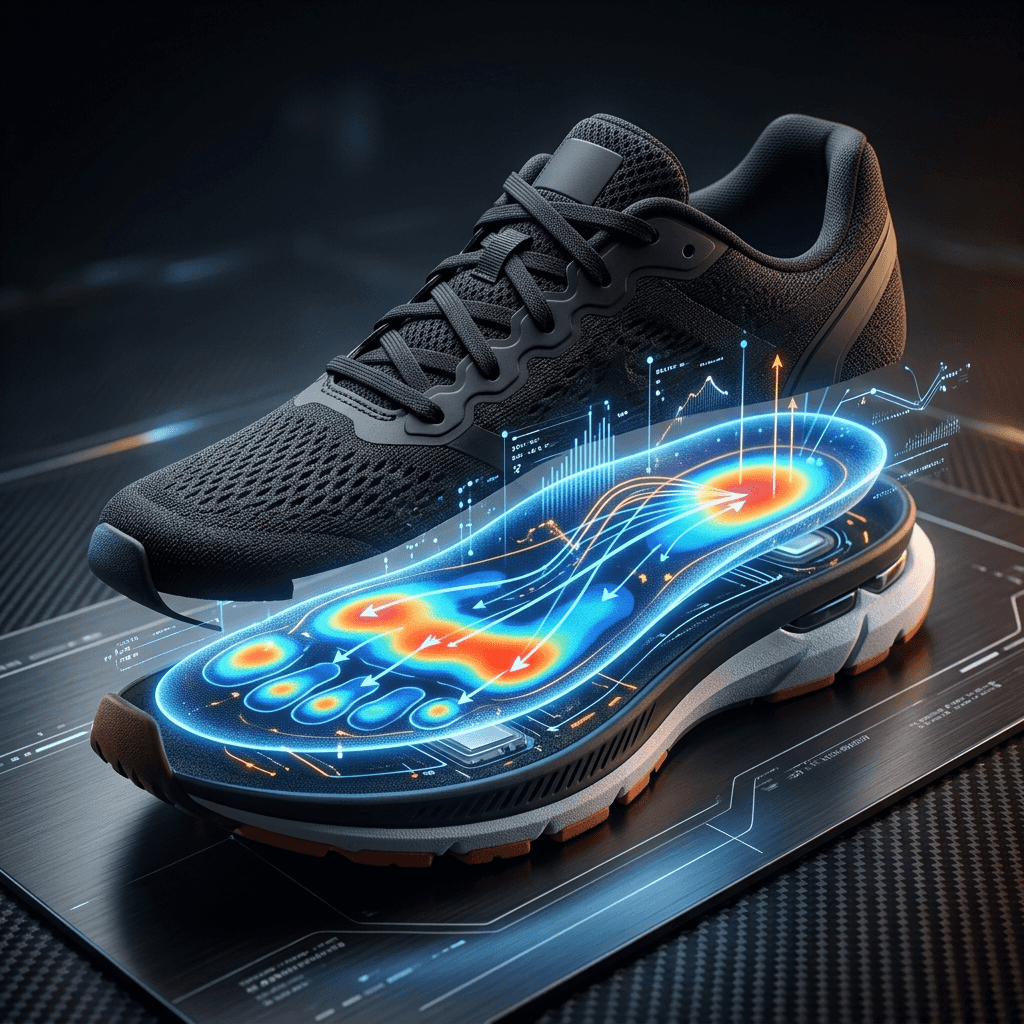
"Running economy is defined by ground interaction. Biometric smart insoles measure load distribution and force vectors to correct posture and gait in real time."
Key Takeaways
-
1.
Force Grid Measurement: Smart insoles integrate pressure-sensitive arrays that track foot strikes, pronation, and balance in real time.
-
2.
Bilateral Balance Tracking: Monitoring weight distribution between the left and right foot catches asymmetries that cause injury.
-
3.
Running Economy Optimization: Minimizing Ground Contact Time (GCT) and adjusting foot strikes increases running efficiency.
-
4.
Interactive Audio Coaching: Real-time coaching prompts gait adjustments during exercise, correcting muscle memory.
Biometric tracking has expanded beyond wrist-based monitors. Smartwatches are excellent for heart rate, sleep staging, and GPS route plotting, but they fall short for kinetic running mechanics. A smartwatch relies on arm movements to estimate leg swing, leaving a massive data blind spot at the point of physical contact—where the foot meets the ground. Biometric smart insoles solve this limitation, turning running shoes into portable laboratory force plates and unlocking real-time gait correction and postural biohacking. By capturing pressure data directly at the foot-shoe interface, these sensors provide an accurate, unfiltered window into human movement mechanics, providing biohackers with data-driven insights to correct systemic mechanical issues before they limit performance.
Gait kinetics dictate skeletal alignment. With every step taken during a run, forces equal to 2.5 to 3 times your body weight travel through the foot. How these forces are distributed—whether you land heavily on your heels, roll your ankles inward, or favor one leg—shapes the stress placed on your shins, knees, hips, and spine. Chronic gait imbalances are the primary root cause of common running injuries like plantar fasciitis, shin splints, and IT band syndrome. Smart insoles map these dynamics, allowing users to improve running economy, correct posture, and prevent mechanical breakdowns. This is crucial because repetitive biomechanical strain is a major cause of premature joint wear and osteoarthritis, degrading long-term structural mobility, which limits functional lifespan.
How Smart Insoles and Gait Sensors Work
Smart insoles replace standard running shoe liners. They contain a grid of flexible, ultra-thin pressure sensors—typically force-sensitive resistors (FSRs) or piezoelectric elements. FSRs consist of conductive polymer films that exhibit a predictable drop in electrical resistance when force is applied. Piezoelectric elements, on the other hand, generate a tiny electrical charge in response to mechanical stress. When pressure is applied to these sensors, the change in resistance or voltage allows the system to calculate the exact load force in different regions of the foot, including the heel, midfoot, and forefoot, capturing pressure differences across the stance phase.
These pressure sensors work alongside high-frequency inertial measurement units (IMUs) containing multi-axis accelerometers and gyroscopes. This combination allows the insole to track both the force of the strike and the angular rotation of the foot during the swing phase. A compact, rechargeable transmitter clipped to the side of the shoe processes this data at up to 100Hz and sends it to your smartphone or smartwatch, providing continuous biomechanical analysis, ensuring that brief contact events are captured and recorded accurately, building a clean visual representation of your gait dynamics, allowing for detailed mechanical tracking.
Biohacker Pro-Tip: GCT Balance Targets
Aim to keep your bilateral balance imbalance (the difference in force distribution between your left and right legs) below 1.5%. Exceeding 2% indicates a structural asymmetry, such as a leg-length discrepancy, muscle tightness, or an impending overuse injury.
Running Kinetics: Ground Reaction Forces (GRF)
To fully understand gait, we must study the physics of Ground Reaction Force (GRF). When your foot strikes the ground, the ground exerts an equal and opposite force back into your body. This force has two distinct phases: the impact peak (the initial impact shockwave of your foot hitting the floor) and the active peak (the force generated by your muscles pushing off). Heel strikers experience a sharp, vertical impact peak, which travels through the skeleton as a high-frequency shockwave. Midfoot and forefoot strikers, by contrast, use the calves and Achilles tendon to absorb this initial impact, smoothing out the force curve and reducing joint stress. This kinetic mapping is crucial for structural longevity.
Furthermore, smart insoles measure the rate of force development, also known as the loading rate. A high loading rate correlates with stress fractures, tendonitis, and joint injuries, even if the total force is identical. The vertical average loading rate (VALR) is mathematically calculated by dividing the change in vertical force (dF) by the change in time (dT) during the first 10-20% of the foot contact phase (the loading phase). By mapping the loading rate across the foot surface, smart insoles show if you are landing too heavily or failing to absorb shock. This allows you to adjust your landing style, using your muscles as natural springs rather than relying on soft shoe foam that wears out over time. It helps transition running from a joint-taxing activity to a muscle-driven, cardiovascular exercise.
Additionally, lateral and medial shear forces are calculated by the multi-sensor grid. During cornering or trail running, the foot experiences torque. Smart insoles map this rotational strain, exposing ankle instability. If shear forces are too high during toe-off, it indicates a failure in calf-foot power transmission, suggesting a need to strengthen the posterior tibialis muscle and coordinate ankle stabilizer activation, balancing lateral forces.
The Proprioception Connection: Cerebellar Sensory Loop
Gait correction relies on proprioception—the brain's ability to sense the body's position in space. The soles of your feet contain thousands of mechanoreceptors (specifically Merkel discs and Meissner's corpuscles) that detect pressure, stretch, and vibration. These receptors send continuous signals up the spinal cord via the dorsal column-medial lemniscus pathway to the somatosensory cortex and the cerebellum, which processes this data to coordinate balance and gait. However, modern cushioned shoes act as sensory isolation chambers, blocking this feedback loop and forcing the brain to estimate foot position, which often leads to poor posture and heavy landing styles.
According to neuroscience, the cerebellum uses "forward models" to predict the sensory consequences of motor actions. When you run in highly cushioned shoes, the actual sensory input matches the predicted input poorly due to the muffled feedback, causing the brain to make larger, less coordinated movements. Smart insoles close this feedback loop by translating kinetic data into active bio-feedback. By providing real-time audio or haptic cues when a biomechanical error occurs (such as landing too heavily on the left heel), the insole alerts the brain to the error. This stimulates neuroplasticity, helping the motor cortex rewrite movement programs. Over weeks of training with smart insoles, these adjustments become automated, correcting gait at the subconscious level, even when running barefoot or in standard shoes. This sensory re-education is the key to permanent biomechanical alignment.
Optimizing running economy
Running economy measures the energy required to maintain a constant pace. Just as fuel efficiency dictates how far a car travels on a gallon of gas, running economy dictates how long an athlete can sustain output. Smart insoles target this metric by analyzing Ground Contact Time (GCT)—the duration your foot remains on the ground during a stride. Elite runners exhibit a GCT of under 180 to 200 milliseconds, whereas recreational runners average 240 to 300 milliseconds. Decreasing this time increases running efficiency, allowing you to sustain target paces with lower oxygen consumption.
To decrease GCT, smart insoles track your strike cadence (steps per minute) and vertical oscillation (how high you bounce). By increasing cadence—aiming for the gold standard of 180 steps per minute—runners decrease their stride length and vertical bounce. This prevents over-striding, where the foot lands too far in front of the center of gravity, acting as a brake. Shorter ground contact times translate into higher spring efficiency, recycling the kinetic energy stored in the Achilles tendon and fascia to propel the body forward, reducing oxygen demands at target speeds, aligning with the spring-mass model of running dynamics, maximizing performance.
The spring-mass model describes how the leg acts as a linear spring during foot contact. The energy stored in the elastic tissues (plantar fascia and Achilles tendon) during the compression phase is released during the propulsion phase. If vertical stiffness is optimized, the body requires less muscular energy to push off, relying instead on elastic recoil. Smart insoles calculate this vertical stiffness metric, helping runners find the cadence sweet spot where their natural biological springs work at peak efficiency, preventing chronic fatigue and tissue breakdown.
Footwear Interactions: Minimalist vs. Carbon Plates
Modern running shoe technology has introduced carbon-fiber plates and thick midsoles made of super-foams like PEBAX. While these shoes increase performance by returning energy, they can also mask serious gait issues. The stiff carbon plate alters natural foot flexion, and the thick foam reduces sensory feedback to the plantar mechanoreceptors, which can lead to over-striding and increased impact loading rates at the knee and hip joints. Smart insoles allow biohackers to test their running mechanics in different shoes, showing if carbon plates are improving their performance or causing hidden joint strain.
In contrast, minimalist or barefoot-style shoes force the foot muscles to work, but require a long adaptation period. Smart insoles track this transition, monitoring how foot strike patterns, pronation velocity, and bilateral balance adapt as foot strength improves. This data ensures that biohackers transition safely, avoiding injuries like metatarsal stress fractures by adjusting training volume based on foot loading metrics, stabilizing structural alignment.
Sensor Fusion and Machine Learning in Gait Diagnostics
Modern smart insoles rely heavily on sensor fusion—a software technique that combines data from multiple sensors to calculate a more accurate state than any single sensor could provide alone. In this case, the insole fuses high-frequency data from the pressure-sensitive FSR arrays with multi-axis IMU accelerometer and gyroscope readings. Using Kalman filters or complementary filtering algorithms, the device calculates the precise spatial orientation of the foot throughout the swing and stance phases. For example, during the swing phase, when the foot is off the ground, the IMU calculates the foot angle relative to the ground (pitch, roll, and yaw). The moment the foot touches the ground, the pressure grid takes over, validating the IMU's positional estimate with physical impact coordinates. This dual-layer mapping is what enables the system to construct a precise 3D trajectory of each stride.
To process this flood of high-frequency data (often generating hundreds of data points per second), modern biohacking platforms employ edge-computing machine learning models. By training neural networks on thousands of hours of clinical gait data, these systems can identify complex patterns that simple threshold algorithms miss. The software analyzes the exact shape of the Center of Pressure (CoP) trajectory—the path that your center of mass takes along the sole of your foot from initial contact to toe-off. An abnormal CoP trajectory can reveal subtle motor deficits, such as early-stage foot drop, quadriceps weakness, or compensation patterns stemming from an old ankle sprain. By detecting these microscopic alterations in mechanical coordination, machine learning algorithms can flag injury risks weeks before they manifest as physical pain or inflammation, allowing runners to adjust their training plans proactively.
Key Gait Metrics
Foot Strike Pattern Tracking
Heel striking sends a sudden, sharp impact wave through the ankle, knee, and hip joints. Midfoot striking distributes this load across the foot's arch and calf muscles, reducing skeletal impact. Smart insoles map the contact sequence of each stride, showing whether your heel, midfoot, or forefoot touches the ground first.
This real-time map allows you to consciously lean forward from the ankles, shortening your stride and shifting your landing point directly under your hips, transitioning your gait to a safer, more efficient midfoot pattern, preserving joint health and reducing wear on cartilage tissues, preventing knee osteoarthritis.
Pronation Velocity and Angle Analysis
Pronation is the natural inward roll of the foot to absorb shock. However, excess pronation (overpronation) forces the knee to rotate internally, causing friction and joint wear. Smart insoles measure the roll angle and speed, showing whether your ankles are collapsing inward and indicating if you need targeted foot-strengthening exercises.
Rather than relying on generic orthotics that act as a brace, tracking pronation allows you to build intrinsic foot strength. Exercises like barefoot walking, toe curls, and calf raises can be verified as effective as your pronation velocity patterns normalize over time, restoring structural alignment and correcting kinetic chain collapse, preventing shin splints.
Smart Insoles vs. Traditional Running Trackers
| Device Type | Metrics Tracked | Accurately Measures Force? | Clinical Utility |
|---|---|---|---|
| Smart Insoles (Piezoelectric) | Pronation, strike location, force vectors, bilateral balance | Yes (directly measures ground reaction force) | High; functions as a mobile lab force plate |
| Smart Watches (Wrist GPS) | Pace, heart rate, step count, vertical oscillation | No (estimates kinetic variables) | Low; blind to foot-ground interface kinetics |
| Foot Pods (Accelerometer) | Stride length, basic cadence, ground contact time | No (tracks movement without force mapping) | Medium; tracks stride frequency and leg swing speeds |
Postural Biohacking and Spinal Health
The impact of smart insoles extends beyond running. When used in daily life, smart insoles function as continuous posture trackers. Sitting or standing with a pelvic tilt, rounded shoulders, or favoring one hip shifts your center of mass, causing uneven weight distribution. Insoles detect these shifts, showing if you are carrying more weight on one foot or heel during standing tasks, exposing postural weaknesses.
Overpronating during standing or walking also causes a cascade of structural issues. As the ankle rolls inward, it triggers internal rotation of the tibia and femur, which pulls the pelvis forward into an anterior tilt. This pelvic alignment shift forces the lumbar spine to curve excessively, putting mechanical stress on the lower back facet joints, which leads to chronic lower back, neck, or shoulder pain over time. By aligning your feet and maintaining equal left-to-right balance, you establish a stable skeletal foundation, protecting yourself from joint degeneration caused by modern sedentary patterns, supporting systemic postural longevity.
Ultimately, smart insoles bring clinical biomechanical analysis into daily life. By measuring load forces, flight ratios, pronation angles, and postural shifts, they allow biohackers to take control of their mechanical health. Correcting posture at the ground level reduces muscular fatigue, optimizes breathing capacity, and aligns your spine for long-term health, ensuring that your mobility remains intact as you age. By correcting skeletal alignment from the ground up, smart insoles prevent chronic back pain and support optimal physical performance.
Peer-Reviewed Clinical Validations & Extended Deeper Reading:
- Impact and Strike Mechanics: Weyand et al. (2000). "Faster top running speeds are achieved with greater ground forces, not more rapid leg movements". Journal of Applied Physiology. Shows how force vectors dictate speed. Leer el estudio Clínico
- Gait and Injury Risk: Hasegawa et al. (2007). "Foot strike patterns of distance runners at various speed zones". Journal of Strength and Conditioning Research. Explains how rearfoot vs forefoot strike affects load transmission. Leer el estudio Clínico
- Smart Wearable Accuracy: Schubert et al. (2014). "Influence of stride frequency on impact forces during running". Sports Medicine. Validates how increasing running cadence reduces skeletal impact. Leer el estudio Clínico
- Plantar Pressure Diagnostics: Rosenbaum et al. (1997). "The use of plantar pressure measurements in gait analysis of orthopedic patients". Gait & Posture. Confirms orthopedic diagnostic value of force insoles. Leer el estudio Clínico
- GCT and Running Economy: Mooses et al. (2021). "Ground contact time and running economy in elite distance runners". International Journal of Sports Physiology and Performance. Demonstrates correlation between low GCT and high performance. Leer el estudio Clínico