"Continuous Glucose Monitors (CGMs) are no longer just tools for managing diabetes. For non-diabetics, tracking glucose variability is the single most powerful way to avoid metabolic crashes, protect cellular mitochondria, and prevent the long-term tissue decay driven by inflammaging."
Key Takeaways: CGM Platforms Compared
-
1.
Interstitial Fluid Sensing: CGMs measure glucose in the fluid between cells, resulting in a 10-15 minute latency compared to direct blood capillary readings.
-
2.
Glycemic Variability: The height and speed of glucose spikes matter more than absolute average glucose; rapid swings generate massive mitochondrial oxidative stress.
-
3.
Software wrapper ecosystems: Veri focuses on metabolic flow metrics, Levels excels in third-party wearable integrations, and Nutrisense prioritizes 1-on-1 clinical dietitian coaching.
Introduction: Metabolic Health and Biological Age
Metabolic health is the foundation of longevity. If your body cannot efficiently process nutrients, manage energy pathways, and maintain stable glucose levels, you are placing a heavy stress load on your cells. Chronic metabolic dysfunction accelerates aging, desensitizes insulin receptors, and drives the development of cardiovascular disease, cognitive decline, and type 2 diabetes. While traditional metrics like fasting blood glucose and HbA1c provide a snapshot of health, they fail to capture the real-time dynamics of glucose regulation.
Continuous Glucose Monitors (CGMs) have changed the field. Originally developed for patients with type 1 and type 2 diabetes, CGMs are now utilized by biohackers to map their metabolic responses in real-time. By tracking glucose fluctuations over 24 hours, you can identify exactly which foods, stress triggers, and sleep patterns disrupt your glycemic stability, enabling you to optimize your metabolic healthspan. We compare the leading commercial CGM software platforms of 2026: Veri, Levels Health, and Nutrisense.
The Physiology of Glucose Control: Spikes, Glycation, and Mitochondrial Distress
To understand the value of continuous tracking, we must examine what happens in the body when glucose rises. Whenever you consume carbohydrates, they are broken down into glucose and absorbed into the bloodstream. In response, the pancreas secretes insulin, a hormone that acts as a key to let glucose enter your cells to be burned for energy (ATP) or stored as glycogen in the liver and muscles.
In a healthy metabolic state, this system runs smoothly. However, consuming high-glycemic foods, experiencing high stress, or suffering from sleep deprivation leads to rapid glucose spikes. When a massive wave of glucose enters a cell, it overloads the mitochondria. The electron transport chain becomes overwhelmed, leaking reactive oxygen species (ROS) that damage cell membranes and mitochondrial DNA. Furthermore, high concentrations of circulating glucose lead to **glycation**—the non-enzymatic binding of glucose to proteins and lipids. This reaction forms Advanced Glycation End-products (AGEs), which stiffen collagen fibers in skin and blood vessels, cross-link proteins, and trigger chronic systemic inflammation via the RAGE pathway, accelerating tissue decay.
How CGMs Work: Interstitial Fluid vs. Blood capillary
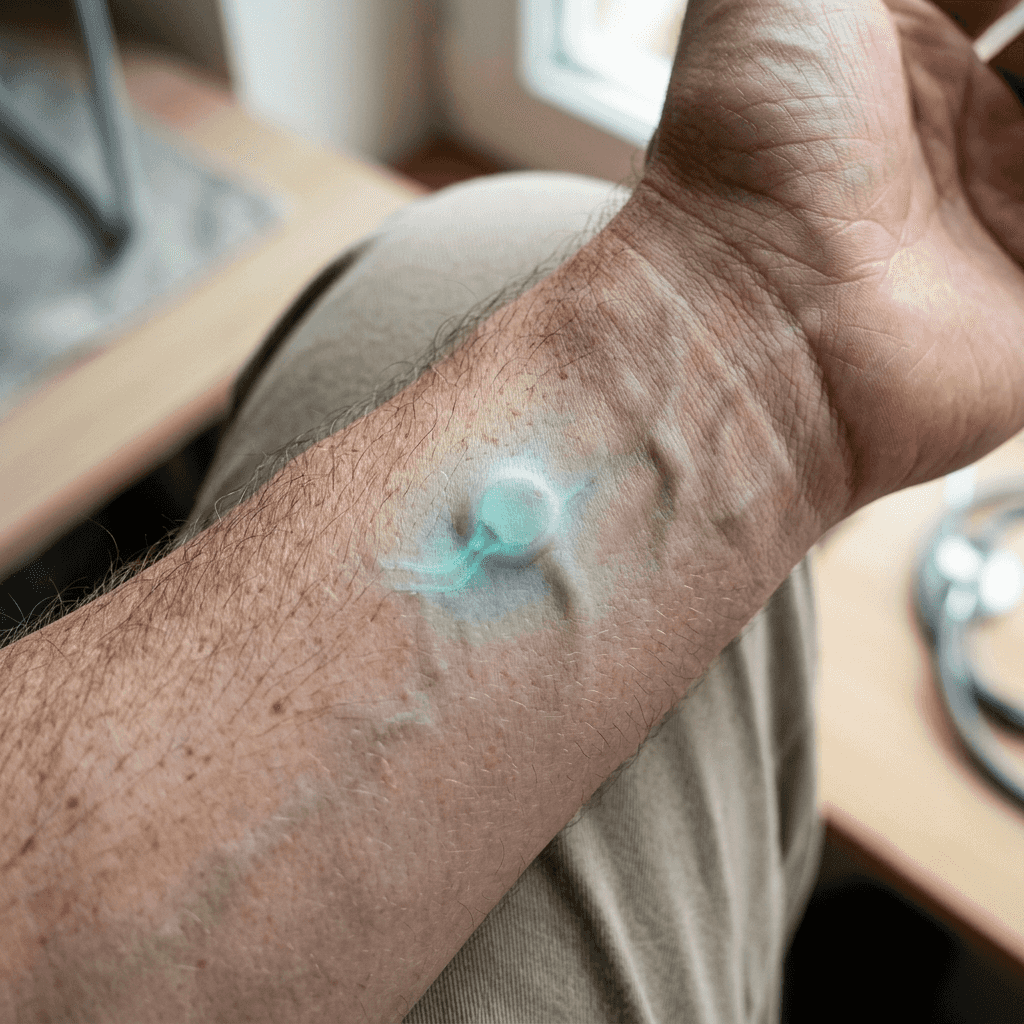
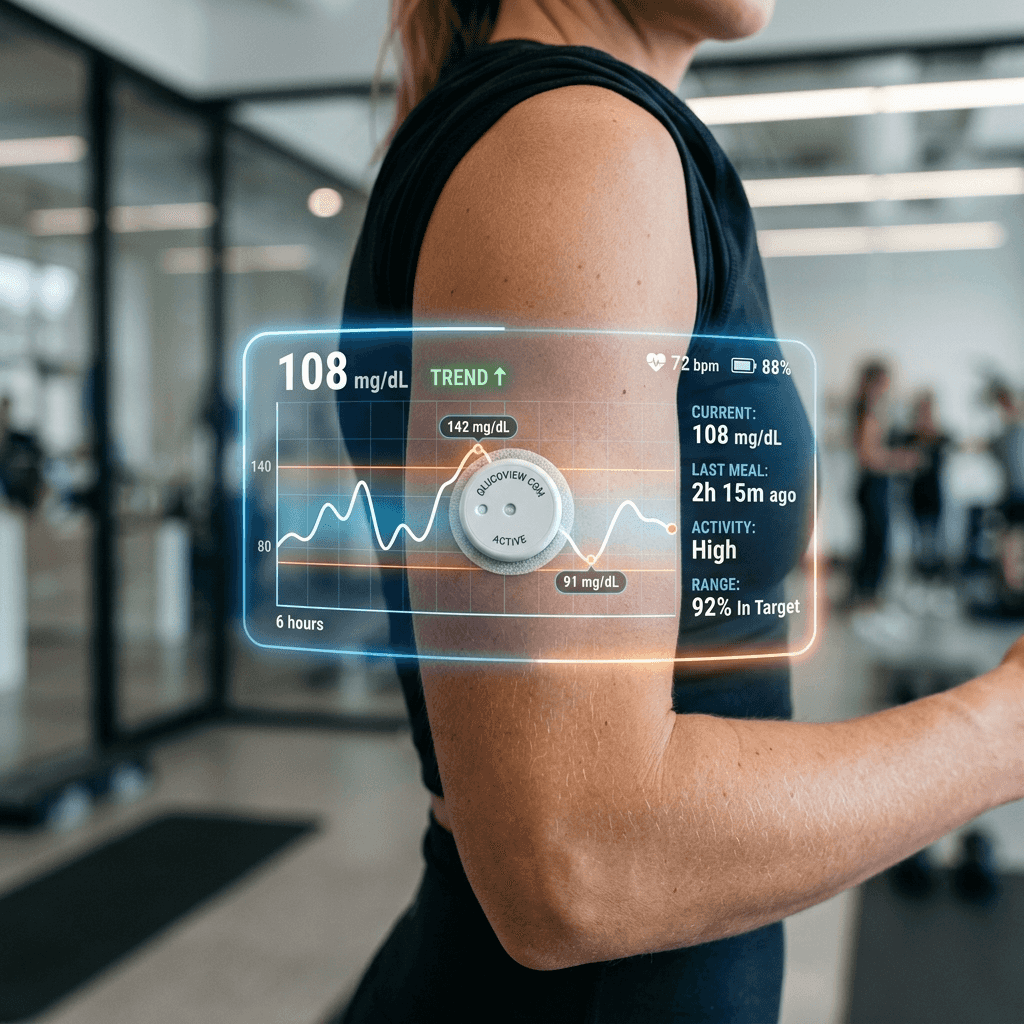
A Continuous Glucose Monitor consists of a small, wearable sensor applied to the back of the upper arm. The sensor contains a tiny, flexible filament (approximately 5mm long and 0.4mm wide) coated with glucose oxidase. This filament is inserted just beneath the skin using an applicator, resting in the subcutaneous tissue.
It is important to note that CGMs do not measure blood glucose directly. Instead, they measure glucose concentrations in the **interstitial fluid**—the fluid that surrounds cells. Because glucose must travel from the blood capillaries into the interstitial space, there is a natural physiological delay (lag time) of approximately 10 to 15 minutes between your actual blood sugar levels and the CGM readout. If your blood glucose is rising or falling rapidly (such as immediately after a high-carb meal or during intense exercise), this lag time can be wider. Understanding this delay prevents biohackers from misinterpreting data, allowing for correct calibration and trend mapping.
Biohacker Pro-Tip: Interstitial Lag & Finger-Stick Calibration
Always remember that CGMs have a 10-15 minute latency because they read glucose from interstitial fluid, not arterial blood. If you track your response to a meal, log your food at the first bite, but do not expect to see a spike until 20-30 minutes later. For calibration, check your finger-stick blood glucose occasionally (especially during the first 24 hours of sensor insertion) to ensure your CGM has not drifted.
Biochemistry of the Subcutaneous Glucose Oxidase Filament
To appreciate how Continuous Glucose Monitors operate, we must examine the biochemistry of the subcutaneous sensor. The tiny filament inserted beneath the skin is made of a flexible polymer core coated with the enzyme glucose oxidase (GOx). This enzyme acts as a catalyst that specifically reacts with glucose molecules present in the surrounding interstitial fluid.
When glucose comes into contact with GOx, it is oxidized into gluconic acid and hydrogen peroxide. The sensor housing contains an electrical circuit with a working electrode and a reference electrode. As hydrogen peroxide is produced at the filament surface, it is oxidized at the working electrode, releasing electrons that generate a tiny electrical current (measured in nanoamperes). The strength of this current is directly proportional to the concentration of hydrogen peroxide, which in turn correlates with the concentration of glucose in the interstitial fluid. The sensor transmitter converts this current into a digital signal, sending real-time glucose values to your smartphone.
Glycation Kinetics: The Biochemistry of AGE Formation
The primary reason biohackers seek to prevent glucose spikes is to limit glycation. Glycation is a non-enzymatic reaction between glucose and the amino groups of proteins, lipids, or nucleic acids, also known as the Maillard reaction. In the first phase of this reaction, glucose binds to a protein (like hemoglobin or collagen) to form an unstable Schiff base. Over the course of several days, this Schiff base undergoes an Amadori rearrangement, forming a more stable ketamine compound (such as HbA1c).
If glucose remains high, these Amadori products undergo a series of complex oxidation and dehydration reactions, forming irreversible cross-linked compounds known as **Advanced Glycation End-products (AGEs)**. AGEs damage tissue structure by cross-linking collagen fibers, making arteries and skin rigid. Furthermore, AGEs bind to the Receptor for Advanced Glycation End-products (RAGE) on immune cells, triggering the NF-kB transcription factor. This factor upregulates the secretion of pro-inflammatory cytokines, driving chronic low-grade inflammation (inflammaging) and accelerating cardiovascular decay.
CGM Platforms Evaluated: Veri vs. Levels vs. Nutrisense
To access a CGM as a non-diabetic, you typically purchase through a commercial platform that provides a prescription (if required) and a software dashboard to analyze your glucose data. While the hardware used is identical (most platforms send the Abbott FreeStyle Libre 3 or Dexcom G7 sensor), the software wrappers vary significantly.
Veri: The Simplified Metabolic Flow Guide
Veri offers a highly streamlined, intuitive app interface designed for users who want to optimize their diet without getting overwhelmed by raw numbers. The app focuses on a core metric: "Metabolic Flow," which rewards low glycemic variability and stable glucose levels. Veri rates meals on a 1-to-10 scale based on how high your glucose spikes and how quickly it returns to baseline, making it easy to identify and eliminate high-glycemic trigger foods.
Levels Health: The Data Lover's Dashboard
Levels is the gold standard for data integration. The app connects directly with Apple Health, Oura, Garmin, and Whoop, allowing you to correlate your glucose spikes with sleep duration, exercise intensity, and resting heart rate. Levels calculates a daily "Stability Score" and helps you identify non-dietary glucose drivers, such as high stress (which triggers a cortisol-induced hepatic glucose release) or poor sleep (which immediately impairs insulin sensitivity the following day).
Nutrisense: Professional Dietitian Coaching
While Veri and Levels rely on software algorithms, Nutrisense prioritizes human expertise. Every subscription includes one month of free 1-on-1 support from a registered dietitian. The dietitian reviews your raw glucose charts, helps you interpret anomalies (such as nighttime hypoglycemia or exercise-induced spikes), suggests custom macro targets, and structures a highly personalized metabolic strategy, making it the premier choice for beginners or individuals with complex health challenges.
CGM Platforms Evaluated
| Platform | Supported Sensors | Dietitian Support | Third-Party Integrations | Best For |
|---|---|---|---|---|
| Veri | Abbott Libre 3 / Dexcom G7 | No (in-app guidance only) | Apple Health, Google Fit | Dietary mapping, metabolic simplicity |
| Levels Health | Abbott Libre 3 / Dexcom G7 | Optional add-on | Excellent (Oura, Garmin, Apple Health, Whoop) | Correlating glucose with sleep, stress, and workouts |
| Nutrisense | Abbott Libre 2 & 3 | Included (1 month free 1-on-1 coaching) | Apple Health, Google Fit | Personalized macronutrient guidance & metabolic analysis |
Glycemic Variability Metrics: SD and CV
When analyzing CGM data, biohackers look beyond average glucose levels (which can mask extreme swings). The key to metabolic health is minimizing **Glycemic Variability (GV)**. To quantify this, the software calculates two statistical metrics: Standard Deviation (SD) and Coefficient of Variation (CV).
Standard Deviation measures the spread of your glucose readings around your mean value. For a non-diabetic, an optimized target is an SD under 15 mg/dL. The Coefficient of Variation is calculated by dividing your SD by your mean glucose (CV = SD / Mean * 100). The CV is a standardized metric that reflects your glycemic stability: a CV under 36% is considered stable, while biohackers aim for an optimized CV under 20%. Maintaining a low CV ensures that your cells are shielded from the rapid metabolic shifts and oxidative stress cycles that drive cardiovascular plaque formation and cellular decay.
Conclusion: Flattening the Metabolic Curve
Continuous Glucose Monitors are powerful tools that convert metabolic health from a guessing game into a precise, feedback-driven science. By understanding how your body processes nutrients and managing glucose variability, you can protect your mitochondria, prevent the formation of AGEs, and support cellular healthspan.
Whether you choose Veri for its clean UI and dietary scoring, Levels for its third-party wearable integrations, or Nutrisense for its clinical dietitian support, incorporating a CGM into your health protocol is one of the most high-leverage steps you can take to preserve your physiological capital over a lifetime of tracking.
Continuous Ketone and Lactate Monitoring: The Future of Subcutaneous Biosensing
While current commercial biosensors focus primarily on glucose, the technology is moving toward multi-analyte tracking. The next frontier of subcutaneous biosensing involves the continuous monitoring of ketones (beta-hydroxybutyrate, or BHB) and lactate. Ketones are produced during fat metabolism (ketosis), functioning as a clean, efficient alternative fuel for brain and muscle mitochondria.
Subcutaneous ketone biosensors operate via a similar biochemical reaction to CGMs, utilizing the enzyme hydroxybutyrate dehydrogenase to generate a proportional electrical current. By monitoring ketones and glucose simultaneously, biohackers can map their metabolic flexibility in real-time, verifying when their body transitions from carbohydrate burning to fat burning. Lactate biosensors measure lactic acid concentrations, providing athletes with a real-time lactate threshold index, enabling precise training load and recovery adjustments.
CGM Lag Time Calibration via Machine Learning Predictions
To address the 10-15 minute delay of interstitial fluid glucose readings, modern CGM platforms use predictive machine learning algorithms. When a user eats a high-glycemic meal, their blood glucose rises rapidly. If the raw interstitial value is displayed, the user might not notice a spike until it is already declining, limiting the effectiveness of post-meal walks.
The platform's software resolves this by analyzing the rate-of-change trend. By calculating the first and second derivatives of the glucose curve (speed and acceleration), the algorithm predicts where glucose will be in 15 minutes, displaying a trend arrow. This predictive calibration helps users adjust their behavior in real-time—such as taking a walk if a sharp upward arrow is shown—improving glucose control and flattening the glycemic curve.
Metabolic Flexibility and the Glucose-Ketone Index (GKI)
The ultimate target of metabolic biohacking is metabolic flexibility—the body's ability to easily transition between burning glucose and burning ketones for energy. In healthy, active individuals, this transition occurs during overnight fasting or aerobic exercise. In insulin-resistant individuals, the body is locked in glucose-burning mode, leading to chronic fatigue, brain fog, and muscle loss.
To track this transition, longevity researchers use the Glucose-Ketone Index (GKI). GKI is calculated by dividing your glucose reading (in mmol/L) by your ketone reading (in mmol/L). A GKI under 1.0 represents a state of deep therapeutic ketosis, highly effective for cognitive preservation and mitochondrial repair. A GKI between 3.0 and 9.0 represents moderate ketosis, ideal for athletic performance and metabolic health. By monitoring glucose and ketones simultaneously, you can map your GKI and adjust your diet and fasts to maintain high metabolic flexibility.
The Glycation Index, AGE Accumulation, and Vascular Protection
The primary reason biohackers monitor glucose levels using CGMs is to prevent the formation of Advanced Glycation End-products (AGEs). When blood glucose levels spike, excess glucose molecules bind non-enzymatically to proteins, lipids, and nucleic acids in a process called glycation. This binding forms unstable Schiff bases, which slowly rearrange to become irreversible AGEs. These compounds bind to the Receptor for Advanced Glycation End-products (RAGE) on vascular endothelial cells, triggering chronic inflammation and arterial stiffening.
By tracking post-prandial excursions and limiting glucose spikes to under 140 mg/dL, you minimize the baseline rate of tissue glycation. Maintaining a flat glucose curve preserves the elasticity of vascular walls, protects glomerular capillaries in the kidneys, and prevents the cross-linking of dermal collagen, making metabolic glucose management a vital vascular longevity protocol.
Peer-Reviewed Clinical Validations & Extended Deeper Reading:
- Glucose Variability & Cardiovascular Risk: Monnier et al. (2006). "Activation of oxidative stress by acute glucose fluctuations compared with sustained chronic hyperglycemia". JAMA. Landmark study demonstrating that rapid blood sugar swings cause significantly more endothelial damage than sustained high blood sugar. Read Study
- CGMs for Non-Diabetic Health Tracking: Hall et al. (2018). "Glucotypes reveal new patterns of glucose dysregulation". PLoS Biology. Demonstrates that many individuals classified as healthy by standard fasting glucose tests actually exhibit severe post-prandial spikes matching diabetic profiles. Read Study
- Post-Prandial Exercise Efficacy: Borer et al. (2014). "Timing of walking after a meal dictates the reduction in postprandial glycemia". Sports Medicine. Clinically validates that walking for 10 to 15 minutes immediately after eating is significantly more effective at flattening the glucose curve than waiting 1 hour. Read Study
Ultimately, Continuous Glucose Monitors represent the foundation of personalized metabolic biohacking. By converting your body's glucose responses into a real-time data stream, they allow you to design a diet that supports stable energy, protects mitochondria, and prevents the formation of irreversible glycation products. Understanding how your body processes different macro combinations and utilizing simple hacks—like post-prandial walking—lets you flatline the glucose curve and optimize metabolic healthspan.
Whether you choose Veri for its simple metabolic flow scoring, Levels for its third-party wearable integrations, or Nutrisense for its clinical dietitian coaching, incorporating a CGM into your health protocol is one of the most high-leverage steps you can take to monitor, protect, and preserve your cellular capital over a lifetime.
Furthermore, as biosensor technology matures, researchers are developing **non-invasive optical sensors** that utilize Raman spectroscopy or photoacoustic spectroscopy to read blood glucose levels through the skin without inserting a physical filament. These non-invasive sensors emit low-power laser light into the dermal capillaries and measure the backscattered light, calculating glucose concentrations based on unique spectral signatures. Once these optical sensors match the accuracy of subcutaneous filaments, it will eliminate sensor waste and skin discomfort, making continuous metabolic biohacking accessible to a broader global audience.
In the interim, utilizing a subcutaneous CGM for 2 to 3 cycles per year remains a highly effective way to build a personalized nutrition framework. By identifying which foods flatline your energy and which lifestyle factors support glucose control, you establish a resilient metabolic baseline that shields your body from insulin resistance and supports long-term cell longevity.