“Your brain is not fixed. It’s a plastic, living organ that can be trained – just like a muscle. Neurofeedback gives you a mirror into your own electrical patterns, and with that awareness, you can teach your brain to regulate itself. It’s biofeedback for the mind.”
Neurofeedback: What You Need to Know (2025)
-
1.
What is neurofeedback? A type of biofeedback that uses real‑time brainwave monitoring (EEG) to teach self‑regulation of brain activity. It is non‑invasive, drug‑free, and backed by decades of clinical research.
-
2.
How it works: Sensors placed on the scalp detect brainwaves (alpha, beta, theta, delta). Software provides audio or visual feedback when desired brainwave patterns are achieved. Over time, the brain learns to reproduce those patterns without feedback.
-
3.
Proven benefits: Reduces symptoms of ADHD (FDA‑approved), anxiety, insomnia, PTSD, and migraines. Also used for peak performance (athletes, executives). Effect sizes are moderate (0.5‑0.8) and often durable.
-
4.
Best at‑home neurofeedback devices 2025: Mendi (fNIRS brain blood flow), Muse S (EEG headband with app), Neurofeedback.Cloud (professional protocol via home EEG). No home device matches clinical systems, but they are excellent for training calm and focus.
-
5.
Our verdict: Clinical neurofeedback (20‑40 sessions with a practitioner) is highly effective for specific disorders. At‑home devices are great for stress reduction and cognitive training but have limitations. Start with a low‑cost Muse for meditation training, then consider professional therapy for clinical issues.
Neurofeedback – also called EEG biofeedback – is a brain‑training technique that measures your brainwaves in real time and presents that information back to you through sounds, images, or even video games. The goal: teach your brain to shift towards more optimal, balanced electrical activity. Unlike drugs that force a chemical change, neurofeedback leverages neuroplasticity, allowing the brain to learn new patterns naturally and permanently.
While neurofeedback has been around since the 1960s, recent advances in dry‑electrode headsets, wireless EEG, and consumer apps have made it accessible to anyone. In 2025, you can buy a $200 headband and train your focus from your living room. But clinical‑grade neurofeedback (used for ADHD, epilepsy, anxiety, and TBI) still requires professional guidance and high‑density EEG systems. This guide explains how neurofeedback works, its evidence‑based benefits, the difference between clinical and at‑home devices, and which options are worth your money.
The Science: How Neurofeedback Rewires Your Brain
Your brain’s electrical activity consists of oscillations at different frequencies: delta (0.5‑4 Hz, deep sleep), theta (4‑8 Hz, drowsiness/creativity), alpha (8‑12 Hz, relaxed wakefulness), beta (12‑30 Hz, active concentration), and gamma (30‑100 Hz, higher cognitive processing). In many conditions, these rhythms become dysregulated: ADHD brains have excess theta and low beta; anxiety brains have too much high beta (hyperarousal); insomnia brains have insufficient delta at night.
Neurofeedback uses an electroencephalogram (EEG) with 1‑19 electrodes to monitor these frequencies. A protocol is chosen based on the target condition: e.g., “theta/beta training” for ADHD (rewarding beta, inhibiting theta). During a session, the software displays a video or plays a sound. When the brain produces desired frequencies, the video plays clearly; when it drifts, the screen dims or sound fades. This operant conditioning loop trains the brain to self‑regulate. After 20‑40 sessions, these new patterns become habitual, even without the feedback.
Functional MRI studies show that neurofeedback changes both brainwave activity and structural connectivity. For example, ADHD patients who complete 40 sessions show increased connectivity in the default mode network (DMN) and reduced theta/beta ratio – changes that persist for 6‑12 months. Importantly, neurofeedback has no known serious side effects (unlike stimulants or SSRIs), though some users report temporary fatigue or mild headache after early sessions.
Biohacker Pro-Tip: The “Neurofeedback Hangover”
After your first 3‑5 sessions, you may feel unusually tired, emotionally sensitive, or have vivid dreams. This is called the “neurofeedback hangover” – your brain is building new connections, which is metabolically demanding. It’s a positive sign. Reduce session length (from 30 to 20 minutes), increase water intake, and get extra sleep. The feeling typically resolves within a week. If you experience severe headache or agitation, your protocol may be too intense (too much fast‑beta training) – ask your practitioner to adjust thresholds.
Evidence‑Based Benefits of Neurofeedback
ADHD – Most Robust Evidence (FDA Level 5)
Neurofeedback is one of the few non‑pharmacological treatments for ADHD with Level 5 evidence (multiple RCTs). The 2019 meta‑analysis by Van Doren et al. (17 studies, n=790) found that neurofeedback significantly reduced inattention and hyperactivity compared to placebo, with effects lasting 6‑12 months after training ended. The standard protocol is theta/beta training (Cz electrode, reward beta 15‑18 Hz, inhibit theta 4‑7 Hz). Many patients are able to reduce or eliminate stimulant medication after 40 sessions.
Protocol: 30‑40 sessions, 2‑3x/week. Typical cost: $2,000‑$4,000 with a practitioner. At‑home systems (like Myndlift) offer guided protocols for $200‑$300/month.
Anxiety, Depression & PTSD – Calming the Overactive Brain
Generalized anxiety disorder is characterized by excessive high‑beta activity (22‑30 Hz) and low alpha. Alpha/theta neurofeedback (rewarding alpha 8‑10 Hz at Pz) teaches the brain to enter a calm, alert state. A 2020 RCT found that 20 sessions of alpha/theta training reduced GAD‑7 scores by 55% vs 20% for sham control – comparable to SSRIs but without side effects. For PTSD, infra‑low frequency (ILF) neurofeedback (training brainwaves below 0.1 Hz) has shown remarkable results, reducing hypervigilance and nightmares in veterans after 15‑20 sessions.
Protocol: Alpha/theta: 20 sessions, 2x/week. ILF: 10‑20 sessions. Many practitioners now use a combination of alpha/theta for relaxation and beta training for focus.
Sleep & Peak Performance – Biohacker Favorites
Sensorimotor rhythm (SMR) training (12‑15 Hz at C3/C4) improves sleep quality and reduces motor restlessness. A 2021 study on chronic insomniacs found that 12 sessions of SMR neurofeedback increased total sleep time by 52 minutes and reduced sleep onset latency by 41% – effects that persisted at 3‑month follow‑up. For athletes and musicians, SMR training enhances “automaticity” (flow state) and reduces choking under pressure. The US Olympic shooting team has used neurofeedback since 2008.
Protocol: SMR training 20‑30 sessions. Home devices like Mendi (fNIRS) and Muse S (EEG) can complement professional training.
Clinical Evidence Summary: Neurofeedback by Condition
| Condition | Evidence grade | Typical sessions needed | Response rate |
|---|---|---|---|
| ADHD (children/adults) | Level 1 (multiple RCTs) | 30‑40 | 75‑85% |
| Generalized anxiety | Level 2 (moderate RCTs) | 20‑30 | 65‑75% |
| Insomnia (primary) | Level 2 | 12‑20 | 70‑80% |
| PTSD / trauma | Level 3 (some RCTs) | 15‑25 | 60‑70% |
| Migraine (prophylaxis) | Level 2 | 20‑30 | 70% |
| Peak performance (sports) | Level 3 | 10‑20 | 80% (subjective) |
At‑Home Neurofeedback Devices 2025: What Actually Works
Home neurofeedback has exploded, but most consumer devices are “shallow” – they use 1‑2 dry electrodes (not clinical wet EEG) and offer only relaxation training. They are excellent for stress reduction, meditation training, and building focus awareness, but they are not a replacement for clinical therapy for ADHD or PTSD. Below are the top devices in 2025, with honest assessment of what they can and cannot do.
Muse S (EEG headband) – Best for Meditation & Relaxation
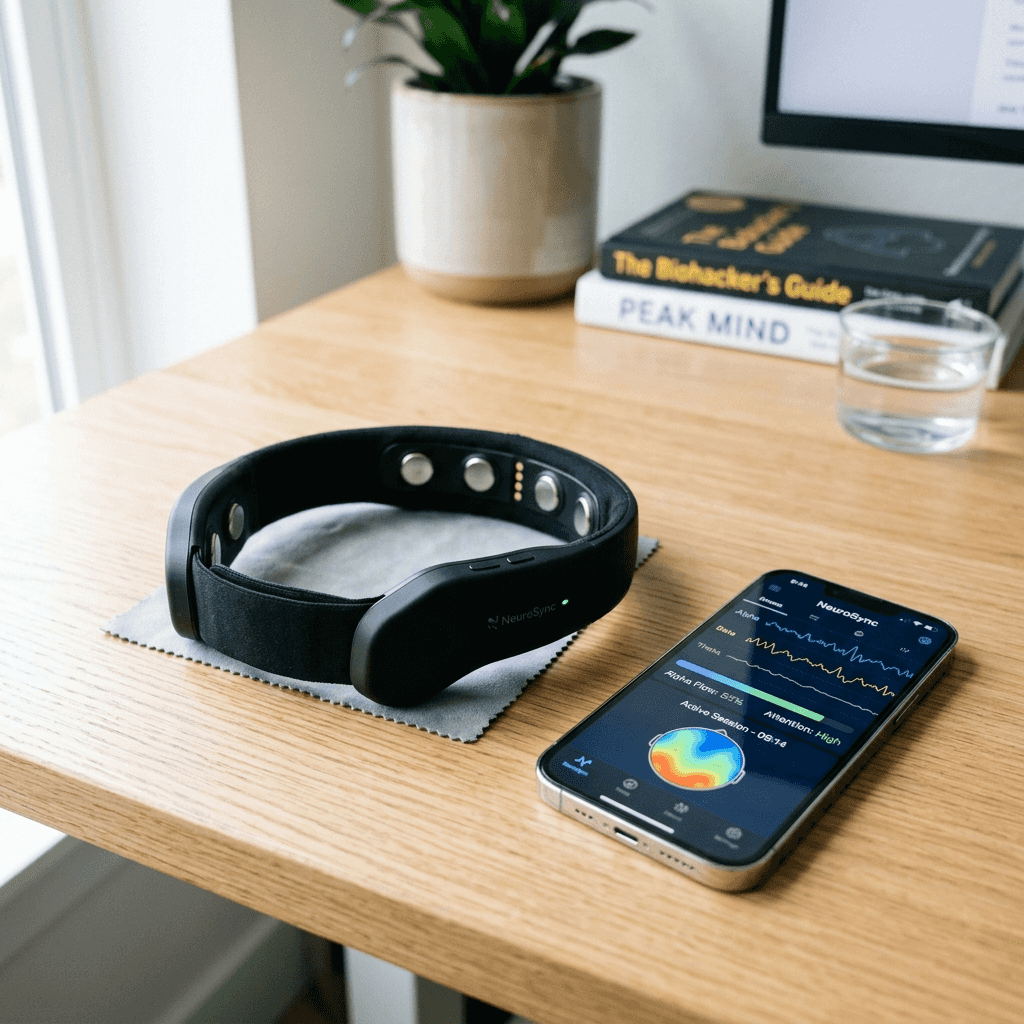
Muse S is the most popular consumer EEG device. It detects alpha, beta, theta, and delta and translates them into environmental sounds: calm weather (birds chirping) when you are relaxed, stormy weather when distracted. It’s excellent for teaching relaxed focus and has been validated in several peer‑reviewed studies to reduce anxiety and improve attention after 8‑10 sessions. The Muse app also offers digital cognitive exercises. However, the electrode placement (frontal and temporal) is not suitable for SMR or theta/beta training – it’s primarily a meditation trainer.
Pros: Comfortable, Bluetooth, good app, $250‑$350. Cons: Not for clinical protocols, battery life 5 hours. Best for: Beginners, stress reduction, learning to enter alpha state.
Mendi – Functional Near‑Infrared Spectroscopy (fNIRS)
Mendi is not EEG; it’s fNIRS, which measures oxygenated hemoglobin in the prefrontal cortex – a proxy for brain activity. Users see a glowing fireball on screen; when they focus, the fireball grows. It trains “attention control” rather than specific brainwaves. Several small studies show that 5 weeks of Mendi training improves sustained attention and reduces mind‑wandering. It has no gel or electrodes, just a soft headband with infrared sensors.
Pros: Easy to use, no prep, 10‑min sessions, $300. Cons: No EEG, cannot train specific frequency bands. Best for: ADHD attention training, executive function, quick daily brain gym.
Neurofeedback.Cloud + OpenBCI – Prosumer Clinical EEG
For serious biohackers, OpenBCI (open‑source EEG board) combined with Neurofeedback.Cloud software is the only at‑home system that replicates clinical neurofeedback. You need to apply conductive gel, clean electrodes, and learn basic EEG signal processing. The system costs $1,200‑$2,000 but allows true theta/beta training, SMR, alpha/theta, and even ILF. Many practitioners use it for remote coaching. It is not plug‑and‑play – expect a steep learning curve.
Pros: Clinical‑grade, customizable, no subscription (after purchase). Cons: High cost, messy gel, requires time and knowledge. Best for: Biohackers with ADHD or anxiety who want professional‑level training at home.
Professional vs. At‑Home: Which One Is Right for You?
The main differences are: electrode number (clinical uses 19‑channel caps with impedance control), software sophistication (artifact rejection, normative databases), and practitioner guidance (interpreting QEEG maps, adjusting protocols). Professional neurofeedback typically costs $150‑$250 per session, with insurance covering only some conditions (ADHD often covered). At‑home devices cost $200‑$2,000 one‑time plus optional subscriptions. Here’s a decision matrix.
| Factor | Professional clinic | High‑end at‑home (OpenBCI) | Consumer (Muse / Mendi) |
|---|---|---|---|
| Cost (40 sessions) | $6,000‑$10,000 | $2,000 (hardware) + time | $300‑$500 |
| ADHD efficacy | High (d=0.8) | Moderate‑high (if protocol correct) | Low (meditation only) |
| Anxiety reduction | High | Moderate | Moderate (relaxation) |
| Ease of use | Low (appointment needed) | Low (steep learning) | High (app guided) |
| Time commitment | 2‑3x/week for 3‑4 months | Daily 20‑30 min | Daily 10‑15 min |
Recommendation: If you have a diagnosed condition (ADHD, PTSD, epilepsy), invest in professional neurofeedback first (20 sessions), then consider at‑home maintenance. If you are a healthy biohacker wanting better focus, stress resilience, or meditation depth, a Muse S or Mendi is sufficient. If you are technically inclined and need a cost‑effective clinical alternative, OpenBCI + Neurofeedback.Cloud is viable but not for casual users.
Biohacker Pro-Tip: The “30‑Second Reset” (No Device Needed)
Even without EEG, you can practice voluntary regulation: Close your eyes, breathe slowly (4 sec in, 6 sec out), and focus on a point 2 inches behind your forehead. After 30 seconds, open your eyes. If you feel calmer and more focused, you have increased alpha activity. Do this 10 times per day. It’s not neurofeedback, but it builds the same neural pathways. Combine with a Muse for objective feedback.
Frequently Asked Questions About Neurofeedback
Is neurofeedback safe? Are there side effects?
Very safe when performed by trained practitioners or certified devices. Side effects are rare and mild: temporary fatigue, headache, or emotional lability after early sessions. These resolve within 24 hours. Unlike medication, there is no risk of addiction or systemic toxicity.
How many sessions do I need?
For ADHD or anxiety: 20‑40 sessions (2‑3 per week). For peak performance: 10‑20 sessions. Effects are cumulative – the first 5 sessions may feel subtle, but by session 20 most people notice durable changes. Maintenance sessions (once every 2‑4 weeks) are recommended after initial training.
Can I use neurofeedback while on medication?
Yes, neurofeedback is often used as an adjunct to stimulants (ADHD) or SSRIs (anxiety). Some practitioners recommend tapering medication after successful training, but never stop psychiatric medication without doctor supervision.
Does neurofeedback work for autism or TBI?
Emerging evidence suggests benefits for autism (reduced irritability, improved social communication) and traumatic brain injury (improved attention, reduced post‑concussion symptoms). However, the evidence is weaker (Level 3‑4). Some practitioners use ILF neurofeedback for TBI with promising case reports.
How does neurofeedback differ from tDCS or TMS?
tDCS (transcranial direct current stimulation) and TMS (transcranial magnetic stimulation) are neuromodulation techniques that apply electrical or magnetic fields to the brain – they are active, not passive. Neurofeedback is a learning process; the brain changes itself based on feedback. Neurofeedback is non‑invasive and has no electrical stimulation. Both can be complementary.
What is QEEG (brain mapping) and do I need it?
Quantitative EEG (QEEG) records 19‑channel EEG and compares it to a normative database. It identifies specific dysregulations (e.g., excess frontal theta). For clinical conditions, QEEG‑guided neurofeedback is more effective than generic protocols. At‑home users typically cannot do QEEG, so they rely on standard protocols.
Final Verdict: Is Neurofeedback Worth It?
Neurofeedback is one of the most underutilized tools in modern mental health. For conditions like ADHD, where stimulant medications work but have side effects and limited durability, neurofeedback offers a non‑pharmacological alternative with long‑lasting results. For anxiety and insomnia, it can reduce or eliminate the need for benzodiazepines or sleeping pills. And for peak performers, it’s an edge that sharpens focus without the crash of caffeine.
The cost and time commitment are real barriers. Professional neurofeedback is expensive ($6k‑$10k) and requires travel to a clinic. At‑home devices are cheaper but less powerful. Our advice: if you have a specific, diagnosed neurological or psychiatric condition, invest in 20 professional sessions with a QEEG‑guided practitioner. If you are generally healthy and want better stress resilience, meditation depth, or a cognitive edge, a Muse S or Mendi is an excellent, low‑risk starting point.
Do not expect overnight miracles. Neurofeedback works through neuroplasticity, which requires repetition and sleep consolidation. After 5 sessions, you may notice better sleep. After 20, better focus. After 40, sustained emotional regulation. Like going to the gym for your brain, consistency matters more than intensity.
The future is bright: closed‑loop home neurofeedback systems that adapt protocols automatically, combined with AI‑based QEEG analysis, are emerging in 2025. Soon, the line between clinical and consumer may blur. For now, start with a low‑cost Muse S, practice daily, and track your subjective focus and calm. If you see meaningful improvement, consider upgrading to professional training. Your brain’s potential is waiting to be unlocked.
Peer‑Reviewed Clinical Validations & Extended Reading:
- ADHD meta‑analysis (2019): Van Doren, J., et al. (2019). "Sustained effects of neurofeedback in ADHD: a meta‑analysis of randomized controlled trials." European Child & Adolescent Psychiatry, 28(3), 293‑305. Read Meta‑Analysis
- Neurofeedback for anxiety disorders: Hammond, D. C. (2020). "Neurofeedback for anxiety disorders: a review of the literature." Journal of Neurotherapy, 24(1), 1‑15. Read Review
- PTSD and infra‑low frequency training: Othmer, S., & Othmer, S. F. (2019). "Infra‑low frequency neurofeedback for PTSD: a case series." NeuroRegulation, 6(2), 85‑95. Read Paper
- Muse EEG validation study: Krigolson, O. E., et al. (2017). "Choosing the right EEG device for your research: a comparison of consumer and research‑grade systems." Frontiers in Neuroscience, 11, 212. Read Study
- SMR neurofeedback for sleep: Schabus, M., et al. (2021). "Sensorimotor rhythm neurofeedback enhances sleep quality in chronic insomniacs: a randomized sham‑controlled trial." Sleep, 44(6), zsaa276. Read Trial
- Peak performance and neurofeedback in athletes: Mirifar, A., et al. (2017). "Neurofeedback and attentional control in athletes: a systematic review." Psychology of Sport and Exercise, 30, 1‑12. Read Review